
Port strike raises supply risks ahead of Ramadan, traders fear price pressure

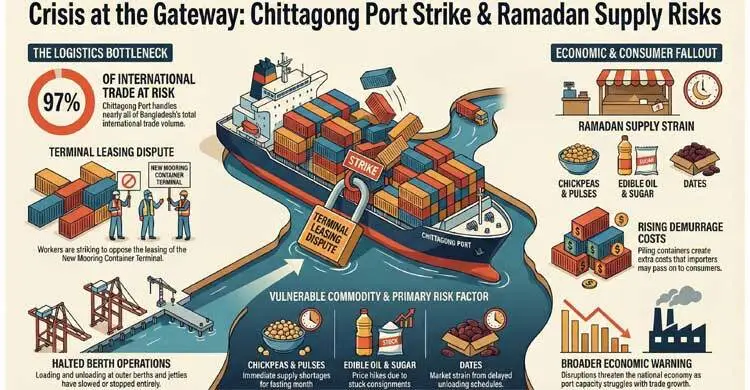
A strike at Chittagong Port has begun to disrupt cargo handling and is raising fresh concerns among businesses over supply shortages and possible price increases ahead of Ramadan.
With weekend closures, upcoming election holidays and the fasting month approaching, traders warn that delays in unloading imported goods could strain the market. More than 97 per cent of Bangladesh’s international trade moves through Chittagong Port, making any disruption a major risk for supply chains, particularly for import-dependent consumer products.
Workers under the banner of the Chittagong Port Protection Movement Council began the strike at 8:00am on Sunday (February 8), pressing a four-point demand that includes opposing the leasing of the New Mooring Container Terminal. Operations at outer berths and jetties slowed sharply, halting loading and unloading activities for much of the day. A similar programme was observed last week.
Importers say containers are piling up at the port, increasing demurrage costs that could eventually be passed on to consumers. Traders fear that prices of Ramadan essentials such as chickpeas, pulses, edible oil, sugar and dates may rise if the disruption continues.
Taslim Shahriar, deputy general manager of Meghna Group of Industries, said many consignments of Ramadan goods have already arrived but remain stuck at the port. “If supplies are delayed, the market will feel the impact,” he said.
Abul Bashar Chowdhury, chairman of BSM Group, said uncertainty over unloading schedules was creating pressure on importers and threatening normal trade flows. He urged authorities to resolve the situation quickly to avoid wider economic fallout.
Policy Exchange Bangladesh chairman M Masrur Riaz warned that prolonged disruptions in logistics could affect the broader economy, noting that Bangladesh’s port capacity already struggles to keep pace with growing trade volumes.
Meanwhile, PPP Authority CEO Chowdhury Ashiq Mahmud Bin Harun said on Sunday that no agreement would be finalised with UAE-based DP World to operate the New Mooring Container Terminal during the current government’s tenure, though discussions continue under a government-to-government framework.
Despite the announcement, strike organisers have yet to withdraw the programme. As a result, container handling, delivery of imported goods and movement of cargo vehicles inside the port remain largely suspended, although lighter vessel operations at outer anchorage continue.