
Yunus-led review signals economic turnaround

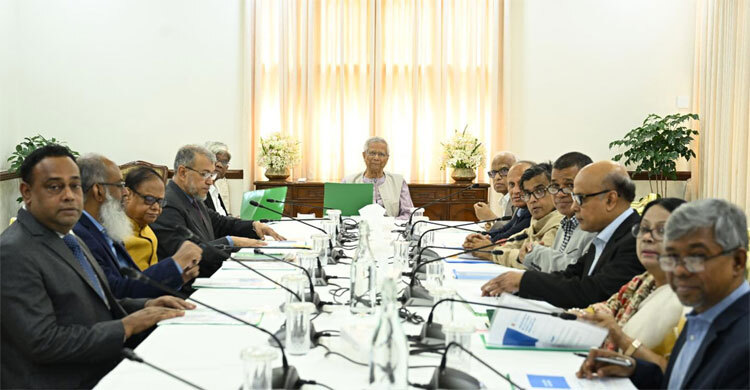
A high-level meeting chaired by Chief Adviser Professor Muhammad Yunus on Monday reviewed the country’s overall economic performance and budget expenditure, with officials expressing cautious optimism over stabilising macroeconomic indicators, easing inflationary pressure and improving external sector conditions.
The meeting, held at the State Guest House Jamuna, was attended by Finance Adviser Salehuddin Ahmed, Planning Adviser Professor Wahiduddin Mahmud and Bangladesh Bank Governor Ahsan H Mansur.
Officials said the discussion focused on inflation trends, wage growth, agricultural output, foreign exchange reserves, the current account balance, remittances, imports and trade financing – key areas that had come under strain in recent years.
Inflation trends show sustained easing
According to the review, the country’s 12-month average inflation fell below 9 per cent in November 2025 for the first time since June 2023, marking a significant easing of price pressures.
On a point-to-point basis, inflation – which crossed the 9 per cent mark in March 2023 and stood at 9.33 per cent at the time – declined below 9 per cent in June 2025 and further eased to 8.29 per cent in November 2025.
Officials said inflation is projected to fall below 7 per cent by June 2026, driven by the government’s contractionary monetary policy, fiscal discipline and austerity measures.
Wage growth gap narrows, real income pressure easing
The meeting noted that the gap between inflation and wage growth – which had widened sharply in recent years and eroded real incomes – has narrowed considerably in recent months.
In November 2025, point-to-point inflation stood at 8.29 per cent, while wage growth reached 8.04 per cent. By contrast, in FY2022–23 inflation was 9.02 per cent against wage growth of 7.04 per cent.
Officials said while real incomes had declined due to prolonged high inflation, the narrowing gap signals gradual recovery in purchasing power during the current fiscal year.
Agriculture supports food security outlook
The meeting highlighted improved performance in the agricultural sector, supported by incentives and better management.
A strong Boro paddy harvest was recorded in the previous fiscal year, and with no major natural disasters reported so far, officials expressed optimism over a good Aman harvest as well.
As of December 15, 2025, Aman paddy production reached 160.95 lakh metric tonnes, with output expected to exceed the target once harvesting is completed. Although Aush paddy production fell slightly short of the target, total output rose by 7.2 per cent compared to FY2024–25.
Officials said the improved output is expected to help the government meet its foodgrain procurement targets in the current fiscal year.
External sector stabilises, reserves rebound
The financial and foreign exchange situation has shown marked improvement, officials said.
Gross foreign exchange reserves stood at US$ 32.57 billion as of December 18, 2025 – up from around $25 billion in August 2024. The recovery was attributed to exchange rate stabilisation, rising remittances and higher interest rates in the financial sector.
The meeting noted that reserves are expected to strengthen further in the coming months.
Current account deficit sharply reduced
Officials said sustained reforms in financial management and efforts to curb money laundering have significantly narrowed the current account deficit.
After remaining in deficit from FY2016-17 to FY2023-24 – reaching $18.7 billion in FY2021-22, $11.6 billion in FY2022-23 and $6.6 billion in FY2023-24 – the deficit narrowed to just $139 million by the end of FY2024-25.
During the July-October period of the current fiscal year, the deficit stood at $749 million, indicating continued improvement.
Remittances, overseas employment surge
The meeting also reviewed expatriate income trends, noting a strong rise in both overseas employment and remittance inflows.
During July-November of the current fiscal year, around 5,00,000 workers secured overseas employment, compared to 397,000 during the same period last year.
Over the same period, remittance inflows reached $13.04 billion – an increase of 17.14 per cent year-on-year.
Imports rebound as restrictions eased
Officials said import restrictions imposed earlier to manage external pressures have been relaxed to support productive economic activity.
As a result, import growth during July-November shifted from a negative 1.2 per cent in FY2024-25 to a positive 6.1 per cent in the same period of FY2025–26.
Trade financing recovers, investor confidence improves
A key indicator of recovery discussed at the meeting was the sharp turnaround in letters of credit (LCs).
During July-October of FY2024-25, LC openings for capital machinery recorded a negative growth of 32.8 per cent. In the same period of the current fiscal year, growth rebounded to 27.7 per cent.
Similarly, LC openings for industrial raw materials rose from 10.1 per cent growth to 40.98 per cent year-on-year.
Officials said the rebound reflects easing trade financing constraints, improved confidence and a gradual restoration of the country’s economic credibility following years of financial mismanagement.
‘Economy regaining balance’
Summing up the discussion, officials said the imbalances across key macroeconomic variables have largely stabilised, though vigilance will be required to sustain the recovery.
The meeting underscored the interim government’s focus on maintaining discipline in monetary and fiscal policy while supporting growth, food security and employment.