
The long route to India: Bangladesh food exports under strain

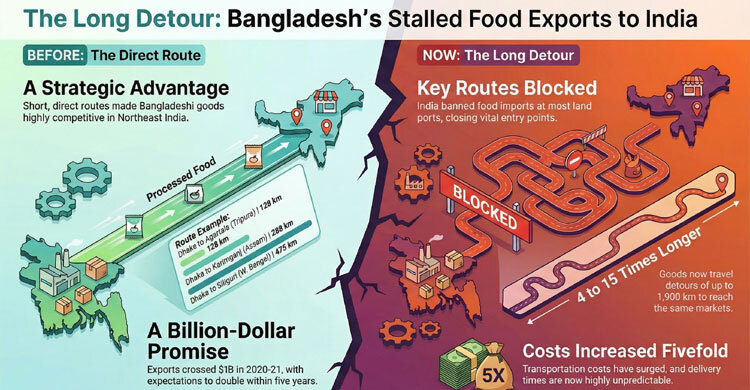
Bangladesh’s processed food exports to India are now taking a journey so long and convoluted that exporters compare it to commuting across Dhaka by deliberately avoiding every direct road. What was once a short, cost-effective cross-border trade has turned into a logistical ordeal – raising costs, stretching delivery times, and steadily eroding a billion-dollar export dream.
A billion-dollar promise that stalled
In the 2020-21 fiscal year, Bangladesh’s agricultural and processed food exports crossed the symbolic milestone of $1 billion. Industry players were optimistic: with India next door and demand rising in its northeastern states, exporters expected the figure to double within five years.
That optimism has since faded. Exports have remained stuck around the same level – and in some cases declined – despite capacity expansion by major food processors. Exporters now say the growth story has been derailed not by lack of demand, but by policy and logistics barriers.
From short hops to thousand-kilometre detours
To understand the problem, exporters offer a simple analogy. Imagine living in Paltan and working in Motijheel, but being forced to travel via Shahbagh, Farmgate, Mirpur, Badda, and Rampura before reaching your office. The distance, cost and exhaustion would make the daily commute unbearable.
That, exporters say, is exactly what is happening to Bangladeshi food products heading to India.
Despite India surrounding Bangladesh on three sides, goods are now effectively allowed to enter through only one side. Until recently, products such as biscuits, cakes, chips, beverages, furniture and plastic goods moved swiftly through multiple land ports, covering short distances and reaching markets quickly.
Key direct routes once included:
Dhaka-Banglabandha-Siliguri (West Bengal): about 475 km
Dhaka-Burimari-Cooch Behar (West Bengal): about 451 km
Dhaka-Akhaura-Agartala (Tripura): about 128 km
Dhaka-Chatlapur-Karimganj (Assam): about 308 km
Dhaka-Sheola-Karimganj (Assam): about 288 km
Dhaka-Tamabil-Shillong-Guwahati: about 468 km
These routes made Bangladeshi products highly competitive in India’s northeastern states, often reaching markets faster and cheaper than goods from mainland India.
Four to fifteen times the distance
That advantage has vanished.
Following India’s decision in June this year to ban imports of nine categories of goods – including processed food – from most land ports, exports through Assam, Meghalaya, Tripura and Mizoram were halted. The Changrabandha and Phulbari customs stations in West Bengal were also closed to these items.
At present, Bangladeshi food products can enter India through only three land ports:
Petrapole (adjacent to Benapole)
Ghojadanga (Bhomra)
Hili (Hakimpur)
As a result, exporters must now send goods via routes such as Dhaka-Bhomra-Kolkata-Siliguri-Guwahati-Karimganj-Agartala, covering up to 1,900 km, or Dhaka-Sonamasjid-Siliguri-Guwahati-Agartala, about 1,600 km – four to fifteen times longer than before.
Exporters point out the absurdity: a factory in Habiganj once supplied Tripura via Agartala by traveling just 156 km, with final destinations like Mizoram within 350 km. Today, the same shipment must travel more than 1,000 km, often first moving westward to Kolkata before heading back east.
Costs, delays and collapsing interest
The financial impact has been severe. According to exporters and clearing agents, transportation costs have increased fivefold, while delivery times have become unpredictable due to congestion, weak port infrastructure and limited transport availability inside India.
Akij Food and Beverage Limited, once a regular exporter of soft drinks to India, has seen its exports stumble.
“After India’s decision, every company has suffered,” said Maidul Islam, Head of Marketing at Akij Food and Beverage. “Costs and lead times have increased so much that many exporters have stopped altogether. Indian importers are also losing interest because their margins are shrinking.”
Debashish Roy, a C&F agent in India, put the numbers into perspective: “Earlier, a truckload could be delivered to the northeastern states for Tk 18,000 to Tk 25,000 through ports like Akhaura or Tamabil. Now exporters must pay an additional Tk 1 lakh just to move goods from Kolkata to Siliguri and onward to Assam, Meghalaya or Tripura.”
Losing a strategic edge
Bangladeshi food products have long been popular in seven Indian states, particularly in the northeast. Many companies deliberately built factories near the border to exploit shorter supply chains. With those routes closed, exporters are now forced to move goods in the opposite direction – raising domestic logistics costs as well.
Exporters argue that Bangladesh once enjoyed a natural advantage: it could supply northeastern India faster and cheaper than producers from India’s own mainland. Many now believe the restrictions were designed to close that competitive window.
Even large players are feeling the strain. PRAN-RFL Group, the country’s leading dry food exporter to India, says transport costs have risen sharply.
“Our cost of moving goods has increased by about 8.5 per cent since the land ports were closed,” said Marketing Director Kamruzzaman Kamal. “We are trying to adjust, but it is difficult.”
Diplomatic silence, economic strain
Six months after the restrictions were imposed, exporters say there has been little relief. Initial diplomatic efforts appear to have stalled.
Commerce Secretary Mahbubur Rahman told Jago News that Bangladesh sought a secretary-level meeting immediately after the ban.
“We did not receive a response. We sent letters afterward. If we hear back, we can engage again,” he said.
For now, exporters remain caught between policy uncertainty and rising costs – watching a once-promising export corridor turn into a long, expensive detour.