
Tariffs, uncertainty drag Bangladesh exports down

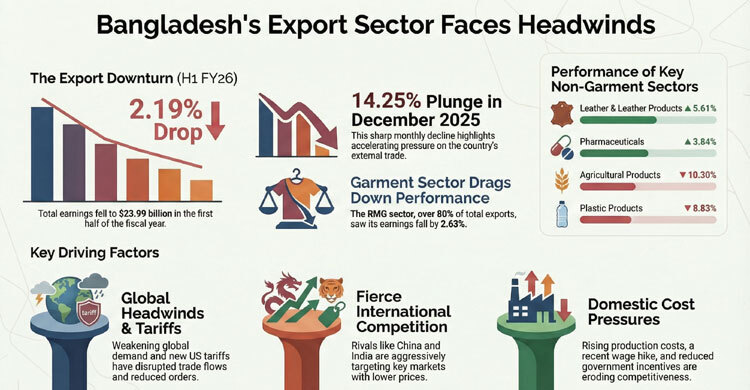
Bangladesh’s export sector has entered a challenging phase as earnings posted negative growth in both the first half of the 2025-26 fiscal year and December 2025, validating earlier concerns raised by exporters amid fresh US tariffs, policy adjustments linked to LDC graduation, and lingering political uncertainty.
According to data released by the Export Promotion Bureau (EPB) on Sunday, total export earnings during July-December of FY26 fell by 2.19 per cent year-on-year to $23.99 billion, down from $24.53 billion in the same period of the previous fiscal year.
The downturn deepened in December, when exports declined sharply by 14.25 per cent to $3.89 billion, compared with $4.62 billion in December 2024 – highlighting growing pressure on the country’s external trade performance.
Garments sector under pressure
The ready-made garments (RMG) sector – accounting for more than 80 per cent of Bangladesh’s total exports – continued to drag down overall performance. Export earnings from the sector declined by 2.63 per cent to $19.36 billion in the first half of FY26, from $19.88 billion a year earlier.
Knitwear exports dropped by 3.22 per cent to $10.48 billion, while woven garment exports fell by 1.91 per cent to $8.87 billion.
Industry insiders said slowing demand in key Western markets, coupled with price pressure from competing exporters, has significantly reduced order volumes and margins.
Exporters noted that although some shipments were redirected to alternative markets, this was not sufficient to offset the contraction in traditional destinations, particularly the United States.
Divergent trends in non-RMG sectors
Performance across non-garment sectors remained mixed, reflecting uneven global demand and sector-specific challenges.
Frozen and live fish exports registered modest growth, rising to $254.85 million from $254.71 million, while shrimp exports increased by 2.08 per cent to $176 million. However, exporters cautioned that higher compliance and logistics costs are limiting stronger growth potential.
Agricultural exports suffered a significant setback, declining by 10.30 per cent to $534.16 million from $595.51 million.
Analysts attributed the fall to weaker global demand, quality-related issues, and higher freight and input costs.
Pharmaceutical exports continued their gradual upward trend, increasing by 3.84 per cent to $119 million, reflecting Bangladesh’s growing footprint in regulated and semi-regulated markets. In contrast, plastic product exports declined by 8.83 per cent to $144 million amid shrinking orders and intense competition.
The leather and leather products sector emerged as a relatively bright spot. Overall exports rose by 5.61 per cent to $610 million, driven largely by a 19.50 per cent surge in leather goods exports to $194 million. Leather footwear exports edged up slightly to $355 million, while raw hide exports declined marginally by 1.87 per cent.
Jute and jute product exports posted marginal growth of 0.31 per cent to $419 million, indicating stagnation rather than recovery. Specialised textile exports dropped by 8.18 per cent to $189 million, while home textile exports rose by 2.93 per cent to $423 million. Non-leather footwear exports declined by 3.84 per cent to $263 million.
Export destinations: Mixed signals
Despite the overall downturn, Bangladesh maintained positive momentum in several major and emerging markets. The United States, Germany and the United Kingdom remained the top three export destinations in December 2025.
During the month, exports to the US grew by 7.14 per cent, Germany by 18.08 per cent, and the UK by 14.50 per cent. Significant growth was also recorded in emerging and strategic markets, including the United Arab Emirates (25.39 per cent), Australia (21.33 per cent), and Canada (9.13 per cent).
However, economists warned that market-wise growth figures mask underlying vulnerabilities, as gains in some destinations are being offset by declining volumes and prices in others.
Tariffs, policy changes, and rising costs
Exporters and analysts identified multiple factors behind the negative growth trend. In a statement, the EPB cited weakening global demand, counter-tariffs imposed by the United States, increased competition from China, rising production costs, and ongoing geopolitical and trade uncertainties.
Bangladesh Knitwear Manufacturers and Exporters Association (BKMEA) President Mohammad Hatem said the Trump administration’s tariff measures have disrupted global trade flows, leading to reduced demand for apparel and slower inflow of work orders, particularly from the US market.
“China and India have shifted aggressively into the European Union, taking advantage of US tariff hikes by offering products at lower prices,” Hatem said, adding that competing countries are offering incentives to shield exporters from the tariff shock.
“In contrast, Bangladesh has reduced cash incentives and policy support in line with LDC graduation and IMF recommendations, putting our exporters at a disadvantage,” he added.
Hatem also pointed to rising production costs stemming from labour law compliance and a 9 per cent wage hike, warning that these pressures are eroding competitiveness. “At this stage, it is difficult to see a turnaround. There is a strong possibility that export growth will remain negative this fiscal year,” he said.
Policy response needed
Economist Prof Dr Mustafizur Rahman, distinguished fellow at the Centre for Policy Dialogue (CPD), described the shift from early-year growth to a year-end slowdown as a worrying signal for the economy.
“The Trump administration’s tariff policies have altered global trade dynamics, forcing some exporters to divert shipments to the EU, while exports to the US market remain under stress,” he said.
Mustafizur stressed the need for swift and coordinated policy measures to support exporters, including targeted incentives, market diversification strategies, and productivity-enhancing reforms.
“Without timely intervention, the export sector may continue to face headwinds, which could have broader implications for employment, foreign exchange earnings and macroeconomic stability,” he warned.