
Govt clears rice imports amid bumper harvest, farmers fear price shock

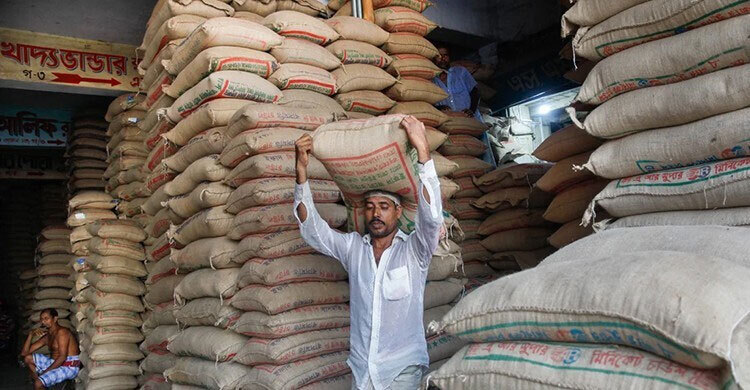
Just as freshly harvested Aman season rice is flooding markets across Bangladesh and farmers are preparing fields for the crucial Boro season, the government has approved fresh private-sector rice imports – raising concerns of a potential price shock for growers.
Farmers and agricultural economists warn that allowing imports at a time of ample domestic supply could depress farmgate prices, hurt Aman farmers and discourage cultivation in the ongoing Boro season, the country’s largest rice-producing cycle.
A review of government data and market trends shows that Bangladesh is currently sitting on one of its highest-ever rice stocks.
Aman production this season reached around 18 million tonnes, roughly 1.5 million tonnes more than last year, while Aus output was also strong. At the same time, government warehouses are well stocked, with no immediate supply pressure.
Despite this, the government last Sunday approved the import of 2,00,000 tonnes of parboiled rice by 232 private companies.
The Ministry of Food has since written to the Ministry of Commerce seeking formal approval, citing concerns over a recent uptick in fine rice prices.
In its letter, the Food Ministry noted that prices of fine rice have shown an upward trend, warning that medium and coarse rice prices could follow, potentially destabilising the market.
However, market insiders and farmers’ representatives say the price rise has been limited and seasonal – and does not justify imports.
Traders ‘creating pressure’ amid peak supply
In the past week, prices of certain fine rice varieties rose by Tk 2-3 per kg, prompting traders to lobby for imports. Critics argue this reflects opportunistic behaviour rather than a genuine supply crisis.
“Traders are trying to create an artificial shortage even during peak supply season,” said a reliable source at the Food Ministry. “Instead of addressing market manipulation, the government is responding by opening imports.”
Economists warn that such a move could send the wrong signal to farmers just as Boro cultivation begins.
Experts see no logic in imports now
Agricultural economist Dr Jahangir Alam told Jago News that the decision lacks economic justification.
“The government has sufficient stocks, Aman production has been excellent, and Boro, the biggest rice season, is underway,” he said. “There is no reason to import rice at this point. This decision benefits a specific group and risks hurting farmers.”
Govt defends move, cites fine rice pressure
Food Department Director (Procurement) Md Moniruzzaman offered a different explanation, saying imports are needed to stabilise prices of narrow-grain fine rice varieties, which are mainly produced during the Boro season.
“Prices of narrow rice increased a few days ago. Since Boro rice is yet to arrive, imports are needed to keep prices under control,” he told Jago News.
Market data supports a modest rise. Over the past 10 days, prices of Jirashail and Shampa Katari rice increased by Tk 2-3 per kg.
According to the Department of Agricultural Marketing, retail prices of Jirashail rose 7.69 per cent, while Shampa Katari increased 5.56 per cent.
Millers say supply remains strong
Rice millers and wholesalers say the price hike is limited to a few fine varieties and has not affected medium or coarse rice, which dominates household consumption.
Naogaon District Rice Mill Owners’ Association General Secretary Farhad Hossain said mill gate prices of Jirashail and Shampa Katari rose by less than Tk 2.
“Other varieties haven’t increased at all,” he said. “In fact, prices of newly harvested Aman rice are declining due to ample supply.”
Record stocks raise bigger questions
As of January 15, government foodgrain stocks stood at around 2.1 million tonnes, including over 1.84 million tonnes of rice – an amount sufficient to meet public distribution needs for the rest of the fiscal year.
In addition, the government is already importing more than 5,00,000 tonnes of rice this year, while 4,83,000 tonnes have entered through private imports.
With domestic production strong and warehouses full, farmers fear that fresh imports could undermine prices just when they are hoping to recover rising production costs.
“If imports push prices down,” one farmer said, “it will be Aman farmers who suffer – and Boro farmers who lose confidence before planting.”