
Ramadan essentials: Stocks adequate, most prices stable or lower

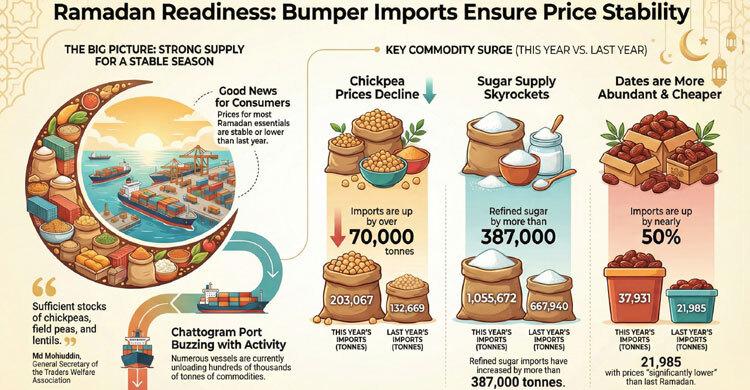
Stocks of key Ramadan commodities such as chickpeas, dates, and lentils are at normal levels, with additional imports made ahead of the holy month, according to Chattogram-based consumer goods traders. Imports of sugar and edible oil are also normal, leading traders to expect stable prices during Ramadan.
Chickpea prices decline
Traders at Khatunganj, the country’s second-largest wholesale market for consumer goods, said prices of most essential commodities are lower than last year. While prices of newly arrived field peas have increased compared to last month, chickpea prices have declined. Sugar prices are also lower than a year ago, while edible oil prices remain stable. Prices of dates—an essential Ramadan item—are significantly lower than last year.
According to National Board of Revenue (NBR) data, 203,067 tonnes of chickpeas were released from ports between July 1 and January 28 of the current 2025–26 fiscal year, compared with 132,669 tonnes during the same period of the previous fiscal year. This represents a year-on-year increase of 70,398 tonnes. At present, chickpeas are still being unloaded from two vessels at Chattogram Port.
Relief in coarse lentils
Between July 1 and January 28 of the current fiscal year, 254,676 tonnes of lentils were released, mainly imported from India, Nepal, and Australia. During the same period last fiscal year, lentil imports stood at 301,799 tonnes—47,123 tonnes higher year-on-year. However, lentils are currently being unloaded simultaneously from four vessels at Chattogram Port.
From the beginning of the fiscal year to January 28, Bangladesh imported 217,796 tonnes of field peas from India, Canada, and Australia, compared with 205,395 tonnes during the same period of fiscal year 2024–25—an increase of 12,401 tonnes.
Strong imports of oil and sugar
As of January 28 of the 2025–26 fiscal year, imports of crude soybean oil stood at 380,618 tonnes, while refined palm oil imports totaled 1,502,877 tonnes. Combined imports of crude soybean and palm oil were 25,000 tonnes higher than during the same period last year. Currently, five vessels carrying 213,376 tonnes of crude soybean oil are unloading at the port anchorage.
Refined mill sugar imports reached 1,055,672 tonnes as of January 28, compared with 667,940 tonnes during the same period last year—an increase of 387,732 tonnes. In addition, six vessels carrying around 350,000 tonnes of raw sugar are currently unloading at Chattogram Port.
According to port data, two vessels anchored at Chattogram Port are unloading 66,000 tonnes of chickpeas. The vessels arrived on January 6 and January 15. Lentils are also being unloaded from four vessels, including the MV Shakespeare Bay, which arrived from Australia on January 29 carrying 19,497 tonnes of lentils. The remaining three vessels are unloading 79,000 tonnes of lentils.
No shortage of onion and garlic
Between July 1 and January 28 of the current fiscal year, Bangladesh imported 85,939 tonnes of onions, 49,671 tonnes of garlic, and 91,797 tonnes of ginger. The Department of Agricultural Extension has also reported record domestic onion production this year.
Traders said prices have increased only for fine-grain lentils compared with last year, while prices of Australian coarse lentils remain low due to existing stocks from the previous year.
Md Mohiuddin, general secretary of the Chaktai-Khatunganj Wholesaler General Traders Welfare Association, told Jago News that a large number of letters of credit (LCs) have been opened ahead of Ramadan.
“There are sufficient stocks of chickpeas, field peas, and lentils. Ramadan-related items such as chickpeas, lentils, dates, field peas, edible oil, and sugar are being released regularly from the port,” he said.
He added that although cargo handling has been disrupted due to a shortage of lighterage vessels, importers’ warehouses across the country hold adequate stocks, ensuring price stability during Ramadan.
“Large quantities of lentils were imported last year, and those stocks still remain. As a result, lentil prices have dropped sharply,” he said.
Australian lentils are currently selling at Tk 75 per kg in the wholesale market, compared with Tk 74 a month ago and Tk 80 in early November. Prices of fine-grain Indian lentils, however, have increased and are now selling at Tk 155 per kg at the wholesale level.
Field peas sold at Tk 49 per kg in Khatunganj on Thursday, up from Tk 43 last month. Whole peas are currently selling at Tk 45 per kg, compared with Tk 40 last month. Chickpeas are selling at Tk 70–80 per kg, depending on quality, down from Tk 83 in December and Tk 100 in November.
Adequate supply of dates
Fresh date imports totaled 37,931 tonnes between July 1 and January 28 of the current fiscal year, compared with 21,985 tonnes during the same period last year—an increase of 15,945 tonnes, or nearly 50 percent.
Although dates were once considered a seasonal food mainly consumed during Ramadan, fruit traders said they have now become part of people’s regular diet.
Chattogram Fruit Traders Association General Secretary Touhidul Alam told Jago News that despite increased imports, date prices are significantly lower than last year.
“Ahead of Ramadan, there has been discussion about reducing government duties. As a result, many importers are waiting before importing dates. If duties are reduced, more dates will be imported before Ramadan,” he said.
He added that commonly consumed varieties such as Zahidi and Mashruk dates have seen notable price declines.
“Currently, 10 kilograms of Zahidi dates are selling for Tk 1,850 to Tk 1,900, compared with Tk 2,200 during last Ramadan. Similarly, five kilograms of Saudi Mashruk dates are selling for Tk 1,900 to Tk 2,000, depending on quality, compared with Tk 2,200 last year. Sack-packed wet dates are now selling at Tk 135 to Tk 142 per kg, while last year prices ranged between Tk 155 and Tk 160,” he said.
He said year-round consumption has increased demand for dates, but imports have grown faster than demand. “If the government announces a duty reduction, more dates will be imported and prices will remain stable during Ramadan,” he added.