
Election manifestos: Businesses want transparent policies, credible roadmaps, not rhetorics

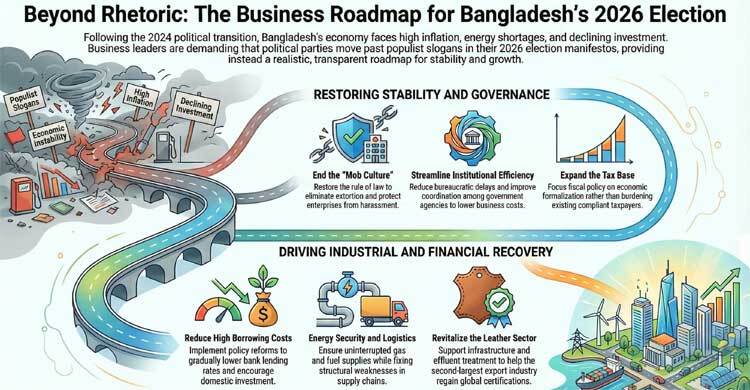
With the 13th National Parliament election scheduled for February 12, Bangladesh’s business community is calling on political parties to present clear, transparent and realistic economic roadmaps in their election manifestos, warning that vague promises will fail to restore investor confidence at a time of prolonged uncertainty.
The election comes at a critical moment for the economy. After years of political turbulence, the business sector – already strained by inflation, energy shortages and global headwinds – says it needs stability, policy clarity and institutional efficiency to recover lost momentum.
A fragile economic backdrop
In 2024, the Awami League government was ousted following a mass uprising led by students and the public. Since then, the country has been governed by an interim administration headed by Nobel laureate economist Professor Muhammad Yunus. While the interim government has initiated reforms aimed at restoring confidence and addressing governance gaps, traders say the post-uprising instability has disrupted supply chains, discouraged investment and slowed industrial activity.
Business leaders point to declining domestic investment, cautious foreign investors, and weakened consumer demand as signs that confidence has yet to fully return. They argue that the upcoming election is a decisive opportunity to reset economic direction – but only if political parties move beyond populist pledges.
Manifestos must go beyond rhetoric
As political parties unveil their election programmes, the business community insists that manifestos must reflect practical, implementable strategies rather than aspirational language.
“Businesses do not operate on slogans,” said several industry leaders. “They operate on predictability, security and policy continuity.”
Traders and manufacturers stress that restoring confidence will require concrete commitments across several key areas.
Law and order: The foundation of investment
Foremost among business concerns is the deterioration of law and order. Entrepreneurs say extortion, disorder and informal coercion – often referred to as “mob culture” – have become major deterrents to investment.
Without security of life, property and reputation, they argue, no incentive package or tax relief can attract sustained investment. Business leaders are demanding firm political commitments to uphold the rule of law, ensure swift enforcement and protect enterprises from harassment.
Inflation and supply chain reform
Rising prices of essentials have eroded consumer purchasing power and increased operating costs for businesses. While monetary tightening has been used to control inflation, traders argue that interest rate hikes alone are insufficient.
They are urging political parties to focus on fixing structural weaknesses in supply chains – eliminating middlemen, improving logistics and ensuring direct market access for farmers. Such reforms, they say, would stabilise prices, ensure fair returns for producers and protect consumers.
Financial and energy bottlenecks
High borrowing costs and unreliable energy supplies remain major obstacles. Businesses are calling for policy reforms to gradually reduce bank lending rates, ensure uninterrupted gas and fuel supply and improve the efficiency of government services.
Delays in approvals, weak coordination among agencies and lengthy bureaucratic processes, they say, continue to raise the cost of doing business and undermine competitiveness.
Fiscal strategy without excessive pressure
The business community is also seeking clarity on fiscal policy. Rather than aggressive revenue collection that burdens compliant taxpayers, they want governments to focus on expanding the tax base through economic growth, formalisation and efficiency.
Manifestos, they say, should clearly outline how revenue will be increased without discouraging entrepreneurship or investment.
Reviving industrial sectors
Industry leaders have highlighted the need for sector-specific strategies, particularly for industries facing structural challenges. The leather sector – Bangladesh’s second-largest export industry after garments – has been singled out as a key example.
Despite strong global demand, many tanneries have lost international certifications due to compliance issues related to effluent treatment and solid waste management. Business leaders argue that coordinated government support, infrastructure upgrades and regulatory clarity could unlock the sector’s growth potential and generate significant employment.
Voices from the business community
Bangladesh Chamber of Industry (BCI) President Anwarul Alam Chowdhury Parvez told Jago News that business-friendly policies must be clearly reflected in election manifestos.
“Ensuring the safety and dignity of businessmen and their property is fundamental. Improving law and order and ending chaos are essential. Without these, no business or investment can be sustainable,” he said.
Parvez also stressed the need for a clear roadmap on reducing loan interest rates, ensuring energy supply and improving administrative efficiency. “Promises alone will not work. Businesses need to know how policies will be implemented and within what timeframe,” he added.
Bangladesh Knitwear Manufacturers and Exporters Association (BKMEA) President Mohammad Hatem said Bangladesh is navigating a particularly complex period, marked by post-LDC graduation challenges, global economic uncertainty and potential risks linked to US trade policies.
“This is not the time for emotional or rhetorical manifestos,” he said. “What we need are practical, effective guidelines that show real commitment to implementation in the national interest.”
Md Sakhawat Ullah, senior vice chairman of the Bangladesh Tanners Association (BTA), echoed the call for transparency and realism. “The business community wants policies that enrich industry and trade, attract investment and create employment. If the government and industry work together, sectors like leather can regain competitiveness,” he said.
Former Bangladesh Textile Mills Association (BTMA) director Engineer Rajib Haider emphasised the importance of protecting the domestic industry. “Countries with successful industrial policies prioritise their own industries and jobs. Our manifestos should clearly reflect that commitment through concrete policy measures,” he said.
A defining test for political leadership
For Bangladesh’s business community, the upcoming election is not just about political change – it is about economic direction. Traders and industrialists say the credibility of future governments will depend on whether election promises are backed by clear plans, timelines and accountability.
As one senior entrepreneur put it, “Confidence will not return through words alone. It will return when policies are transparent, predictable and genuinely implemented.”