
Port strike threatens Ramadan supply chains, raising fears of price surge

Published: 7 February 2026, 09:29 PM
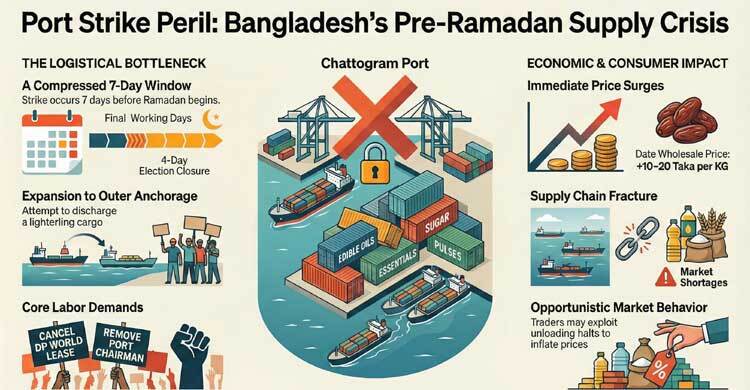
With Ramadan expected to commence on 18 or 19 February, Bangladesh faces mounting pressure on its consumer goods supply chain following an indefinite strike by workers at the Chattogram port, the country's principal maritime gateway.
The industrial action, timed amid a compressed pre-Ramadan window of just seven working days, has sparked concerns among traders and consumer advocates that prices for essential items could rise sharply during the holy month.
The disruption centres on opposition to the proposed lease of the New Mooring Container Terminal to global port operator DP World. Although workers suspended their strike for 48 hours last Thursday following assurances from an adviser to the interim government, the Port Protection Movement Council announced on Saturday that indefinite industrial action would resume on Sunday.
Crucially, workers have indicated they will extend stoppages to outer anchorage operations, a step not taken in previous disputes, potentially halting the unloading of vessels carrying time-sensitive imports.
The timing could not be more critical. With a two-day weekend and a four-day closure for the 12 February national parliamentary elections, only seven working days remain before Ramadan begins. This narrow window leaves little room for recovery should port operations stall further.
Already, the previous week's disruption has delayed the discharge of ships carrying edible oils, pulses, sugar, and dates, staples of the Ramadan market.
Khairul Kabir Sujan, former director of the Bangladesh Shipping Agents Association, warned that several vessels laden with Ramadan essentials remain anchored offshore.
"If unloading at the outer anchorage is halted, the supply chain for consumer goods will fracture," he said. "Should obstacles persist, we will see rapid price escalation with direct consequences for ordinary consumers."
The repercussions are already being felt at Khatunganj, Chattogram's second-largest wholesale market and a key distribution hub for the region. Mohammad Sekandar, a spice and pulse trader there, reported that chickpea and pea prices have begun climbing following last week's five-day work stoppage. "If the strike resumes, price increases in the Ramadan market are inevitable," he said. "Low-income households will bear the heaviest burden."
Dates, almost entirely imported to meet domestic demand during Ramadan, present a particular vulnerability. Touhidul Alam, general secretary of the Chattogram Fruit Traders Association, noted that wholesale date prices have already risen by Tk 10 to Tk 20 per kilogramme due to last week's delays. "Should unloading halt again, we face a dual risk," he explained. "Either a supply shortage drives prices higher, or delayed arrivals miss peak demand, leaving importers with unsold stock."
Consumer advocacy groups suspect opportunistic behaviour may exacerbate the situation. SM Nazer Hossain, president of the Consumer Association of Bangladesh's Chattogram division, called the timing of the strike "unreasonable" given the interim government's limited mandate ahead of the election.
He cautioned that unscrupulous traders might exploit port disruptions to inflate prices artificially. "When unloading stops ahead of Ramadan, market instability follows," he said. "Those with existing stockpiles may seize the moment to raise prices, knowing supply constraints limit consumer choice."
Compounding the challenge, many workers at Khatunganj are preparing to return to their home districts ahead of the election, further dampening market activity just as demand typically peaks in the final days before Ramadan.
The Bandar Rakkha Sangram Parishad, led by Jatiyatabadi Sramik Dal figures Md Humayun Kabir and Md Ibrahim Khokon, has tabled four core demands: a formal government commitment not to lease the terminal to DP World; the removal of port chairman SM Moniruzzaman; reversal of all disciplinary actions against workers involved in earlier protests; and immunity from legal proceedings for labour leaders.
As negotiations continue, businesses and consumers alike watch nervously. With Ramadan's heightened demand for specific commodities and a fragile political transition underway, the port strike has created a perfect storm for market volatility.
For millions of Bangladeshis preparing for a month of fasting and reflection, the prospect of inflated prices for basic necessities threatens to deepen economic strain at a spiritually significant time.