
Bangladesh in strategic squeeze as US, China vie for influence

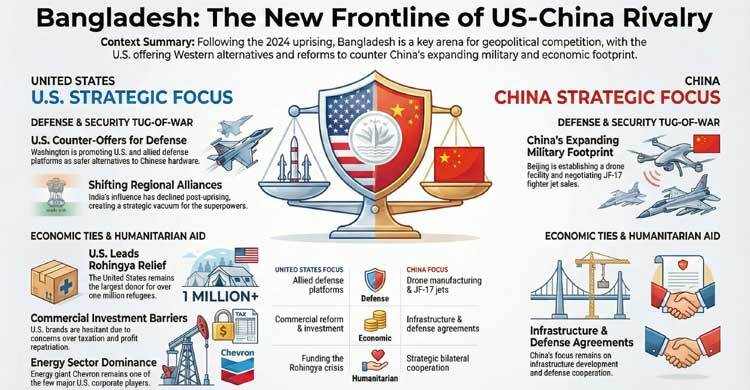
The United States is moving to counter China’s expanding influence in Bangladesh by offering the country’s next government alternative defence systems from the US and its allies, Washington’s ambassador to Dhaka has said, highlighting a growing strategic contest ahead of the national election.
In an interview with Reuters, US Ambassador Brent T Christensen said Washington was concerned about Beijing’s rising presence in South Asia and wanted to provide Bangladesh with options beyond Chinese military hardware.
“The United States is committed to working closely with the Bangladeshi government to clearly communicate the risks of certain types of engagement with China,” he said, adding that American and allied defence platforms could serve as alternatives.
The comments come at a politically sensitive moment. Bangladesh is heading into a general election following the 2024 uprising that forced former prime minister Sheikh Hasina into exile in India, a shift that diplomats say has opened space for China to expand its footprint as New Delhi’s influence declines.
China recently signed a defence agreement with Bangladesh to build a drone manufacturing facility near the Indian border, a move that has drawn attention from Western diplomats. Dhaka is also discussing a possible purchase of JF-17 Thunder fighter jets, jointly developed by China and Pakistan.
Beijing rejected Washington’s concerns. China’s foreign ministry said its cooperation with Bangladesh was mutually beneficial and “not directed against any third party.”
The Chinese embassy in Dhaka criticised the US envoy’s remarks as “old-fashioned” and ill-intentioned.
The Chinese Embassy has made clear its solemn position on the relevant issue, said a spokesperson, noting that the US Ambassador to Bangladesh was singing the same old tune again, pointing fingers at Bangladesh-China relations and mixing white and black. “Such remarks are made with ulterior motives.”
The spokesperson reiterated that China and Bangladesh respect and support each other and have set a fine example of friendly exchanges and mutually beneficial cooperation between countries.
“China is a trustworthy partner of South Asian countries, and its friendly cooperation with South Asian countries has safeguarded peace and stability in the region, promoted development and revitalisation, and has been supported and welcomed by the peoples in the region,” added the spokesperson.
Amid the strategic rivalry, Christensen stressed that Washington also wants stable ties between Dhaka and New Delhi, noting that Bangladesh-India relations have cooled since Hasina’s departure, affecting visas and even sporting exchanges.
Commercial diplomacy and investment
Beyond security, the US envoy said economic engagement would be a priority for Washington after the election. Many American companies are exploring investment opportunities but are waiting for clear signals that Bangladesh is “open for business,” he said, pointing to concerns over taxation and profit repatriation that have kept major US brands largely absent from the market.
Energy giant Chevron remains one of the few major American corporate players in Bangladesh despite decades of operations.
Christensen added that the United States would work with whichever government emerges from the vote, widely seen as a contest between coalitions led by the BNP and Jamaat-e-Islami.
Rohingya aid pressure
On humanitarian issues, the ambassador reaffirmed that the US remains the largest donor supporting more than a million Rohingya refugees in Bangladesh, but urged other countries to step up contributions as funding gaps force aid cuts.
“The US cannot sustain the bulk of the effort alone,” he said.
As Dhaka prepares for a new political chapter, competing offers from Washington and Beijing signal that Bangladesh is becoming an increasingly important arena in the broader geopolitical contest shaping South Asia.