
Businesspeople expect improved law and order from new govt

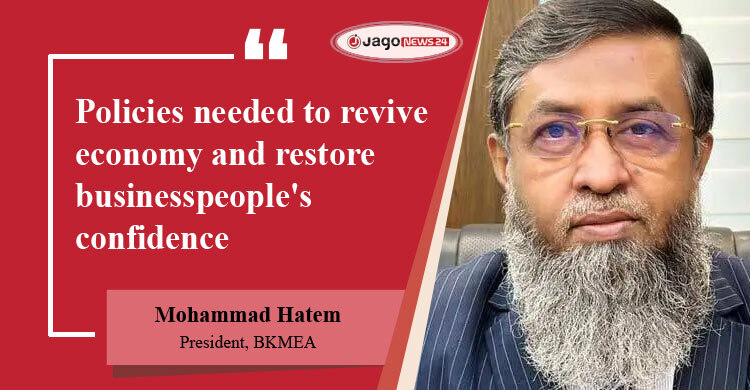
Business leaders expect the new government to improve the law-and-order situation, adopt zero tolerance against corruption, and take strict action to curb graft in order to restore economic momentum, said Mohammad Hatem, president of the Bangladesh Knitwear Manufacturers and Exporters Association (BKMEA).
He shared his expectations from the new government in an interview with Jago News. The interview was conducted by Special Correspondent Ibrahim Hussain Ovi.
Jago News: What does the business community expect from the new government?
Mohammad Hatem: The first thing we want is an improvement in the law-and-order situation. There must be zero tolerance for corruption, and it must be firmly controlled. These two issues are extremely important to revive the pace of the economy.
At present, the economy is in a fragile condition due to widespread irregularities and looting in the banking sector. To recover from this situation, the government must formulate effective and timely policies. Policies are needed to make the economy dynamic again and restore businesspeople's confidence. After ensuring law and order and controlling corruption, the next important task will be to take specific policy measures to reactivate the economy.
Jago News: There are several upcoming issues, including bringing the export sector back to a positive trajectory and LDC graduation. What are your expectations in this regard?
Mohammad Hatem: After Tarique Rahman returned to the country from London, we discussed these issues with him. He fully agreed with our views, particularly regarding LDC graduation.
We believe the new government will take initiatives to defer LDC graduation for at least three years. Although time is limited, a formal application should still be submitted and necessary steps taken. A sudden graduation would put significant pressure on our export sector.
Secondly, the severe mismanagement currently prevailing in the banking sector, especially affecting exporters, must be addressed urgently. Export activities are being hampered due to the banking crisis, and prompt policy changes are required so that exports are not disrupted by a shortage of funds.
Jago News: What kind of problems are you facing in the banking sector?
Mohammad Hatem: On one hand, there are fund-related problems; on the other, there are complications in opening letters of credit (LCs). LCs are being delayed on various pretexts, causing delays in timely imports.
During the previous government’s tenure, we witnessed how banks were looted and how funds were siphoned abroad. Now we see banks holding back business funds or creating complications that are harming entrepreneurs. We are helplessly watching the situation without being able to take effective action.
Therefore, our expectation from the new government is to rescue businesses from this crisis and restore discipline and good governance in the banking sector.
Jago News: What do you think could be the biggest challenge for the new government?
Mohammad Hatem: The government will face multiple challenges in keeping the economy running. Recent developments surrounding Chattogram port are very concerning. If such issues are properly controlled and not allowed to escalate, the government will be able to stay on the right path of development.
Any instability in the port and logistics sectors has a direct impact on the economy. Therefore, strict monitoring in these areas is essential.
Jago News: In the past, bureaucratic complications disrupted work during the interim government period. What is your view on this?
Mohammad Hatem: The distance between the government and bureaucracy increases when a government lacks a strong political mandate. However, when a government elected by the people assumes power, political leadership has the capacity to control the bureaucracy.
Since the new government comes with public expectations and a popular mandate, it will be able to control bureaucratic excesses if it chooses to do so. With political goodwill and effective supervision, administrative complications will not stand in the way of economic recovery.