
Attack on Iran triggers sharp fall in Bangladesh stock market

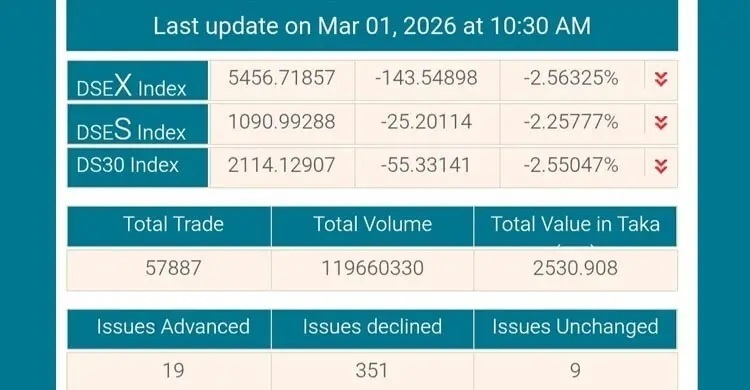
Bangladesh’s stock market experienced a significant decline on Sunday, the first trading day of the week, following reports of a joint United States–Israel attack on Iran.
At the opening bell, share prices across nearly all sectors dropped sharply. The benchmark index of the Dhaka Stock Exchange (DSE) plunged 208 points within minutes of the session starting.
Although some bargain hunters entered the market after the initial slump, helping the index recover about 100 points within the first 10 minutes, selling pressure continued to outweigh buying interest, keeping the market firmly in negative territory.
As of 10:30 am, only 19 companies at the DSE recorded price gains, while 351 declined and 9 remained unchanged. The DSE’s main index was down 143 points at that time. The DSE-30 index fell by 55 points, and the DSE Shariah index dropped 25 points. Total turnover stood at Tk 2.53 billion.
At the Chittagong Stock Exchange (CSE), the overall index CASPI declined by 54 points. Trading turnover there reached 12.6 million taka. Among 55 traded companies, 8 advanced, 43 declined, and 4 remained unchanged.
Market insiders attributed the downturn to renewed geopolitical tensions in the Middle East, which have heightened uncertainty in global financial markets. Investors typically shift away from riskier assets during periods of international instability, triggering increased selling in equity markets.
Analysts also expressed concern over potential volatility in global oil prices following the attack. As Bangladesh relies heavily on energy imports, rising oil prices could increase import costs, intensify pressure on foreign currency reserves, and heighten inflation risks. These concerns have negatively influenced investor sentiment.
Despite the sharp decline, market participants noted that Bangladesh’s stock market has been in a prolonged downtrend, leaving many stocks undervalued. They suggested that if investors refrain from panic-driven selling, the market could stage a recovery.
Brokerage officials said the news of Iran’s supreme leader being killed in the attack further intensified uncertainty, prompting aggressive selling at the market’s opening.
A senior brokerage executive advised investors to monitor developments carefully rather than react emotionally, noting that markets often partially recover after sharp, news-driven declines.
MAS/MHK