
Bangladesh faces new US trade scrutiny

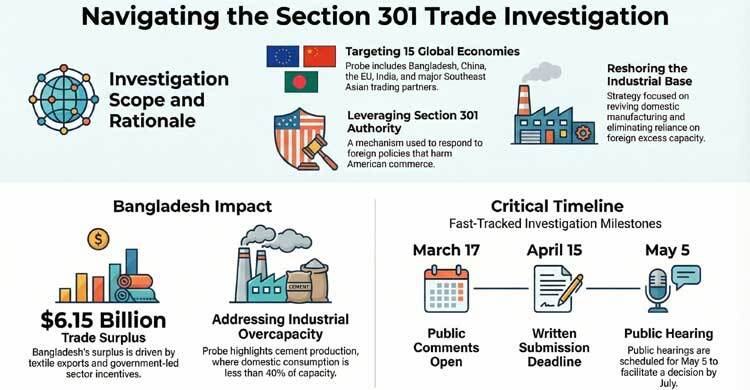
The United States has launched a new trade investigation into Bangladesh and several major trading partners, raising the possibility of fresh tariffs on imports if Washington finds evidence of unfair trade practices.
The probe was initiated by the Office of the United States Trade Representative under Section 301 of the Trade Act of 1974, a powerful mechanism used by the US to examine and respond to policies it considers harmful to American commerce.
US Trade Representative Ambassador Jamieson Greer said on Wednesday that the investigation will determine whether the acts, policies and production practices of the targeted economies are “unreasonable or discriminatory” and whether they burden or restrict US trade.
Bangladesh is among more than a dozen economies included in the investigation, alongside China, the European Union, India, Japan, South Korea, Mexico, Vietnam, Thailand, Malaysia, Cambodia, Singapore, Indonesia, Switzerland and Norway.
The move comes weeks after the US Supreme Court struck down a key part of President Donald Trump’s tariff policy, ruling that the International Emergency Economic Powers Act does not grant the president authority to impose tariffs. The court said such powers lie with Congress and require explicit approval.
Following the ruling, Trump announced a new 10 per cent global tariff and warned that it could be increased to 15 per cent. Earlier tariffs imposed in late February are set to expire in July, and US officials hope to complete the current investigations before then.
Greer said the probes are part of Washington’s broader effort to revive domestic manufacturing and bring supply chains back to the United States.
“The United States will no longer sacrifice its industrial base to other countries that may be exporting their problems with excess capacity and production to us,” Greer said, adding that the investigations reflect the administration’s commitment to reshoring critical industries and creating manufacturing jobs.
According to the USTR statement, the investigation will also examine whether structural overcapacity in manufacturing sectors in these economies is contributing to global supply imbalances that harm US producers.
The US noted that Bangladesh has a bilateral goods trade surplus of about $6.15 billion with the United States, largely driven by textile exports. Washington also pointed to government export incentives across dozens of sectors, including textiles and leather goods.
The statement also highlighted excess capacity in Bangladesh’s cement industry. National consumption fell to around 38 million tonnes in 2024, less than 40 per cent of total production capacity, and declined further in 2025.
The USTR will open a public docket for comments on March 17. Interested parties can submit written comments and requests to appear at a hearing by April 15. A public hearing on the investigation is scheduled for May 5.
Meanwhile, senior US and Chinese officials are expected to meet in Paris later this week, in talks that could pave the way for a possible meeting between Trump and Chinese President Xi Jinping in Beijing later this month.