
Fuel supply strain deepens: Industrial giants warn production slowdown

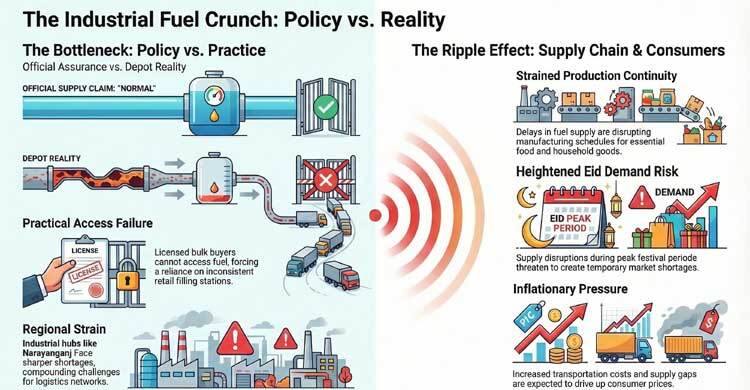
Bangladesh’s industrial sector is facing mounting pressure as major manufacturing groups report persistent fuel shortages at the depot level, despite repeated assurances from authorities that supply remains normal.
At a time when factories are operating at full capacity to meet heightened Eid demand, the inability to secure sufficient fuel is beginning to disrupt production lines, delay deliveries and raise concerns about price stability in the coming weeks.
A disconnect between policy and reality
The Bangladesh Petroleum Corporation continues to maintain that there is no shortage of fuel in the country, insisting that stocks are adequate and distribution is being monitored closely.
However, large industrial consumers, who are authorised to procure bulk fuel directly from depots, say the situation on the ground tells a different story.
Instead of receiving timely and sufficient allocations, companies report partial deliveries, long waiting periods and, in some cases, an inability to access fuel altogether. This has forced many to fall back on retail filling stations, where queues are long, and supply remains inconsistent.
Production lines under strain
For manufacturers of essential goods, fuel is not just an input – it is the backbone of operations, powering factories, transport fleets and backup generators.
Executives say even short disruptions can have cascading effects.
Toufiq Hasan, Chief Business Development Officer at Akij Resource Group, described the situation as operationally damaging.
“Excessive waiting times at filling stations and delays in depot supply are affecting production continuity. Delivery schedules are being disrupted, and the entire supply chain is under strain,” he said.
At Pran-RFL Group, one of the country’s largest producers of food and household products, similar concerns are emerging.
Marketing Director Kamruzzaman Kamal said that even companies with proper licences are struggling to secure fuel in required volumes.
“Bulk buyers are not getting enough fuel from depots, and collecting fuel from petrol pumps involves long delays and limited supply. It is becoming difficult to maintain production and timely delivery,” he noted.
Supply chain risks intensify
The impact is particularly visible in logistics.
Transporting essential goods – from food items and dairy products to packaged consumer goods – depends heavily on a steady fuel supply. Any disruption slows down distribution networks, leading to delays in reaching wholesale and retail markets.
Industrial hubs on the outskirts of Dhaka, especially Narayanganj, are reportedly facing sharper shortages, compounding the challenge during the peak Ramadan and Eid period.
Business leaders warn that if the situation persists, shelves could see slower replenishment, creating temporary shortages in certain categories.
Global factors adding to pressure
The domestic situation is unfolding against a backdrop of global uncertainty.
Ongoing tensions in the Middle East have affected international fuel supply dynamics, contributing to volatility in availability and pricing. Within Bangladesh, concerns over potential shortages have triggered higher demand, with businesses and consumers alike attempting to secure additional reserves.
Earlier restrictions imposed by BPC on fuel sales at filling stations, though later withdrawn, are also believed to have disrupted normal supply patterns.
Price implications for consumers
For consumers, the consequences may soon be felt in their wallets.
Higher fuel costs and supply disruptions increase transportation expenses, which are often passed on through the value chain. During Eid, when demand for goods peaks, even small disruptions can translate into noticeable price increases.
Industry insiders caution that without swift intervention, the current situation could contribute to inflationary pressure on essential commodities.
Official position: No crisis
Despite mounting complaints, BPC remains firm in its position.
Muhammad Morshed Hossain Azad, General Manager (Trade and Operations), said the corporation has sufficient stock and is working to ensure smooth distribution.
“There is no crisis. We have instructed depots to maintain normal supply and ensure that fuel reaches industrial consumers,” he said.
The real challenge: Access, not availability
For businesses, however, the issue is less about national stock levels and more about practical access.
Even if fuel exists within the system, delays, distribution bottlenecks and inefficiencies at the depot level can effectively create shortages for end users.
This disconnect is now placing significant pressure on manufacturers at a critical time of the year.
A narrow window before Eid
With Eid fast approaching, the window to stabilise supply is rapidly narrowing.
Industrial groups are calling for immediate measures to streamline depot distribution, reduce delays and ensure that bulk consumers receive their allocated fuel without disruption.
Without swift action, they warn, the consequences could extend beyond factories – impacting supply chains, market prices and ultimately, millions of consumers preparing for one of the most important festivals of the year.