
Meat, vegetable prices remain high even after Eid

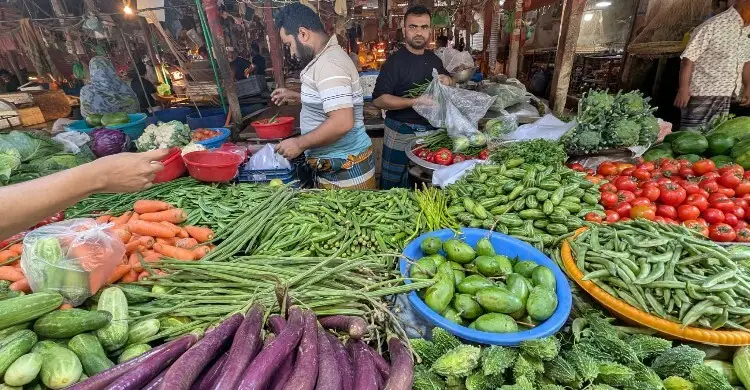
Despite a noticeable drop in consumer activity following the Eid-ul-Fitr holidays, prices of essential food items, including meat, fish, and vegetables, remain stubbornly high across the capital, raising concerns among consumers.
Millions of residents left Dhaka during the Eid break, leaving the city unusually quiet. This seasonal migration typically leads to reduced demand and, in some cases, a temporary easing of prices. However, market observations on Sunday (March 22) across key areas such as Mirpur, Agargaon, Taltola, Shewrapara, and Matikata indicate that this expected trend has not materialized this year.
Markets appeared subdued, with fewer customers and a significant number of shops remaining closed. Yet, traders have largely maintained pre-Eid price levels.
Vegetable prices, in particular, remain elevated, with no item available below Tk 60 per kilogram. Tomatoes are selling at approximately Tk 80 per kg, cucumbers at Tk 50, and bottle gourd at Tk 50–Tk 60 per piece. Eggplants—both round black and white varieties—are priced between Tk 100 and Tk 120 per kg. Bitter gourd is selling at Tk 100, okra at Tk 80, while beans and pointed gourd are priced between Tk 70 and Tk 80 per kg.
Traders attribute the continued high prices to supply constraints. According to them, fewer trucks carrying fresh produce are arriving in Dhaka from rural areas, limiting availability in wholesale markets and driving up retail prices.

Consumers, however, argue that the price hike is not entirely supply-driven. Many believe that traders take advantage of the festive period to increase prices, a practice that often continues even after Eid.
A buyer at Taltola market said that although demand has decreased, prices have not followed suit, suggesting a lack of effective market monitoring.
The edible oil market remains volatile. A shortage of soybean oil, which began nearly two weeks before Eid, continues to affect availability.
Retailers report that before Eid, they were often required to purchase additional products in order to secure soybean oil from suppliers. Even now, supply remains inconsistent. In some cases, oil is being sold at Tk 5–Tk 10 above the printed price, while others are restricting customers to limited quantities.
A 1-litre bottle of soybean oil is officially priced between Tk 190 and Tk 195, while a 5-litre container ranges from Tk 920 to Tk 955. Retailers say that dealers have yet to resume regular deliveries after Eid, creating ongoing uncertainty in the market.
Beef prices also remain high, selling between Tk 810 and Tk 860 per kilogram. Traders explain that cattle prices surged by up to Tk 10,000 in the week leading up to Eid, resulting in an increase of around Tk 100 per kg in beef prices.
Prices saw an additional spike on Chand Raat, when beef was sold Tk 50–Tk 60 higher than earlier in the week. Chicken prices have similarly remained steady at pre-Eid levels, offering little relief to consumers.
The fish market presented a quieter picture, with most shops closed and minimal trading activity. The few that remained open reported low customer turnout.
Current prices show rohu fish selling between Tk 260 and Tk 400 per kg, tilapia at Tk 200–Tk 220, and pangas at Tk 200–Tk 240 per kg.
SM/MHK