
Per capita income hits $2,769

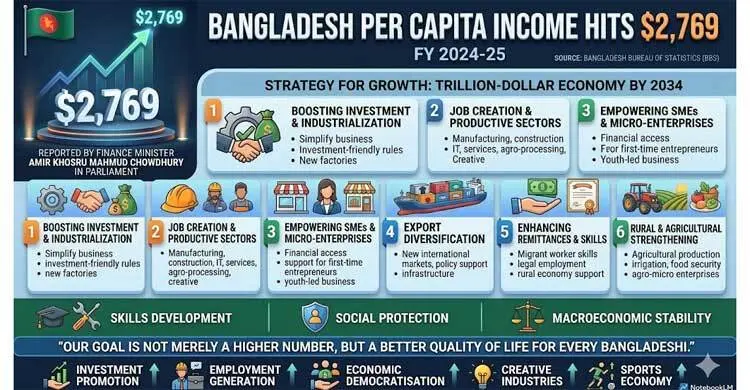
Bangladesh's per capita income has reached $2,769 in the 2024-25 fiscal year, according to the latest official data published by the Bangladesh Bureau of Statistics, Finance Minister Amir Khosru Mahmud Chowdhury confirmed in parliament on Monday.
Responding to a written question from Dhaka-18 MP SM Jahangir Hossain during the ninth day of the first session of the 13th Jatiya Sangsad, presided over by Speaker Hafiz Uddin Ahmed, the Minister outlined the government's comprehensive strategy to sustain this upward trajectory and achieve a trillion-dollar economy by 2034.
The Minister emphasised that raising per capita income remains a central pillar of the current administration's economic agenda. To this end, the government is preparing a multi-dimensional action plan encompassing investment promotion, employment generation, economic democratisation, creative industries and the emerging sports economy.
Rather than focusing on a single sector, the government is pursuing a holistic approach that prioritises employment creation, private investment, domestic production, export diversification, remittance inflows, skills development, social protection and macroeconomic stability. These interconnected priorities, the Minister argued, form the foundation for sustained income growth across all segments of society.
A key component of this strategy involves expanding employment opportunities across manufacturing, construction, services, information technology, agro-processing and small enterprise sectors. The rationale is straightforward: as more citizens enter productive employment, household incomes rise, driving a gradual but sustained increase in per capita earnings.
Parallel efforts are underway to stimulate private investment and accelerate industrialisation. The government is simplifying business registration and expansion procedures, fostering an investment-friendly regulatory environment and encouraging capital flow into productive sectors. Increased private investment, in turn, generates new factories, enterprises and jobs, creating a virtuous cycle of income generation.
Recognising the critical role of small and medium enterprises as employment engines, targeted initiatives have been introduced to facilitate access to finance, support first-time entrepreneurs, promote women and youth-led businesses and enhance market linkages. Strengthening this segment is expected to catalyse local economic activity, create grassroots employment and broaden the income base.
On the external front, the government is intensifying efforts to diversify exports, penetrate new international markets and retain existing ones. Export-oriented industries are being encouraged through policy support and infrastructure development. Higher export earnings not only strengthen the balance of payments but also stimulate domestic production and industrial employment, contributing to overall income growth.
Remittances from overseas workers remain a vital source of foreign exchange and household income. Initiatives to enhance migrant workers' skills, expand legal employment opportunities abroad and streamline repatriation channels are being prioritised. Increased and formalised remittance inflows bolster rural economies, support consumption and reinforce the country's external resilience.
Human capital development features prominently in the government's strategy. Technical and vocational training programmes are being expanded in alignment with domestic and international labour market demands. A more skilled workforce commands higher wages, accesses better employment opportunities and contributes to elevated productivity – key drivers of per capita income growth.
In the rural economy, efforts are focused on strengthening agricultural production, upgrading rural infrastructure, improving irrigation systems, ensuring food security and promoting agro-based micro-enterprises. Given that a significant proportion of Bangladesh's population resides in rural areas, raising incomes in these communities has a direct and substantial impact on national per capita figures.
The Minister clarified that implementation of these measures is already underway in the current fiscal year, with remaining initiatives scheduled for phased rollout across short, medium and long-term horizons. Particular emphasis will be placed on sustaining momentum in employment generation, investment facilitation, skills enhancement, export promotion and remittance management.
Concluding his response, Finance Minister Amir Khosru Mahmud Chowdhury reaffirmed the government's commitment to policies that simultaneously raise incomes, reduce unemployment, boost production and investment, strengthen external earnings and safeguard the purchasing power of ordinary citizens. "Our approach is inclusive, evidence-based and forward-looking," he stated. "The goal is not merely a higher number, but a better quality of life for every Bangladeshi."
Economists note that while the per capita income figure represents progress, sustaining growth will require navigating global economic headwinds, managing inflationary pressures and ensuring that gains are equitably distributed. The government's success in executing its action plan will be closely watched by investors, development partners and citizens alike.