
Chhatra Federation unveils 9-point proposal for student politics reform

Published: 7 August 2025, 07:40 PM
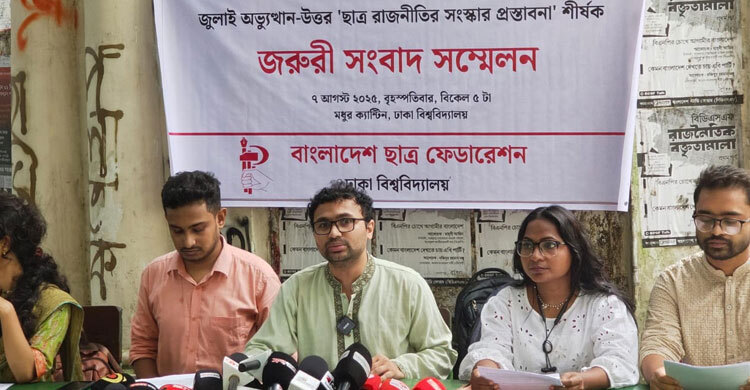
The Dhaka University unit of the Bangladesh Chhatra Federation has put forward a nine-point proposal aimed at bringing qualitative reform to student politics in the country.
The proposals were presented at a press conference held at outside Madhu’s Canteen on Thursday, August 7, by Armanul Haque, President of the Bangladesh Chhatra Federation’s Dhaka University unit.
In a written statement, Haque highlighted the proud legacy of student movements in Bangladesh from the 1952 Language Movement, the 1969 Mass Uprising, and the 1971 Liberation War, to the 1990 Anti-Dictatorship Movement and the recent July Uprising.
He noted that students have consistently played a pivotal role in shaping the nation’s democratic trajectory.
“The July Uprising marked a turning point,” he said. “It led to the downfall of Sheikh Hasina’s regime, continuing the long tradition of united resistance against authoritarian rule. Students, united against the repression of the Chhatra League and the exploitation in guesthouses and messes, were central to this victory.”
Founded in 1985, the Chhatra Federation, Haque explained, emerged with the vision of building a conscious and principled student movement, countering what it describes as the bourgeois and factional politics prevalent on campuses.
Over the decades, organisation has actively participated in major student-led movements, including: Anti-Ershad democratic struggle; the anti-sexual harassment movement at Jahangirnagar University; Shamsunnahar Hall movement at Dhaka University; August 20-22, 2007 student protests; opposition to the Rampal power plant; campaigns against the commercialisation of education at Rajshahi University; anti-VAT movement in private universities; safe roads movement; anti-fascist student movement; and most recently, the July Uprising.
“In the aftermath of the July Uprising, we hoped there would be serious national dialogue on transforming student politics,” Haque said. “While the ‘Anti-Discrimination Student Movement’ platform called for reform, little progress was made. Instead, under the guise of banning student politics, chaos has taken over campuses - silencing discussion and preventing constructive engagement.”
He added that the Dhaka University administration recently initiated talks with student organisations, prompting the Chhatra Federation to propose a framework for meaningful change.
“With the announcement of the DUCSU election schedule, the opportunity has returned to restart this conversation,” Haque said. “We are presenting these nine proposals to fellow students and calling on all progressive student organisations to join us in building a democratic, transparent, and violence-free student political culture.”
The nine-point proposal for qualitative reform:
1. Regular Student Union Elections: Student union elections must be held on schedule as a mandatory requirement. Failure to do so lies with the university administration.
2. Constructive student politics: Political activities and peaceful coexistence of all student organisations, except those officially banned, must be guaranteed.
3. Zero tolerance for violence and crime: Students involved in torture cells, weapons possession, extortion, or drug-related crimes must be expelled and face legal consequences. Rehabilitation programmes should also be introduced.
4. Prevention of online propaganda: Cyberbullying and malicious digital propaganda must be punished. Digital literacy and awareness workshops should be conducted across campuses.
5. Freedom of expression and human rights: Freedom of speech and diversity of opinion must be respected. Incitement to division, hate speech, and religious abuse must not be tolerated.
6. Transparency and accountability: All student organisations must disclose their structures and membership. Secret, underground politics should be prohibited.
7. Formation of an anti-terrorism cell: A central anti-terrorism cell should be established with representation from student bodies to prevent the politicisation of violence.
8. Residence hall politics and security: Control of dormitories must remain with the university administration, which is responsible for ensuring safety. Hall-based and faculty-based politics should be allowed, but politicisation of residential management must end.
9. Trial of July Uprising attackers: Perpetrators of violence during the July Uprising must be identified and prosecuted. At the same time, no individual should be harassed for expressing political opinions—due process and fair trial must be ensured.