
From protest to purpose: Why Bangladesh needs compulsory military training

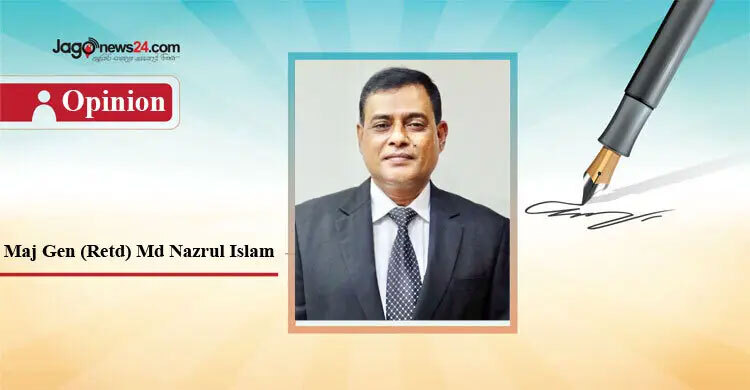
The article argues that Bangladesh should introduce short-term compulsory military training for youth to instill discipline, civic ethics, and teamwork. The August 2024 protests showed moral courage but lacked structured civic education. Drawing lessons from countries like Singapore, South Korea, and Switzerland, Major General (Retd) Md Nazrul Islam suggests training in leadership, disaster management, and fitness, aiming to empower youths, strengthen national cohesion, and prevent lawlessness, without militarising society.
Bangladesh is at a crossroads of both glory and danger. The boldness and solidarity of our young people in the August 2024 movement were not acts of defiance, but a call for just, fair, and accountable leadership. They were morally justified, demanding reforms that the nation needed. Yet, everywhere, the nobility of that cry for change was briefly overshadowed by anarchy. Police stations were attacked, important institutions were burnt down, and public property was vandalised. The passion was right, but the method was not. The destruction cost billions of takas that could have been used to build schools, hospitals, and employment opportunities for the generation that spearheaded the protests. This is not a morality lesson, but a lesson in discipline. Revolutions transform governments; schooling builds states.
A Crisis of Civic Conduct
The August 2024 unrest did not come out of thin air. It reflected decades of deterioration in civic ideals and social forbearance. We live in an age of increasing insensitivity to restraint—be it in the motoring industry, through careless driving, or in the exams system, through cheating. We desire change, but this change is rarely orderly. This is not peculiar to Bangladesh. Citizens around the world are taking the law into their own hands—whether in Paris or Nairobi, New York or Hong Kong—they believe that outrage is the only way to achieve justice. The digital era fuels anger but rarely teaches self-restraint. Passion without training may even turn legitimate protest into lawlessness. It is not the morality of our young generation that is the problem, but rather the absence of formal civic education, which could channel their energy toward creating positive change.
Why Compulsory Military Training
The aim is not to militarise society, but to inculcate disciplined civility and provide all young Bangladeshis with the opportunity to exercise duty, empathy, and self-control before reaching adulthood. Bangladesh must now introduce short-term mandatory military education—not as war conscription, but as peace training integrated with civic education. Just a few months of military training can convey valuable lessons to every democracy:
a. Honour to the legitimate power and to the fellow citizens.
b. Transcending class, faith and region teamwork.
c. The capacity to manage emotions in crisis situations.
d. Hardiness, timekeeping and adherence to a shared objective.
These attributes can transform protesters into reformers and mobsters into integrated societies.
Learning from the World
More than 60 countries operate forms of compulsory national or military training—among them Singapore, South Korea, Israel, Norway, and Switzerland. Each has adapted the model to its own context: Singapore’s programme builds racial unity; South Korea’s cultivates resilience; Switzerland’s maintains civic readiness without aggression. These experiences prove that democracy and discipline are allies, not opposites. A short, structured training period strengthens civic trust and national cohesion—two resources Bangladesh needs.
Strengthening Security and Reducing Costs
Weapons are not the only features of modern security; the will and discipline of citizens are also element of impenetrable defence. A national training system would supplement our military and generate savings in the long term:
a. Deep strategy: The trained citizens would constitute a backup force during disasters and national emergencies.
b. Civil-military synergy: Confidence and cooperation is created through mutual understanding between soldiers and civilians.
c. Psychological deterrence: A disciplined people are an indication of togetherness-a transparent wall to the outside or inside destabilisation.
d. Economy in budget: Bangladesh may spend on human preparedness rather than increase the hardware that is expensive.
A well-trained nation can protect itself with less armaments and requires less policing to be stable.
Designing the curriculum
The suggested programme must be three or six months following secondary or higher-secondary education and be a combination of physical, moral and intellectual training.
a. Civic ethics, team building and leadership.
b. First aid and disaster management.
c. Information discipline and digital literacy.
d. Simple physical fitness and health consciousness.
The medically unfit can do alternative civic service- community work, environmental protection or social welfare. It should be implemented as a pilot in some specific districts or universities, which will be overseen by a civil-military national commission in form of educators and defense workers and representatives of the youth. Depending upon the needs of the participants, certificates, academic credit or job preference may be given and this way, the program will be seen as an honourable civic achievement, rather than a mandate.
Empowering, Not Blaming, the Youth
This is not blaming the younger generation but giving them power. Their bravery transformed the political environment. The last thing they need is the structure to maintain what they have obtained. Military-style discipline at an early age will put the seeds of soldierly characteristics of loyalty, patience, humility, and courage. These attributes will be employed by them in offices, factories, and the general institutions as in any parade ground. The future of Bangladesh is in the hands of youthful citizens who are capable of protesting intentionally and defending proudly. Punishment is no stifle to free speech; it is its reinforcement.
A Global Malaise, A Local Cure
Civic unrest on other continents shows the same trend: passion, lack of patience, rights, lack of responsibility. The erosion of ethics is occurring at a rate that is more rapid than the development of the economies. Bangladesh can be the first to demonstrate how reform and respect, freedom and order can be holding hands. Mandatory military service could act as a kind of civic vaccination against anarchy—instilling a sense of balanced freedom and control that all healthy democracies require.
Reclaiming the Spirit of 1971
Their liberation of this country was carried out courageously, unitedly, and with discipline. It is my—or our—duty to protect this heritage half a century later—but on the battlefield of our civic life. When we educate our youths at an early age to serve, endure and defend, we shall with them inflame the fervor of righteousness, and instill the training of moderation. This is what patriotism is all about, the silent power to do what is right, even when no one is there. Discipline is cheaper than defense and secures much more. A nation thus educated in the morals of service will never again have to have the terror of anarchy.
This notion has nothing in common with taking civilians to barracks; this is about molding character. They are meant to make our young people think rationally in times of confrontation, collaborate instead of competing and above all, to learn how to protect what we create instead of destroying it. To a nation that is struggling to come out of confusion to competence, such training may be an eye opener - training on discipline, respect and unity. It would not be the battle call, but the teaching of citizenship where patriotism fulfills the obligation to serve the country. When the young people of Bangladesh can bring the spirit of a soldier down to the daily, the good spirits of his perseverance, endurance in adversity, and the national self-respect of his duty, then we shall have reached a power mightier than all arms that is the unity of purpose.
Writer: Md Nazrul Islam, Former Executive Chairman, BEPZA & Executive Member (Planning & Development), BEZA