
28.6% of Bangladesh schools meet minimum toilet standards

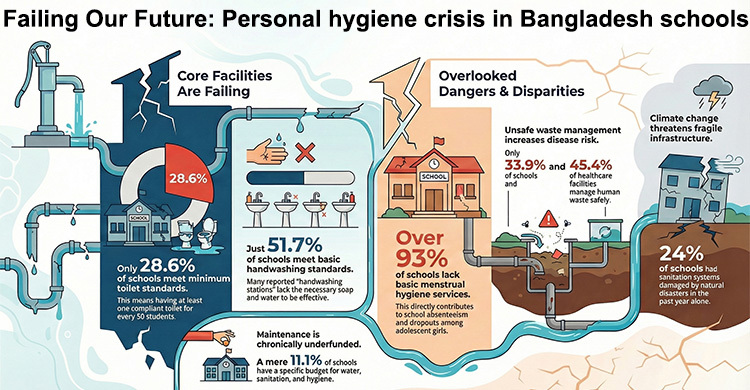
Personal hygiene facilities in Bangladeshi schools remain alarmingly inadequate, raising serious concerns about student health, dignity and learning outcomes.
A recent survey by the Bangladesh Bureau of Statistics (BBS) reveals that only 28.6 per cent of schools nationwide have at least one toilet, that meets internationally recommended minimum standard, for every 50 students.
The findings, released on Sunday, December 21, at the Parisangkhan Bhaban auditorium in Agargaon, also show widespread gaps in sanitation, handwashing and menstrual hygiene management (MHM), despite relatively high access to improved water sources.
Unsafe waste management, rising health risks
According to the BBS survey, only 33.9 per cent of schools and 45.4 per cent of healthcare facilities manage human waste safely, significantly increasing the risk of environmental pollution and the spread of communicable diseases.
BBS officials warned that the situation is being compounded by extremely limited budget allocations for maintaining improved water and sanitation systems, threatening the long-term sustainability of existing facilities.
The event was chaired by BBS Director General Mohammad Mizanur Rahman, with SID Secretary Aleya Akhter attending as chief guest. The survey findings were presented by Md. Alamgir Hossain, Focal Point of the SDG Cell.
Survey scope and methodology
The survey covered all eight divisions and 64 districts, collecting data from both public and private primary and secondary schools, as well as comprehensive healthcare facilities. Sampling followed Watson’s formula, ensuring national representation. Fieldwork was conducted between June 26 and July 17, 2014.
Water access high, but quality and inclusion lag behind
The survey found that 95.4 per cent of schools and 87.5 per cent of healthcare facilities have access to improved water sources – a comparatively strong performance. However, when measured against the definition of basic water service, which requires water sources to be located within institutional premises, compliance drops sharply.
Only 86.1 per cent of schools and 70.5 per cent of healthcare facilities meet this standard. Accessibility for people with disabilities is even more limited, with just 55.4 per cent of schools and 40.9 per cent of health facilities providing suitable water points.
Toilets exist, but standards fall short
While 90.6 per cent of schools and 98.5 per cent of healthcare facilities have at least one toilet, the survey highlights stark deficiencies in quality, availability and usability.
Only 11.1 per cent of schools and 34.9 per cent of health facilities reported having a specific budget allocation for water, sanitation and hygiene (WASH), undermining routine maintenance and upgrades.
Handwashing facilities largely ineffective
Although most institutions reported having handwashing stations, many lacked water and soap, rendering them ineffective. As a result, only 51.7 per cent of schools and a mere 5.0 per cent of healthcare facilities meet the basic handwashing service standard.
Public health experts warn that this severely weakens infection prevention and control, particularly in densely populated school environments where communicable diseases can spread rapidly.
Menstrual hygiene remains a major gap
Facilities for menstrual health management (MHM) remain critically insufficient. The survey found that only 20.7 per cent of schools have separate, safe and hygienic toilets for adolescent girls, while just 6.9 per cent provide basic MHM services.
Education specialists say the lack of adequate MHM facilities contributes directly to school absenteeism, discomfort, dropouts and gender inequality, especially among adolescent girls.
Solid and medical waste mismanagement
While 78.3 per cent of schools reported having proper solid waste disposal systems, the situation in healthcare facilities is far more concerning. Only 25.4 per cent meet basic medical waste management standards, which require safe segregation, treatment and disposal of hazardous waste.
Alarmingly, 41.6 per cent of healthcare facilities rely on open burning of waste, posing serious environmental and public health risks.
Climate vulnerability and lack of preparedness
The survey also highlights the impact of climate-related disasters on hygiene infrastructure. Over the past 12 months, 24.0 per cent of schools and 19.4 per cent of healthcare facilities experienced natural disasters that damaged water and sanitation systems.
Despite this vulnerability, awareness of climate-resilient WASH systems remains low. Only 33.7 per cent of schools and 9.9 per cent of healthcare facilities reported knowing about protective measures, with even fewer having implemented them.