
Chhayanaut hosts Gaane Gaane Sanghati Samabesh

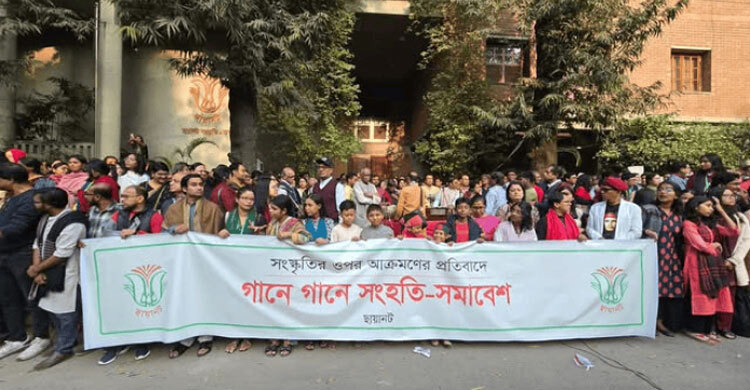
The busy Satmasjid Road in Dhanmondi filled with voices as people gathered outside Chhayanaut on Tuesday afternoon, December 23, not for a routine cultural programme, but for a deliberate act of resistance.
Titled “Gaane Gaane Sanghati Samabesh”, the gathering unfolded as a peaceful, music-led protest against recent attacks on cultural spaces and growing anxieties over freedom of expression in Bangladesh.
As the gates of Chhayanaut opened, it became evident that this was more than a concert. It was a collective response to vandalism, intimidation and the persistent attempts to silence art. Artists, writers, intellectuals, journalists and members of various cultural organisations came together, drawn by the belief that culture must answer violence not with force, but with voice.
The significance of Chhayanaut is inseparable from the nation’s own history. Founded in 1961, when Bengali language and cultural practices were under threat, the institution emerged as a site of resistance long before independence. Through the teaching and practice of Rabindra Sangeet, Nazrul Sangeet and classical Bengali forms, Chhayanaut upheld cultural identity at a time when asserting it was itself an act of courage.
That legacy is precisely why recent acts of vandalism against the institution have resonated so deeply. An attack on Chhayanaut is not an isolated incident; it echoes a longer pattern of efforts to suppress cultural expression. From the censorship of Rabindranath Tagore during Pakistan’s military rule to later authoritarian crackdowns on progressive voices, Bangladesh has repeatedly witnessed how fear enters society through the silencing of art – leaving behind social fracture, mistrust and exclusion.
Earlier in the day, near Abahani Club Field, prominent cultural figures including singer Farzana Wahid Shayan, actress Azmeri Haque Badhan, actor Aanon Siddique and filmmaker Akram Khan gathered under the banner of Drishsho Madhyam Shilpi Shomaj (Visual Artistes Collective). Condemning what they described as systematic attacks on cultural spaces, they marched together to Chhayanaut, a place that carries the enduring weight of cultural defiance.
Standing before the Chhayanaut premises, artistes and participants raised their voices in unison, singing “O Amar Desher Mati”, “Gramer Naujowan Hindu Musolman” and “Amar Mukti Aloy Aloy”. These were not random selections, but songs that have accompanied the nation through some of its darkest chapters. The programme concluded with the national anthem, “Amar Shonar Bangla, Ami Tomay Bhalobashi”, as the national flag was waved.
Speakers at the gathering said fundamentalist and extremist forces – whom they described as including the defeated elements of 1971 – have long feared cultural organisations such as Chhayanaut and Udichi. That fear, they argued, is what drives repeated attacks on cultural institutions. They vowed that such acts would not silence them and reaffirmed their commitment to resist through cultural expression.
Culture, after all, does not call for destruction. It does not demand blood. Yet it is persistently treated as a threat – perhaps because it remembers, perhaps because it resists erasure. In response, artistes chose the most humane form of defiance available to them: song. At a time when aggression is loud and unrestrained, this collective, non-violent resistance through music remains one of the most powerful statements of all.