
“They will eat what we eat”: Hamin remembers Khaleda Zia’s grace and kindness

For Hamin Ahmed of the legendary Bangladeshi band Miles, one memory involves a person whose public image was that of a formidable political leader, but in private, revealed a grace and warmth that left an indelible mark on everyone around her: Former Prime Minister Begum Khaleda Zia.
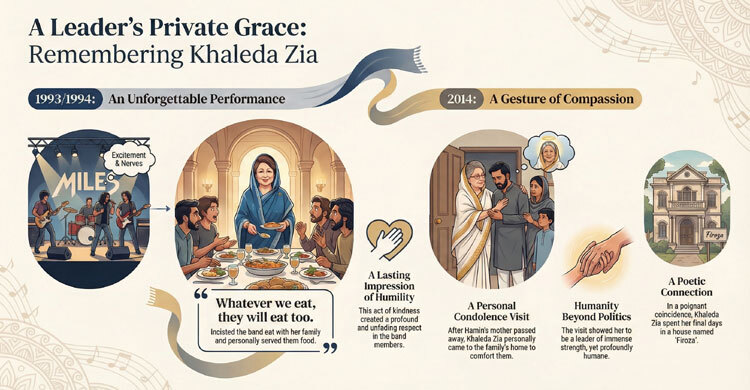
It was 1993 or 1994, and Miles had been invited to perform at the residence of Khaleda Zia on Shaheed Mainul Road in Dhaka Cantonment. Hamin, along with bandmates Shafin, Manam, and possibly Mahbub, set foot in the house with a mixture of excitement and nerves. This was not a typical gig – it was their first chance to perform in the presence of the nation’s leader. Accompanying them was Shafiq Bhai, guiding the young musicians through the corridors of power and history.
For many, a political leader of Khaleda Zia’s stature might have seemed distant, almost untouchable. But when Hamin first saw her, he says, that impression was completely overturned. “She was elegant, aristocratic, and commanding,” he wrote, “yet she greeted us with such sincerity, kindness, and grace that we were all awe-struck. Tarique Rahman and his friends were also warm, making us feel completely at ease.”
The band began their sound check around midday, a routine process they were familiar with. But lunchtime approached, and naturally, the Zia family’s friends suggested taking the band elsewhere to eat. Hamin recalls the moment that would remain in his memory forever. “To everyone’s surprise, Begum Khaleda Zia firmly said, ‘No, they will eat in this house. Whatever we eat, they will eat too.’ And that was that. We sat at the dining table, and to our utter astonishment, she personally served our plates.”
Hamin paused over the memory: “I looked at my plate and wondered, is this really happening? Here was the Prime Minister of our country, the most powerful woman in the nation, yet she was humble, thoughtful, and entirely humane. That act created in me a profound respect that has never faded.”
That evening, Miles performed in the garden while Khaleda Zia watched from a netted enclosure. She listened attentively, later complimenting the band on their music. The memory of that day, Hamin says, left a permanent imprint—not only on him and Shafin, but also on their families, including his mother, the legendary Nazrul singer Firoza Begum.
Years later, this humanity revealed itself again in the most personal of ways. On September 9, 2014, Firoza Begum passed away. While senior politicians from the ruling party visited Shaheed Minar to pay tribute, no one came to her home to honour a life dedicated to music and the national poet. Khaleda Zia, despite her own illness and pain, immediately came to the family home, Kalindi, on Indira Road. She sat with Hamin, Shafin, and their family, spoke of memories, comforted them, and honoured Firoza Begum as if she were part of her own family. “She didn’t have to do that,” Hamin wrote, “but she did. That’s who she was, a leader of immense strength, yet profoundly humane.”
A poetic coincidence deepened the resonance of this memory: Khaleda Zia spent her final days in a house called Firoza. Hamin reflected on the symmetry of it, a gentle nod to the way lives and legacies intersect. “She was a remarkable, gracious, and kind-hearted person who will remain forever in my fondest memories with the highest respect and love,” he wrote.
Ending his tribute, Hamin offered a prayer: “Rabbir hamhuma kama rabbayani saghira. May Allah (SWT) grant her Jannah.”
In a world often defined by politics and power, these intimate recollections offer a different image of Khaleda Zia, a woman who could wield authority yet remain deeply compassionate, who could lead a nation yet still serve food to her guests, who could govern from the corridors of power yet care for the artists who shaped the country’s cultural heartbeat. For those who knew her personally, these gestures of humility and warmth are what endure.
Through the eyes of Hamin Ahmed, Begum Khaleda Zia is remembered not just as a Prime Minister, not just as a political figure, but as a person of extraordinary heart, someone whose kindness continues to echo in the lives she touched, from the music of Miles to the final days of Firoza Begum.