
Jayashree Kabir: The luminous star who chose silence over spotlight

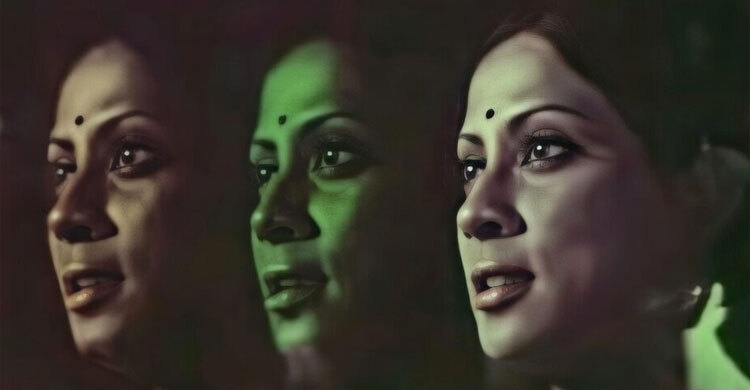
Jayashree Kabir, one of the most refined and unforgettable actresses of Bengali cinema, is no more. The once-celebrated heroine passed away in London on January 12, bringing the curtain down on a life that blended cinematic brilliance with quiet dignity.
Her death was confirmed by her nephew Javed Mahmud, who said Jayashree had been suffering from illness for a long time while living in London. Respecting her lifelong preference for privacy, the family declined media access following her death. Even in her final moments, Jayashree remained true to the life she had consciously chosen – away from the glare of publicity.
Crowned Miss Calcutta in 1968, Jayashree Roy’s journey to the silver screen was swift yet graceful. Her film debut came through Satyajit Ray, who cast her in Pratidwandi (1970), instantly marking her as an actress of depth, restraint and rare screen presence.
Her cinematic destiny, however, found its most enduring expression in Bangladesh. Under the direction of Alamgir Kabir, she delivered some of the most artistically significant performances in the country’s film history. Seemana Periye, Rupali Saikate, Surya Kanya and Mohana not only defined her career but elevated the language of cinema itself. Two of these films – Seemana Periye and Rupali Saikate – were later recognised by the British Film Institute (BFI) as among the finest films ever produced in Bangladesh.
For teenagers of the 1970s, Jayashree Kabir was more than an actress – she was an emotion. Rhymester and lyricist Lutfor Rahman Riton, recalling his youth, described her as a “true classical beauty” who held an entire generation in thrall.
“As a teenager, I was completely spellbound by her,” Riton said. “Her silent and ringing laughter, her tearful and tearless crying, the rhythm of her walk – even the stillness of her steps. Her gaze alone could raise or lower the heartbeat. There was a radiant nobility in her that drowned me in fascination.”
He later came to know many leading heroes and heroines of Bangladesh from close quarters, yet Jayashree remained distant – almost sacred. “I always avoided her. I wished I would never meet this heroine of my dreams,” he said, fearing perhaps that reality might break the spell. Still, like countless admirers of the era, he returned to her films again and again – especially Suryakanya and Seemana Periye, which he watched repeatedly.
Jayashree shared her most memorable on-screen chemistry with the late Bulbul Ahmed, her most frequent co-actor. Years later, at a rare public appearance, she said she missed Bangladesh’s film family deeply – but missed Bulbul Ahmed the most. Their iconic film Seemana Periye remains etched in public memory, particularly the timeless song “Bimurta Ei Ratri Amar Maunatari Sutoy Bona Ekti Rangin Chador,” which still resonates decades later.
Away from the screen, her life followed a quieter path. Her marriage to Alamgir Kabir in 1975 ended after a few turbulent years. She first moved to Kolkata, then settled permanently in London, where she reinvented herself as an academic, teaching English literature at a university. She lived a secluded life, avoiding social gatherings and public attention, finding fulfillment in scholarship and in her close bond with her only son, Lenin Saurav Kabir.
Born in Kolkata in 1952, Jayashree Kabir acted in around 30 films across Bangladesh and West Bengal, including Adhaar opposite Uttam Kumar, Dena Paona, Nalish, Puraskar and Shahar Theke Dure. Each role bore her unmistakable signature – subtle expression, soulful eyes and a rare emotional restraint.
Jayashree Kabir passed away at a nursing home in Romford, Essex. She leaves behind not just a filmography, but a feeling – one that still lives in the hearts of those who first saw her flicker across the silver screen in the 1970s.
In an industry driven by constant visibility, she will be remembered as the star who shone brilliantly – and then chose silence, leaving behind cinema that continues to whisper her name.