
The Role of Social Media in Bangladesh Politics

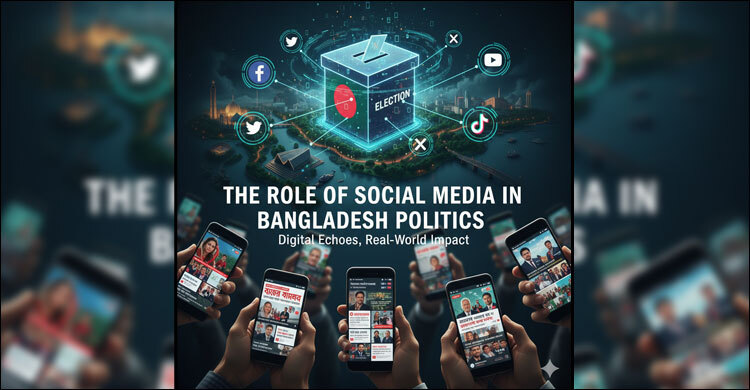
Social media powerfully shapes political discourse in Bangladesh, amplifying both accountability and misinformation. Distrust in leaders—fuelled by broken promises and self-interest—drives citizens, especially youth, to rely on online narratives. To restore faith, the government must act transparently and uphold national values. Used responsibly, social media can strengthen democracy; misused, it deepens division. Ethical leadership and public engagement are vital for national unity and progress, writes Dr HL Neel Wasantha and Md Amran Hossain.
The Role of Social Media in Bangladesh Politics
Social media has become a powerful force in shaping public attitudes and perceptions in Bangladesh, as it has in many other countries. Political parties now routinely use digital platforms for extensive propaganda—both before and after elections. Much of the content shared lacks credible evidence or official verification, resembling sensationalised “newsy marketing” rather than factual reporting. This kind of unverified information spreads rapidly, particularly among Generation Z, who often accept it at face value without critical scrutiny.
Because social media allows both official and unofficial sources to publish content indiscriminately, it has become a fertile ground for the circulation of premeditated narratives and outright disinformation. YouTube channels, for instance, frequently host discussions featuring self-proclaimed “experts” or commentators who offer predictions and political analysis that quickly go viral—especially among young audiences. Over time, this has eroded public trust in traditional institutions, including the government. Even official announcements are met with scepticism, largely because successive administrations have failed to build credibility through transparent and consistent governance.
Rather than focusing on improving citizens’ living standards, many politicians appear driven by personal or partisan agendas. When voters sense that a government is shifting its priorities away from its electoral promises, they naturally resist. Broken commitments—such as unfulfilled pledges on development, reform, or accountability—trigger public outrage and demands for answers. In response, authorities sometimes attempt damage control, but if inconsistencies persist, citizens increasingly turn to social media to expose alleged corruption, mismanagement, or hypocrisy.
This cycle has led to widespread disillusionment. The public no longer trusts either government statements or the political class as a whole, perceiving most leaders as motivated solely by self-preservation or party survival. When people see no tangible improvement in their daily lives, they conclude that those in power are not working for the nation’s welfare.
As rational beings, citizens absorb information through their senses and lived experiences. When they witness a disconnect between official rhetoric and on-the-ground reality, they respond—often by questioning authority. This right to question and critique is enshrined in international human rights principles. Yet, some authorities suppress dissent, further deepening the trust deficit. In such an environment, people increasingly rely on peer-shared content on social media, especially messages that resonate emotionally or reflect their own experiences. This marks a critical turning point: social media is no longer just a communication tool but a catalyst for shifting political consciousness.
For any government to regain public confidence, it must deliver on its promises—not merely repeat them. Repeating the mistakes of past administrations will inevitably invite the same backlash. To rebuild trust, leaders should use media platforms to discuss concrete plans for improving education, healthcare, economic opportunity, and social cohesion. They must also respectfully engage with the nation’s core values—its history, cultural identity, and religious traditions—rather than undermining them. When citizens see genuine commitment to national welfare, they are more likely to believe in the government’s intentions.
Conversely, when politicians disparage their own culture, faith, or social norms—as some have done in pursuit of short-term political gain—it fuels public resentment and polarisation. Such actions often spark protests, strikes, and broader anti-government mobilisation, with social media acting as the organising engine.
Ultimately, social media’s influence can be harnessed for national progress—if used responsibly. It has the potential to reshape mindsets, promote civic awareness, and hold leaders accountable. But this requires collective effort: citizens, civil society, and ethical leaders must work together under a shared vision of “one nation, one people.” True leadership means prioritising the country’s long-term development over personal ambition.
If the government deliberately misleads the public, social media can—and will—become a tool of democratic resistance. Conversely, if used wisely, it can foster unity, transparency, and national renewal. The path forward demands courage, integrity, and a shared commitment from both leaders and citizens to build a Bangladesh that reflects their collective aspirations.
Dr HL Neel Wasantha is a senior lecturer of Management Science at Uva Wellassa University, Sri Lanka, and Md Amran Hossain is a MBM student at University of Kelaniya, Sri Lanka.