
More than a catastrophe, says Krasznahorkai in his first reaction

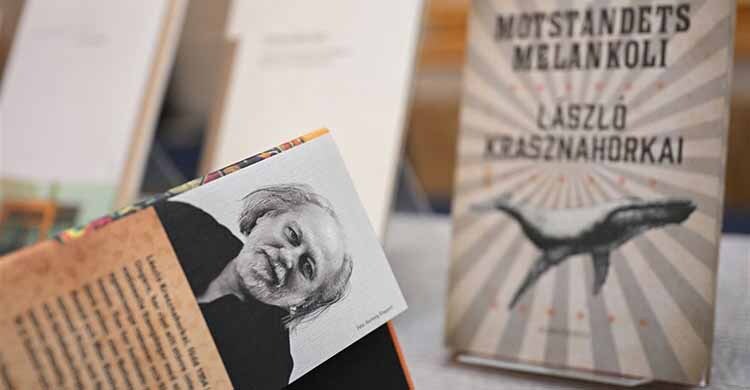
When the call came from Stockholm, László Krasznahorkai was not in a grand study or surrounded by reporters. He was sitting quietly in the Frankfurt apartment of a sick friend he had come to visit — an ordinary day that suddenly turned extraordinary.
“Hello, this is Janian from the Nobel Prize,” came the voice on the other end of the line.
“Yes,” Krasznahorkai replied, almost cautiously. Moments later, he was told that he had just been awarded the 2025 Nobel Prize in Literature.
His reaction? “This is more than a catastrophe,” he said with a laugh — a wry nod to Samuel Beckett, who famously described his own Nobel win with the same word.
“Beckett’s first words were, ‘What a catastrophe,’” Krasznahorkai explained. “That’s why I said this is more than a catastrophe. It is happiness and pride. I am very happy and proud to be in the line of so many great writers and poets.”
“To use my little language”
The Hungarian novelist, known for his dense, lyrical prose and haunting portrayals of moral and spiritual decay, reflected on the honour with humility.
“It gives me power to use my original language — the Hungarian language,” he said. “I am really very proud and happy to use this little language.”
In his measured yet poetic cadence, Krasznahorkai extended gratitude to his readers and offered a plea for imagination in difficult times.
“I thank the readers first of all. And I wish everyone could get back the ability to use their fantasy. Without fantasy, life is absolutely different. To read books and to enjoy them makes us richer, and it gives us more power to survive this very difficult time on Earth.”
A moment of disbelief
The novelist admitted that the news caught him completely off guard.
“I cannot believe it slowly — that I am a Nobel Prize winner,” he said softly. “I was absolutely surprised.”
Krasznahorkai, who divides his time between Hungary, Trieste, and Vienna — “the old Austro-Hungarian monarchy,” as he described it — often shuns public attention. The award, he suggested, will not change his quiet routines.
“I live on top of a hill near Buda, and sometimes in Trieste and Vienna,” he said. “This is my life.”
On writing and survival
For a writer often described as a master of apocalyptic vision, Krasznahorkai’s reflections on his creative process were intimate and restrained.
“Writing is my private thing,” he said. “I never speak about what I write, and I never show my manuscripts to other writers or poets. After I finish a book, I give it to my publisher. Then I take some time — and one day, I start again, to make it better than before.”
When asked about his greatest source of inspiration, his answer was characteristically grave: “Bitterness. I am very sad when I think about the state of the world now. That sadness is my deepest inspiration — the human being now, and until now. This can also be an inspiration for the next generation, to survive this very dark time. We need much more power in us to survive than before.”
A modest celebration
As for how he planned to celebrate his Nobel triumph, Krasznahorkai chuckled.
“I was actually planning to go to the administration office to register my new postal address in Germany,” he said. “But after this fantastic news, I can’t focus on that. Maybe in the evening, we will have dinner with my friends here in Frankfurt — with port wine and champagne.”
Before hanging up, he thanked the caller once again, his voice filled with quiet warmth.
“Thank you so much. You are very kind,” he said, before signing off simply: “Goodbye.