
The timeless giant of Feni: 410-year-old ‘megh shirish’ that breathes history

Published: 30 October 2025, 06:31 PM
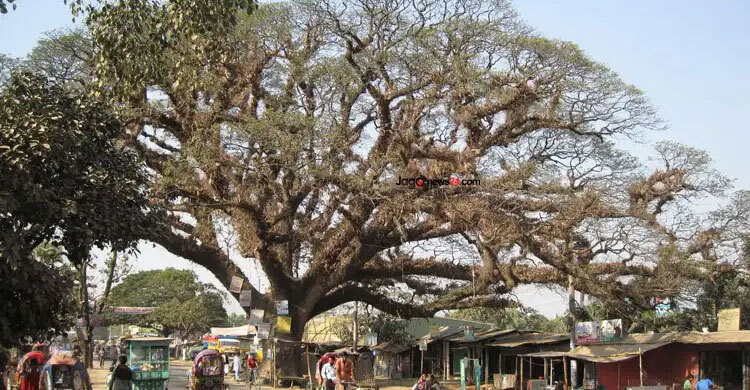
On the historic Grand Trunk Road in Feni, a colossal tree rises above the noise of passing vehicles – its sprawling canopy whispering centuries-old tales.
Locals call it Megh Shirish, though some still fondly refer to it as the Karai tree. For more than four centuries, this magnificent rain tree has stood tall, a silent witness to the passage of time, empires, and generations.
Perched beside the Daudpur Bridge on the Feni-Sonagazi road, the tree’s immense branches stretch across the sky like a green umbrella. As sunlight filters through its layered leaves, the air beneath feels cool – almost sacred. Every day, birds flock to its branches, nesting, chirping, and carrying on the ancient rhythm of life it has sustained for over 410 years.
A living witness of history
The story of Megh Shirish dates back to the time of Sher Shah Suri, who between 1540 and 1545 built the Sadak-e-Azam – today known as the Grand Trunk Road. These routes were lined with shade trees to provide rest for travellers journeying by horse and cart. While most of those trees have vanished, the Megh Shirish of Feni endures, a living relic of that era.
According to the National Information Portal, this tree holds a special place in Feni’s heritage. It is said that poet Nabin Chandra Sen, who once served as a sub-district administrator, used to sit beneath its shade and compose poetry – perhaps inspired by the quiet majesty of the centuries-old giant.
Nature’s rain gauge
Scientifically known as the rain tree (Samanea saman), Megh Shirish is believed to have originated in the tropical forests of Mexico and Brazil. It likely arrived in Bengal through Portuguese traders. The name “Megh Shirish” – meaning “cloud tree” – stems from its peculiar behaviour: its leaves fold inward when clouds gather, almost predicting rain. Locals also note that the ground beneath the tree is often damp even without rainfall – earning it the English name “Rain Tree.”
Towering between 50 and 80 feet, the tree’s crown forms a massive, dome-like canopy. In 2022, students from Feni Government College measured its trunk – an astonishing 7.3 metres in diameter.
A heritage worth protecting
Years ago, more than two hundred locals formed a human chain to demand official recognition and protection of the Megh Shirish. They declared it a symbol of Feni’s heritage and successfully campaigned to make the tree “advertisement-free” — ending years of neglect where posters and banners were nailed into its bark.
“We’ve heard countless stories about this tree from our ancestors,” said Shahid Ullah, a lifelong resident of the area. “Travellers used to rest beneath it, and the locals would offer them food and water. It was more than a tree — it was part of our way of life.”
Even now, the area’s older residents recall its past vividly. “My grandfather saw this tree just as it stands today,” said Rahman Mia of Ukilpara. “They said it was planted during Sher Shah’s time. It’s like a piece of living history.”
A fragile ecosystem
Over the years, the tree has supported countless smaller plants and bird species. Associate Professor Md Mosharraf Hossain Milon of the Botany Department at Feni Government College explained that fern-like plants, such as the bird’s nest fern, grow naturally on its branches — providing homes for birds and small creatures.
“Sadly, during cleaning efforts, many of these ferns were removed, destroying the habitats of nesting birds,” he said. “People often forget that a tree is not just wood and leaves — it’s an entire ecosystem.”
The tree that outlived empires
Under its mighty canopy, traders once rested, poets found inspiration, and families shared stories. Empires rose and fell, rivers shifted course, and the Grand Trunk Road evolved from a horse path to a busy modern highway. Yet the Megh Shirish still stands — its roots deep in the soil of Feni, its branches stretched toward the horizon.
For locals, it is not merely a tree. It is memory, history, and identity — all wrapped in green.