
A house of history: The 130-year-old home carrying Zia’s legacy

Published: 24 December 2025, 09:49 PM
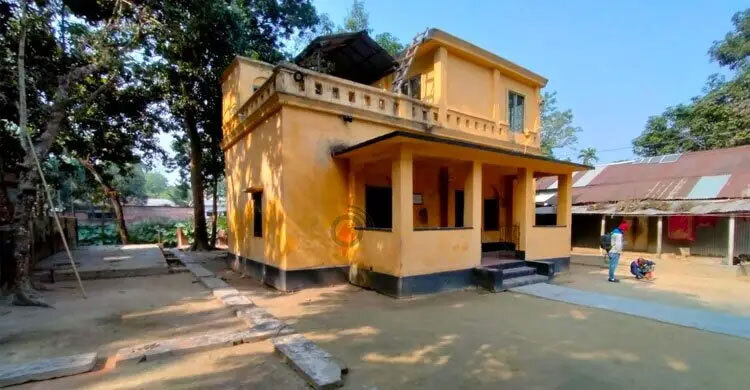
In northern district of Bogura lies the serene village of Bagbari in Gabtali Upazila, where time seems to move at a gentler pace. Here, amid lush green fields and the rhythmic hum of rural life, stands a modest yellow two-storey house that has silently borne witness to over a century of personal and national history.
Known affectionately to locals as 'Zia Bari', this 130-year-old ancestral home was the birthplace and childhood refuge of Ziaur Rahman, the martyred president whose voice echoed across the airwaves in 1971 to declare Bangladesh's independence, igniting the final push towards liberation.
Approaching Bagbari today, one is struck by the subtle transformation of the surroundings. The once-dusty, potholed road leading to the house has been reborn through a recent project by the Local Government Engineering Department (LGED), completed at a cost of approximately Tk 2 crore.
Smooth carpeting now covers the path, flanked by elegant tall pillars and modern solar lights that bathe the area in a soft, ethereal glow after sunset. This infrastructure upgrade, part of broader rural development initiatives, has breathed new life into the village, making it more accessible and visually appealing. Locals speak of how, for nearly 17 years, the road received little attention, turning journeys into ordeals during the rainy season.
Now, as resident Amir Ali notes, "It has become beautiful; people from outside are coming, and a new vitality has come to the area."
Yet, contrasting sharply with this modernity, 'Zia Bari' itself remains a deliberate anachronism – a preserved relic that the family has steadfastly guarded against overzealous renovation.
Built in 1895 as a single-storey pucca structure, its age is proudly proclaimed by an inscription on the western wall: '22nd Asharh 1302’, 1895 in Gregorian calendar. A second floor was added in 2002 during the BNP government's tenure, but beyond that, changes have been minimal. The original windows, doors, staircases, and layout endure, with caretakers diligently sweeping the yard, repainting walls as needed, and maintaining the wooden elements without altering the house's soul.
Inside, the atmosphere is one of quiet nostalgia. A handful of furniture pieces from Ziaur Rahman's early years still occupy their places: a simple bed, a dressing table, a sofa, and other everyday items that evoke the unpretentious lifestyle of a rural Bengali homestead in the 1930s. More fragile heirlooms, such as the buttoned mosquito net from his childhood bed and antique glassware from the zamindar era, have been prudently relocated to a museum in Chattogram to safeguard them from potential damage. The family explains this as a necessary step to protect irreplaceable artefacts while keeping the house livable and authentic.
The story of 'Zia Bari' is inextricably linked to the remarkable journey of Ziaur Rahman himself. Born on January 19, 1936 in this very house, he was the second son of Mansur Rahman and Jahanara Begum. His grandfather, Kamal Uddin Mandal, had settled in Bagbari after marrying into a local landowning family, inheriting substantial property that allowed the family to put down permanent roots. Fondly nicknamed 'Kamal' within the family circle – a name that nodded to his grandfather – young Zia spent his formative years here, playing in the open spaces, attending the local Bagbari High School up to Class 3, and absorbing the values of resilience and community that would define his later life.
Family lore recounts how Zia's father, a chemist by profession, relocated to Kolkata and then Karachi (in undivided Pakistan) for work, separating the boy from his beloved village for many years. It was only after he rose to prominence – first as a valiant sector commander in the 1971 Liberation War, where his radio broadcast from Kalurghat in Chittagong proclaimed independence on behalf of Bangabandhu Sheikh Mujibur Rahman, and later as President from 1977 to 1981 – that he returned to Bagbari.
Those visits stirred immense emotion among villagers and relatives, who had long awaited a glimpse of their hometown hero.
Beyond the house itself, the grounds tell their own tales. A traditional pond with a bathing ghat sits behind the building, a remnant of classic rural architecture designed for daily utility and leisure. To the east runs a canal, personally commissioned by President Zia to aid local irrigation – a practical legacy that continues to nourish farmlands to this day. In front, a spacious courtyard retains its original expanse, inviting reflection on simpler times.
The family's commitment to preservation stems from a deep sense of duty. As Rafiqul Islam, a close associate, puts it: "This is not merely a house; it is a sanctuary of emotion and history. We have repainted walls and repaired roofs as required, but never compromised its originality. We resist distortion or commercial exploitation." He adds that state stewardship could bring more structured care, ensuring longevity without losing character.
This sentiment echoes among locals and visitors. Nashipur Union Chairman Rokon Talukder observes that while 'Zia Bari' is not yet part of a major government project, growing visitor numbers and infrastructure improvements signal potential for balanced development. Recent environmental efforts by the forest department – planting shade and flowering trees along the upgraded road – promise to enhance the area's aesthetics further, creating a greener corridor that complements the historical site.
Visitors often arrive with expectations shaped by grander memorials elsewhere, only to be charmed by the simplicity.
One such traveller, Monir Hossain from Dhunat, shared: "I imagined a large museum, but its understated preservation appealed to me greatly. Adding information boards about the history would help educate the younger generation." Many agree that interpretive signage, perhaps detailing Zia's early life, his military career, and his contributions to multi-party democracy and economic reforms, could enrich the experience without overwhelming the site's intimacy.
Elderly resident Sadek Ali captures the broader hope: "This house has witnessed our nation's story. Government preservation would allow all Bangladeshis to benefit from its lessons." Indeed, in an era where historical sites risk either neglect or over-commercialisation, 'Zia Bari' offers a model of restraint – a place where history breathes freely, unadorned.
As Bangladesh strides forward in the 21st century, with its villages gradually embracing solar power, paved roads, and connectivity, sites like this serve as vital anchors. They remind us of the humble origins of leaders who shaped the nation, of the blend between personal memory and collective heritage. On a quiet evening in Bagbari, as solar lights flicker on and shadows lengthen across the courtyard, 'Zia Bari' stands not as a relic frozen in time, but as a living testament to endurance, authenticity, and the quiet power of roots.
In a country rich with liberation narratives and political legacies, this unassuming house in Bogura invites us to pause, reflect, and appreciate how the past, carefully tended, continues to illuminate the path ahead. Whether through family vigilance or future public initiatives, its story – and that of the boy once called Kamal who grew to lead a nation – deserves to endure for generations to come.