
Words, dreams and state power: The phrases people believed before voting

In electoral politics, words often arrive before policies. Long before ballot boxes are sealed and votes are counted, slogans travel through streets, social media feeds and tea stalls, shaping expectations and emotions.
A campaign theme is never just a sentence – it is a compressed political promise, a mirror of public mood and, at times, a shortcut to history.
As Bangladesh moves towards its next general election, slated for February 12, 2026, parties are once again searching for the right words to capture a restless electorate. Inflation, governance, political trust and the future of democracy loom large. In such moments, campaign language becomes crucial.
History shows that the most memorable election campaigns share three defining traits: simplicity, emotional resonance and relevance to the political moment.
Across the world, certain slogans have not only won elections but also reshaped political communication itself.
When hope became a movement
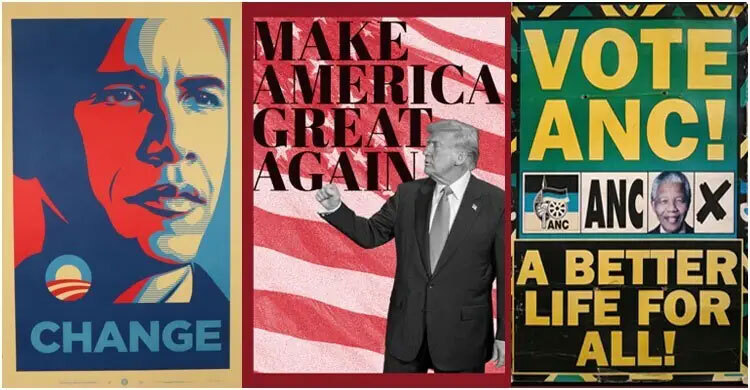
‘Yes We Can’, ‘Change’, ‘Hope’
Barack Obama, United States (2008)
Few campaign themes have aged as gracefully as Barack Obama’s. In 2008, “Yes We Can” was more than optimism—it was an invitation. At a time of economic crisis and war fatigue, Obama’s language suggested collective action rather than heroic leadership. Young voters, minorities and first-time participants felt personally addressed.
What made the slogan powerful was its openness. It did not prescribe a single solution; instead, it allowed voters to project their own aspirations onto it. Modern political branding – from typography to social media storytelling – took a new turn after Obama.
For Bangladesh, where youth voters form a large demographic, such inclusive messaging remains a lesson worth revisiting.
Nostalgia as a political weapon
‘Make America Great Again’
Donald Trump, United States (2016)
Donald Trump’s slogan proved that controversy can be a strategy. “Make America Great Again” fused nostalgia with grievance, offering a return to an imagined past. It was polarising, emotionally charged and deliberately simple.
Politically, it worked because it tapped into anxiety – economic insecurity, cultural displacement and distrust of elites. The lesson is uncomfortable but clear: emotion often outweighs nuance in mass politics.
As Bangladesh’s political discourse grapples with questions of national pride, sovereignty and economic self-worth, nostalgia-based messaging is likely to reappear – though with local adaptations.
One issue, one election
‘It’s the Economy, Stupid’
Bill Clinton, United States (1992)
Interestingly, one of the most influential campaign themes was never meant for the public. Coined by strategist James Carville, this internal memo reminded Clinton’s team to stay focused on economic concerns.
The phrase leaked into public discourse through media repetition and became shorthand for Clinton’s entire campaign. It demonstrated a key principle: clarity of focus beats rhetorical excess.
With cost of living and employment dominating conversations in Bangladesh today, any party that successfully frames the election as a referendum on everyday economics may gain a strategic edge.
A sentence that toppled a government
‘Labour Isn’t Working’
Conservative Party, UK (1979)
Sometimes, a slogan succeeds by accusation rather than aspiration. The British Conservatives’ stark message blamed the ruling Labour government for unemployment and stagnation. Paired with a powerful visual, it cut through policy debates and directly attacked credibility.
This campaign played a decisive role in Margaret Thatcher’s rise. It also showed how negative framing, when aligned with public frustration, can be electorally devastating.
In Bangladesh, where opposition parties often struggle to convert criticism into momentum, this example underlines the importance of concise political storytelling.
Personality becomes the message
‘Ab Ki Baar, Modi Sarkar’
Narendra Modi, India (2014)
“This time, Modi government” signalled a shift in Indian politics. The slogan centred not on ideology but on leadership. Narendra Modi’s personal story, administrative image and promise of decisive governance became inseparable from the campaign message.
The success of this theme revealed a broader trend: voters increasingly relate to faces rather than manifestos.
As Bangladesh heads into 2026, personality-driven campaigns – whether built around continuity or change – are likely to dominate the political landscape.
Strength in uncertain times
‘Strong and Stable Leadership’
Theresa May, United Kingdom (2017)
Crafted during post-Brexit uncertainty, this slogan aimed to project reassurance. Ironically, its repetition later invited satire, especially after May lost her parliamentary majority.
The episode highlights a risk: slogans that overpromise can collapse under real-time political events. Credibility matters as much as confidence.
Faith, nation and politics
‘Brasil Acima de Tudo, Deus Acima de Todos’
Jair Bolsonaro, Brazil (2018)
“Brazil above all, God above all” blended nationalism with religious identity. The slogan resonated strongly with conservative voters who felt culturally marginalised.
This theme demonstrated how moral language can mobilise deeply loyal constituencies – though often at the cost of social polarisation. In South Asia, where faith and politics frequently intersect, such messaging remains powerful but sensitive.
Beyond old party lines
‘En Marche!’
Emmanuel Macron, France (2017)
Meaning “Move on,” Macron’s slogan symbolised momentum and rupture with traditional politics. It functioned both as a party name and a campaign call, suggesting action over ideology.
In contexts where voters feel trapped between familiar rivals, messages of renewal and forward movement can be particularly effective – an idea relevant to Bangladesh’s often binary political environment.
Reinventing a party
‘New Labour, New Britain’
Tony Blair, United Kingdom (1997)
This slogan was about reinvention. Blair used it to distance Labour from its past while reassuring middle-class voters. It proved that rebranding, when credible, can transform electoral fortunes.
A promise after oppression
‘A Better Life for All’
Nelson Mandela, South Africa (1994)
Few slogans carry as much historical weight. After apartheid, Mandela’s message was deliberately inclusive – avoiding revenge, emphasising unity and hope.
It worked because it aligned perfectly with the moment. Voters were not just choosing a government; they were choosing a future.
Bangladesh 2026: searching for the right words
As Bangladesh approaches the February 12, 2026 general elections, the battle of slogans has quietly begun. Will the dominant themes be stability or change? Economy or democracy? Identity or opportunity?
History suggests that the winning words will not be the most poetic, but the most believable. In every era, successful campaign themes have reflected what people already felt but had not yet articulated.
In the end, elections are decided not only by votes – but by the words that shape them.