
Kim’s ‘monster missile’ debut: N korea flaunts ‘most powerful’ weapon

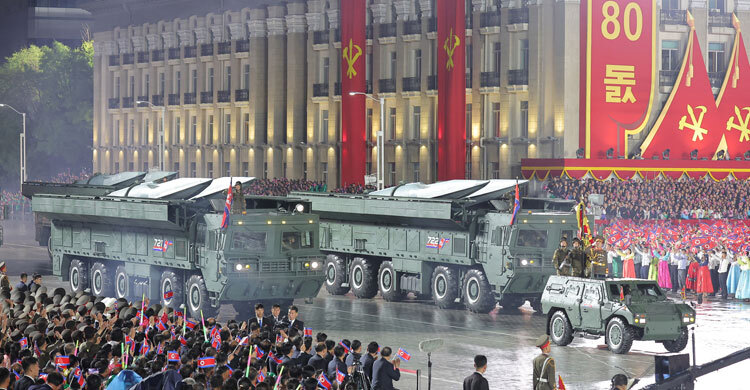
North Korea unveiled what it claims is its “most powerful” intercontinental ballistic missile (ICBM), the Hwasong-20, during a grand military parade in Pyongyang marking the 80th anniversary of the ruling Workers’ Party of Korea (WPK).
The event was presided over by leader Kim Jong Un and widely covered by the state-run Korean Central News Agency (KCNA).
Held on Friday evening, the parade showcased an array of advanced weaponry, including long-range strategic cruise missiles and drone launch vehicles. However, the centrepiece was the debut of the Hwasong-20 ICBM, mounted on an imposing 11-axle transporter-erector-launcher. KCNA hailed it as the military’s “most powerful nuclear strategic weapon system.”
The missile’s existence had only been hinted at in recent weeks, following North Korean tests of a new solid-fuel rocket engine constructed with carbon fibre. According to state media, the engine generates 1,971 kilonewtons of thrust—surpassing the power of earlier North Korean rocket engines—and is designed for a new generation of ICBMs.
“The Hwasong-20 represents, for the moment, the apotheosis of North Korea’s ambitions for long-range nuclear delivery capabilities,” said Ankit Panda of the Carnegie Endowment for International Peace. “We should expect to see the system tested before the end of this year.”
While the Hwasong series has already demonstrated the potential to reach distant targets, experts continue to question the sophistication of its guidance systems and whether its warheads can reliably survive atmospheric re-entry. Analysts believe the Hwasong-20 may be engineered to carry multiple independently targetable nuclear warheads—a capability Kim Jong Un has publicly urged his military to develop to overcome missile defences.
“Multiple warheads will increase stresses on existing US missile defence systems and augment what Kim sees as necessary to achieve meaningful deterrence against Washington,” Panda explained.
In a speech following the parade, Kim declared North Korea a “faithful member of socialist forces” and a “bulwark for independence” against Western hegemony. “Today, we stand before the world as a mighty people with no obstacles we cannot overcome and no great achievement we cannot accomplish,” he said, according to KCNA.
The event drew high-level foreign attendance, including Dmitry Medvedev, deputy head of Russia’s Security Council and a close ally of President Vladimir Putin. Russian state media reported that Medvedev thanked North Korea for its support of Russia’s military campaign in Ukraine, referring to it as a “special military operation.”
“The nature of relations between people and between countries is revealed during times of trial,” Medvedev wrote on the Russian social media platform Max. “This fully applies to the alliance between our countries. We are grateful to the Democratic People’s Republic of Korea for its steadfast support… Our soldiers stood shoulder to shoulder to liberate the Kursk region. This feat will forever remain in our hearts.”
In response, Kim expressed his desire to deepen cooperation with Russia and expand exchanges across multiple domains to achieve shared strategic objectives, KCNA reported.