
Trump declares Venezuelan airspace 'closed' amid fears of invasion

In a stark escalation of the spiralling confrontation between Washington and Caracas, US President Donald Trump has ordered the airspace over and around Venezuela to be treated as "closed in its entirety".
The declaration, posted on his Truth Social platform, comes amid the largest US military deployment in the Caribbean in decades, raising alarms of imminent conflict and drawing sharp rebukes from Latin American leaders and international observers.
"To all Airlines, Pilots, Drug Dealers, and Human Traffickers, please consider THE AIRSPACE ABOVE AND SURROUNDING VENEZUELA TO BE CLOSED IN ITS ENTIRETY," Trump wrote, signing off with his full name for emphasis.
The post, issued on Saturday, offered no further details but followed a week of intensifying rhetoric, including Trump's designation of the so-called Solis Cartel – alleged to be led by Venezuelan President Nicolás Maduro – as a "narco-terrorist organisation".
The announcement has sent shockwaves through global aviation networks. Major carriers, already reeling from a US Federal Aviation Administration (FAA) advisory last week warning of a "potentially hazardous situation" due to "worsening security and heightened military activity", have rerouted flights around Venezuelan territory.
Venezuela's response was swift and punitive: on Wednesday, its civil aviation authority revoked operating permits for six international airlines – Spain's Iberia, Portugal's TAP, Colombia's Avianca, Chile- and Brazil-based LATAM, Brazil's Gol, and Turkish Airlines – accusing them of aligning with "state terrorism promoted by the United States government".
Marisela de Loaiza, president of Venezuela's Airlines Association, confirmed that flights to the country were suspended from November 24 to 28, leaving Simón Bolívar International Airport in Caracas operating on a skeleton schedule of just seven departures and arrivals daily. "This is economic warfare disguised as safety concerns," she said, highlighting the FAA's lack of jurisdiction over sovereign airspace. The International Air Transport Association (IATA) has urged Venezuelan authorities to reverse the bans, warning of further isolation for a nation already plagued by economic sanctions and hyperinflation.
A powder keg in the Caribbean: US Forces mass for 'Land Offensive'
Trump's airspace edict caps a months-long military surge that analysts describe as the most aggressive US posture in Latin America since the 1989 invasion of Panama.
Since early September, US forces have conducted over 20 airstrikes on alleged drug-smuggling vessels in the Caribbean Sea and eastern Pacific Ocean, claiming to have neutralised more than 80 individuals – though critics, including Latin American leaders and US congressional Democrats, decry the operations as "extrajudicial killings" targeting innocent fishermen rather than traffickers.
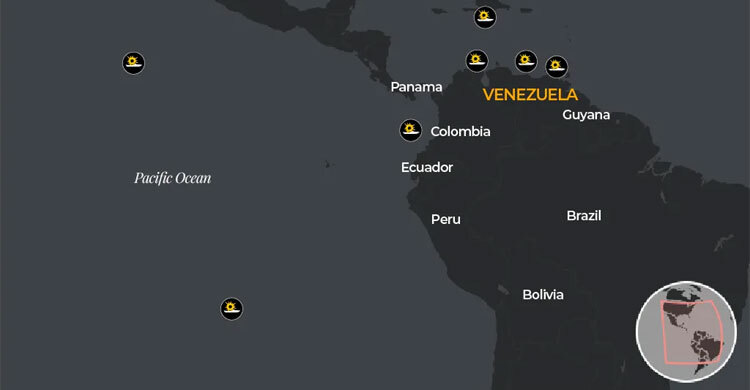
The build-up, framed by the Trump administration as a counter-narcotics offensive, has seen 10,000 US troops, fighter jets, and support vessels converge on the region. Key assets include:
• USS Gerald R. Ford Carrier Strike Group: The world's largest warship, carrying over 75 aircraft including F/A-18 Super Hornets, helicopters, and early-warning planes, docked in the southern Caribbean last month. Accompanied by destroyers USS Winston S. Churchill and USS Mahan, it represents a floating fortress capable of projecting power deep into Venezuelan territory.
• Puerto Rico as Forward Base: Around 5,000 troops, including elite units from the 160th Special Operations Aviation Regiment, have turned the US territory into a staging ground. Ten F-35 stealth fighters and three MQ-9 Reaper drones are now operational there, alongside B-52 bombers conducting "attack demonstration" flights near Venezuela's coast.
• Broader Naval Presence: A nuclear-powered fast-attack submarine and additional warships, including a Navy destroyer berthed in Trinidad, have bolstered the flotilla. Pentagon documents reviewed by The Intercept indicate plans to sustain this presence through 2028, with contracts for troop sustenance and logistics extending into Trump's term.
White House officials insist the operations target the "Cartel de los Soles" – a shadowy network purportedly run by Maduro and high-ranking Venezuelan officials – but have provided scant evidence. On Monday, Trump hinted at expansion: "We've almost stopped [drug trafficking] by sea – it's about 85% done. The land is easier, but that's going to start very soon." This has fuelled speculation of ground incursions, with reports of CIA authorisation for lethal operations inside Venezuela.
Maduro's defiant stand: Mobilisation and calls for 'peace, not war'
Venezuela, with its military estimated at 125,000 active personnel – many under-equipped amid economic collapse – has responded with a massive show of force. Defence Minister Vladimir Padrino López announced a "massive mobilisation" of nearly 200,000 troops, including reservists from the Bolivarian Militia, across land, sea, air, and missile units. "This is the Independence Plan 200 in action," he declared, activating air-defence systems and deploying over 5,000 Russian-made Igla-S man-portable missiles to coastal positions.
President Maduro, speaking in a remixed address on Friday – blending footage from past speeches to evade US sanctions on state media – urged "peace, not war" while lambasting Trump's moves as "excuses and lies to justify intervention". "They fabricate a new eternal war against us," he said, denying involvement in drug trafficking and accusing Washington of eyeing Venezuela's vast oil reserves. Maduro's government has raised its armed forces to maximum alert, conducting drills in Caracas shantytowns and border states, while state television broadcasts propaganda portraying the US as an "imperialist aggressor".
Unconfirmed reports suggest a recent phone call between Trump and Maduro, where the US president reportedly pushed for a face-to-face summit. The New York Times cited sources claiming the leaders discussed de-escalation, though both sides have denied details. Venezuelan opposition figures, including exiled leader María Corina Machado, have decried Maduro's brinkmanship as a ploy to consolidate power, warning it invites catastrophe.
Source Al Jazeera