
Zelenskyy hints at dropping NATO membership plans

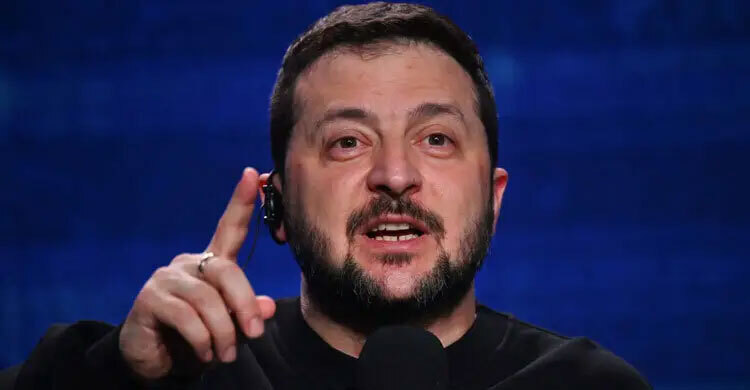
Ukraine’s President Volodymyr Zelenskyy has indicated that Kyiv is prepared to drop its long-held ambition of joining NATO in exchange for Western security guarantees, as he held meetings with US envoys and European allies in Berlin.
The talks on Sunday came amid pressure from US President Donald Trump to reach a settlement. Trump’s envoy Steve Witkoff and his son-in-law Jared Kushner arrived in the German capital city of Berlin on Sunday for discussions involving Ukrainian and European representatives.
Ahead of the talks, Zelenskyy described the proposal on Sunday as a concession by Kyiv, after years of pressing for NATO membership as the strongest deterrent against future Russian attacks. He said the United States, European partners and other allies could instead provide legally binding security guarantees.
“From the very beginning, Ukraine’s desire was to join NATO; these are real security guarantees. Some partners from the US and Europe did not support this direction,” Zelenskyy said in response to questions from reporters in a WhatsApp chat.
“Thus, today, bilateral security guarantees between Ukraine and the US, Article 5-like guarantees for us from the US, and security guarantees from European colleagues, as well as other countries – Canada, Japan – are an opportunity to prevent another Russian invasion,” he said.
“And it is already a compromise from our part,” Zelenskyy added, stressing that such guarantees must be legally binding.
The shift would mark a significant change for Ukraine, which has long sought NATO membership despite Moscow viewing the alliance’s expansion as a threat.
While the move aligns with one of Russia’s stated war objectives, Kyiv has continued to reject demands to cede territory.
Zelenskyy said he was seeking a “dignified” peace and firm assurances that Russia would not launch another attack, as diplomats gathered to discuss what could become Europe’s deadliest conflict since World War II. He also accused Moscow of prolonging the war through sustained attacks on Ukrainian cities and critical infrastructure.
After Sunday’s talks, Witkoff said “a lot of progress was made”.
Zelenskyy’s adviser Dmytro Lytvyn said the president would comment on the talks on Monday once they were completed. Officials, Lytvyn said, were considering the draft documents.
“They went on for more than five hours and ended for today with an agreement to resume tomorrow morning,” Lytvyn told reporters in a WhatsApp chat.
Pressure to reach a settlement
The decision to send Witkoff, who has previously led negotiations with both Kyiv and Moscow, suggested Washington saw scope for progress.
Germany’s Defence Minister Boris Pistorius said it was a “good sign” Trump had sent his envoys while fielding questions in an interview with the ZDF broadcaster on the suitability of Witkoff and Kushner, two businessmen, as negotiators.
“It’s certainly anything but an ideal setup for such negotiations. That much is clear. But as they say, you can only dance with the people on the dance floor,” Pistorius said.
On the issue of Ukraine’s offer to give up its NATO aspirations in exchange for security guarantees, Pistorius said Ukraine had bitter prior experience of relying on security assurances. Kyiv had in 1994 agreed to give up its Soviet-era nuclear arsenal in exchange for territorial guarantees from the US, Russia and Britain.
“Therefore, it remains to be seen to what extent this statement Zelenskyy has now made will actually hold true, and what preconditions must be met,” Pistorius said.
“This concerns territorial issues, commitments from Russia and others,” he said, adding mere security guarantees, especially without significant US involvement, “wouldn’t be worth much.”
Zelenskyy said Ukraine, Europe and the US were also reviewing a 20-point plan that could culminate in a ceasefire, though he reiterated that Kyiv was not holding direct talks with Russia. He said a truce along current front lines could be considered fair, while noting that Russia continues to demand a Ukrainian withdrawal from parts of Donetsk and Luhansk still under Kyiv’s control.
Fighting on ground continues
Despite diplomatic efforts, Russian attacks have continued, leaving thousands without electricity in recent strikes. Ukrainian officials say Moscow is deliberately targeting the power grid to deprive civilians of heat and water during winter.
Fighting has also intensified in the Black Sea. Russian forces recently struck Ukrainian ports, damaging Turkish-owned vessels, including a ship carrying food supplies. An attack on Odesa set grain silos ablaze, according to Deputy Prime Minister Oleksii Kuleba. Zelenskyy said the strikes “had no … military purpose whatsoever”.
Turkish President Recep Tayyip Erdogan warned against further escalation, saying the Black Sea should not become an “area of confrontation”.
“Everyone needs safe navigation in the Black Sea,” Erdogan said, calling for a “limited ceasefire” covering ports and energy facilities. Turkiye controls the Bosphorus Strait, a vital route for Ukrainian grain and Russian oil exports.
Source: Al Jazeera