
US seizes second oil tanker off Venezuela coast

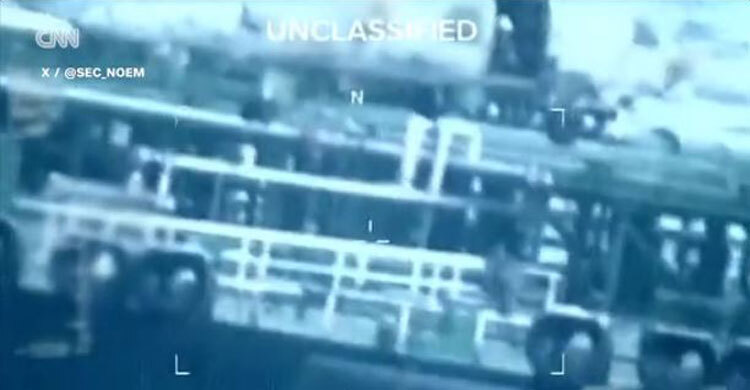
The United States has seized a second oil tanker off the coast of Venezuela, enforcing a “blockade” ordered by President Donald Trump, and prompting anger in Caracas, with officials there denouncing the move as “theft and hijacking”.
US Homeland Security Secretary Kristi Noem confirmed the interception on Saturday, saying in a post on X that the coastguard apprehended the vessel with support from the Pentagon.
“The United States will continue to pursue the illicit movement of sanctioned oil that is used to fund narco terrorism in the region,” she wrote.
“We will find you, and we will stop you,” she added.
The post was accompanied by a nearly eight-minute video of aerial footage that showed a helicopter hovering just above the deck of a large tanker at sea.
The predawn operation marked the second time in recent weeks that the US has gone after a tanker near Venezuela, and it comes amid a large US military build-up in the region. Trump, whose administration has continued to ramp up pressure on Venezuelan President Nicolas Maduro, ordered on Tuesday a “total and complete blockade” of all sanctioned oil tankers entering and leaving the South American country.
‘Act of international piracy’
The Venezuelan government called the US’s latest actions a “serious act of international piracy”.
Vice President Delcy Rodriguez said in a statement that Venezuela “denounces and rejects the theft and hijacking of a new private vessel transporting oil, as well as the forced disappearance of its crew, committed by military personnel of the United States of America in international waters”.
“These acts will not go unpunished,” she promised, adding that Venezuela will take “all corresponding actions, including filing a complaint before the United Nations Security Council, other multilateral organizations, and the governments of the world”.
Drop in Venezuelan crude exports
The United Kingdom maritime risk management company Vanguard said the seized vessel was believed to be the Panama-flagged Centuries, which was intercepted east of Barbados in the Caribbean Sea.
Jeremy Paner, a partner at law firm Hughes Hubbard in Washington, DC, told the Reuters news agency that the US has not sanctioned the vessel.
“The seizure of a vessel that is not sanctioned by the US marks a further increase in Trump’s pressure on Venezuela,” Paner said. “It also runs counter to Trump’s statement that the US would impose a blockade of all sanctioned oil tankers.”
Reuters, citing internal documents from the Venezuelan state oil company PDVSA, said Centuries was carrying some 1.8 million barrels of Venezuelan Merey crude oil bound for China.
It said the ship loaded in Venezuela under the false name “Crag” and is part of a “shadow fleet” of tankers that disguise their location to transport oil from countries sanctioned by the US.
The US actions have meanwhile caused Venezuelan crude exports to fall sharply.
In the days since US forces seized the first oil tanker off Venezuela’s coast last week, there has been an effective embargo in place, with loaded vessels carrying millions of barrels of oil staying in Venezuelan waters rather than risking seizure.
While many vessels picking up oil in Venezuela are under sanctions, others transporting the country’s oil and crude from Iran and Russia have not been sanctioned.
Some companies, particularly the US’s Chevron, transport Venezuelan oil in their own authorised ships.
Trump’s pressure campaign on Maduro has also included a ramped-up military presence in the region and more than two dozen military strikes on alleged drug trafficking vessels in the Pacific Ocean and Caribbean Sea near Venezuela, which have killed at least 100 people.
The strikes are widely considered illegal under both US and international law and have been described as extrajudicial killings by legal scholars and rights groups.
Trump has also said the US land strikes on Venezuela could follow.
‘19th-century foreign policy goals’
Maduro has said the US military build-up is aimed at overthrowing him and gaining control of Venezuela’s oil resources, which are the world’s largest crude reserves.
Adam Clements, a former US diplomat and Pentagon official, told Al Jazeera that the latest seizure was just one method for the Trump administration to try to put pressure on Maduro.
It was not clear what the Trump administration’s specific foreign policy goals were when it came to Venezuela, but it had been “hinting” recently that it sought regime change, he said.
“It’s so difficult to see if that is exactly the objective,” he said, adding that some in the Trump administration had “resurrected some 19th-century foreign policy goals” in the region.
‘Dangerous precedent’
For his part, Trump last week cited lost US investments in Venezuela when he was asked about the newest tactic in the campaign against Maduro, suggesting the Republican administration’s moves are at least somewhat motivated by disputes over oil investments.
“We’re not going to be letting anybody going through who shouldn’t be going through,” Trump told reporters. “You remember, they took all of our energy rights. They took all of our oil not that long ago. And we want it back. They took it; they illegally took it.”
While US and British companies were involved in early oil exploration in Venezuela, the fuel belongs to the Latin American country under the international law principle of permanent sovereignty over natural resources.
Venezuela nationalised its oil sector in 1976 and brought it under the control of the state-owned PDVSA.
Later, in 2007, the late left-wing President Hugo Chavez nationalised the remaining foreign oil projects in Venezuela, effectively ousting US oil giants like ConocoPhillips and Exxon Mobil.
The US’s ship interception on Saturday occurred as South American leaders gathered for a summit of the Mercosur bloc, where tensions over suspended member Venezuela overshadowed discussions of a future trade deal with the European Union.
At the gathering, Brazilian President Luiz Inacio Lula da Silva clashed with his Argentinian counterpart, Javier Milei, arguing that an outbreak of armed conflict over Venezuela could cause a “humanitarian catastrophe”.
Lula said it would set a “dangerous precedent for the world”, and that more than four decades after the Falklands War between Argentina and the United Kingdom, “the South American continent is once again haunted by the military presence of an extra-regional power”.
Milei, a Trump ally, countered by saying Argentina “welcomes the pressure from the United States and Donald Trump to free the Venezuelan people”.
Source: AL Jazeera