
Voting ends in Myanmar's first phase of 'sham' election amid violence

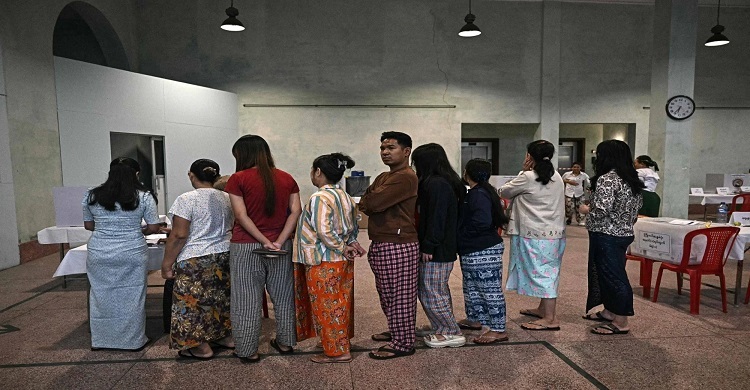
Myanmar has completed the first of three phases of voting in an election widely criticised as a “sham,” with major political parties banned, leaders imprisoned, and ongoing civil war preventing millions from participating.
The military government, nearly five years after seizing power in a coup, is conducting the phased election to consolidate control amid widespread opposition and escalating armed conflict. Observers say the junta, backed by China, seeks to legitimise its rule amid a protracted political and military stalemate.
The first round of voting was marred by explosions and airstrikes in multiple regions. In Mandalay, a rocket attack on an uninhabited house injured three people, while in Myawaddy township near the Thai border, a series of blasts damaged over ten houses, killing a child and injuring three others.
Despite the violence, some voters described the process as “disciplined and systematic.” First-time voter Ei Pyay Phyo Maung, 22, said she voted out of civic duty, hoping for leadership that supports Myanmar’s struggling population.
The junta has rejected international criticism, insisting the election will restore a multi-party democratic system. Junta chief Min Aung Hlaing cast his ballot at a heavily fortified polling station in Nay Pyi Taw, stating the election would be free and fair. He also warned that those who abstain are rejecting “progress toward democracy.”
Meanwhile, prominent figures including film director Mike Tee, actor Kyaw Win Htut, and comedian Ohn Daing have been sentenced to seven years in prison under a law criminalising opposition to the elections, enacted in July.
UN Special Rapporteur Tom Andrews condemned the polls, stating, “An election organised by a junta that continues to bomb civilians, jail political leaders, and criminalise all forms of dissent is not an election – it is a theatre of the absurd performed at gunpoint.”
Voting is being conducted in three phases across 265 of Myanmar’s 330 townships, with remaining areas deemed too unstable. The next rounds are scheduled for 11 and 25 January, with results expected by the end of the month. Large parts of the country remain under opposition control, limiting turnout and undermining the election’s credibility.
Only six parties, including the military-backed Union Solidarity and Development Party, are contesting nationwide, while 40 parties, including Aung San Suu Kyi’s National League for Democracy, remain banned. Many key leaders are imprisoned or in exile.
The ongoing civil war, compounded by humanitarian crises and natural disasters, has displaced millions, killed thousands, and left Myanmar’s economy in ruins, further casting doubt on the legitimacy of the electoral process.
Source: BBC