
Markets on edge as EU puts US trade deal on ice

Global financial markets remained on alert as the European Parliament prepared to suspend approval of a US-EU trade deal agreed in July, according to sources familiar with the parliament’s international trade committee.
The suspension is expected to be announced in Strasbourg on Wednesday, marking a fresh escalation in tensions between Washington and Brussels. The move comes as former US President Donald Trump renews pressure over Greenland, threatening new tariffs at the weekend – a stance that has rattled markets and revived fears of a broader trade war.
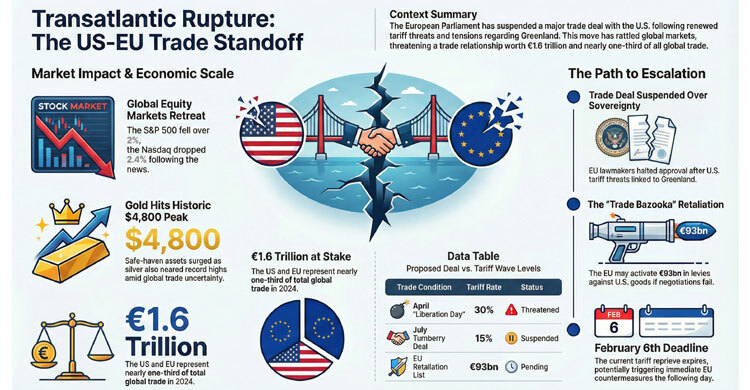
European and US stocks fell sharply on Tuesday. Major European indices posted a second straight day of losses, while in the United States the Dow Jones Industrial Average dropped more than 1.7%, the S&P 500 fell over 2% and the Nasdaq closed down about 2.4%.
Asian markets were mixed on Wednesday. Shares in Japan and Hong Kong traded slightly lower, while markets in mainland China edged higher.
Investor nerves pushed safe-haven assets higher. Gold rose above $4,800 an ounce for the first time, while silver slipped from Monday’s record high above $95 an ounce. Precious metals have surged over the past year amid heightened global uncertainty.
In currency markets, the US dollar steadied against major peers after posting its biggest single-day fall since early December, sliding 0.5% overnight.
Trade tensions had eased after the US and EU struck a deal in July at Trump’s Turnberry golf course in Scotland. Under the agreement, US tariffs on most European goods were set at 15%, down from the 30% Trump had initially threatened during his so-called “Liberation Day” tariff wave in April. In return, the EU agreed to increase investment in the US and make regulatory changes expected to boost American exports.
However, the deal still requires approval by the European Parliament.
On Saturday, hours after Trump threatened tariffs linked to Greenland, senior European lawmakers signalled the process would be halted. Manfred Weber, a leading German MEP, said approval was “not possible at this stage”.
Bernd Lange, chair of the European Parliament’s international trade committee, said there was “no alternative” but to suspend work on the deal.
“By threatening the territorial integrity and sovereignty of an EU member state and using tariffs as a coercive instrument, the US undermines the stability and predictability of EU–US trade relations,” Lange said, adding that the committee would freeze work on the legislative proposals until Washington re-engages “on a path of cooperation rather than confrontation”.
The suspension raises questions over whether the EU will revive plans to retaliate against US tariffs. Last year, the bloc identified up to €93bn worth of US goods that could face levies in response to Trump’s trade measures, but put the plan on hold while negotiations continued.
That reprieve expires on 6 February, meaning EU tariffs could take effect the following day unless an extension is agreed or the deal is approved.
French President Emmanuel Macron has urged the EU to consider retaliation, including the bloc’s anti-coercion instrument – often dubbed the “trade bazooka”.
Washington’s “endless accumulation” of tariffs is “fundamentally unacceptable, especially when used as leverage against territorial sovereignty,” Macron said at the World Economic Forum in Davos.
US warns against retaliation
US officials, also speaking in Davos, warned Europe against hitting back.
Treasury Secretary Scott Bessent urged European leaders to “take a deep breath” and avoid retaliation, saying Trump would “get his message across”.
Commerce Secretary Howard Lutnick and US Trade Representative Jamieson Greer said any EU countermeasures would be met with a response. “When countries follow my advice, they tend to do okay. When they don’t, crazy things happen,” Greer said, according to Agence France-Presse.
The US has previously expressed frustration over delays in European approval of the deal, amid lingering disputes over technology and metals tariffs.
The US and the 27-nation European Union are each other’s largest trading partners, with more than €1.6 trillion in goods and services exchanged in 2024 — nearly one-third of global trade, according to EU data.
While Trump’s tariff announcements last year prompted widespread threats of retaliation, most countries ultimately opted for negotiation. Only China and Canada followed through, with Canada later withdrawing most of its measures amid concerns over economic damage.
In Davos on Tuesday, Canadian Prime Minister Mark Carney warned that “middle powers” must unite to resist a world order shaped by coercion rather than cooperation. “This is not sovereignty,” he said. “It is the performance of sovereignty while accepting subordination.”
Adding to the uncertainty is a pending US Supreme Court decision on the legality of many tariffs imposed last year – a ruling that could further reshape the global trade landscape.
Source: BBC