
Bangladesh caught in US-China power struggle

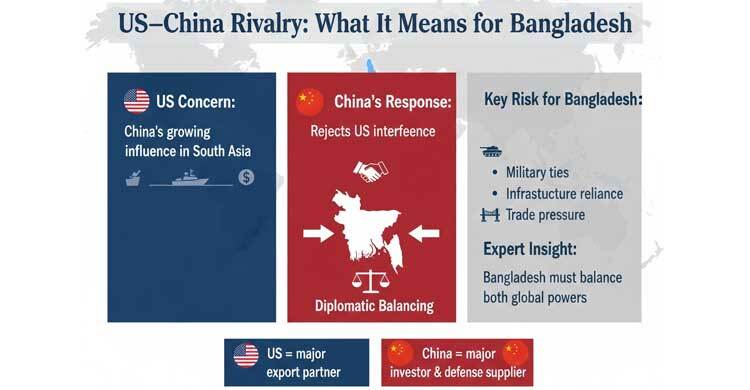
Recent remarks by newly appointed US Ambassador to Dhaka Brent Christensen and China’s sharp rebuttal have highlighted growing geopolitical tensions between Washington and Beijing, raising questions about potential implications for Bangladesh.
Although the exchange appears diplomatic on the surface, analysts believe it signals a broader strategic message for Dhaka as global competition between the two powers intensifies.
What did the US ambassador say?
Speaking to reporters last Wednesday, Ambassador Christensen expressed concern over China’s expanding influence in South Asia. He reiterated views he had previously stated during his US Senate confirmation hearing last October.
“As I said in the hearing, I am concerned about China’s overall influence in South Asia. The US position on this is clear,” he said.
He added that the United States would maintain engagement with Bangladesh regardless of whether the country is governed by an interim or elected administration.
“If the Bangladesh government chooses that path, I will clearly highlight the risks of engaging with China in certain areas,” he noted.
His comments were widely reported in the media.
China responds strongly
In response, the Chinese Embassy in Dhaka issued a strongly worded statement on Thursday, calling the ambassador’s remarks “irresponsible” and “completely baseless.”
The statement emphasised that China-Bangladesh cooperation is strictly a bilateral matter and warned against external interference, urging the United States to act more responsibly.
Military cooperation and strategic signals
During the same briefing, Ambassador Christensen also discussed defence cooperation, noting that the US already collaborates with Bangladesh in multiple areas.
He said Washington helps partner nations identify defence equipment alternatives from the US or allied countries that may better match military needs and affordability.
Dr ASM Ali Ashraf, Professor and Head of the International Relations Department at Dhaka University, views this as a significant signal, given Bangladesh’s long-standing reliance on China for military hardware.
“The United States wants to expand arms and military technology sales to Bangladesh,” he told BBC Bangla, adding that Washington often considers countries with strong military ties to China as strategic risks.
Infrastructure, investment, and economic balance
China remains one of Bangladesh’s largest investors, particularly in major infrastructure projects under the Belt and Road Initiative.
“There is no country that matches China in terms of financing large-scale infrastructure,” Professor Ashraf noted. “China has both the resources and willingness to invest.”
He argued that Bangladesh has limited alternatives in this area and must pursue a balanced diplomatic approach to maintain strong ties with both China and the United States.
The US, meanwhile, remains Bangladesh’s largest export destination and a key development and political partner, making it difficult for Dhaka to favour one side exclusively.
Pressure strategy or routine rivalry?
Former Bangladeshi Ambassador to the US M Humayun Kabir said the exchange reflects long-standing rivalry between Washington and Beijing.
“Bangladesh may face some pressure,” he said, “but effective diplomacy can help protect national interests while maintaining relations with both sides.”
Former Ambassador to China Munshi Faiz Ahmed Hamad criticised the US approach, calling it unnecessary and potentially harmful to Bangladesh’s diplomatic standing.
“There is no need to drag Bangladesh into great-power rivalry,” he said, adding that China’s reaction was justified given the circumstances.
Election context and political messaging
With national elections approaching, analysts believe the US remarks may also serve as a message to future policymakers.
“This signals to political parties and potential future governments whether they will continue close economic ties with China or reassess them under US influence,” Professor Ashraf said.
Outlook: Cautious diplomacy needed
Experts agree that the US-China rivalry is unlikely to ease soon and that Bangladesh cannot easily reduce its economic or strategic dependence on China.
However, they believe Dhaka can continue balancing its partnerships by gradually expanding cooperation with the United States while maintaining existing Chinese ties.
“If tensions escalate, especially with new US trade measures against China, the global economy, including Bangladesh, could feel the impact,” analysts warned.
Ultimately, observers say Bangladesh must exercise diplomatic caution to protect its national interests amid intensifying global power competition.