
US, Japan announce first tranche of $550 bn investments

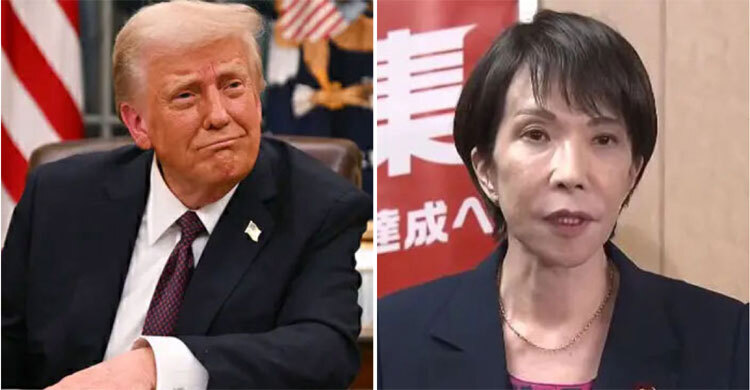
The United States announced Tuesday a first tranche of investments by Japan out of a colossal $550 billion promised by Tokyo in its trade deal with President Donald Trump.
The commitments of $36 billion for three infrastructure projects came as Japan comes under pressure to deliver on its pledges made in 2025 in return for lower US trade tariffs.
"Japan is now officially, and financially, moving forward with the FIRST set of Investments under its $550 BILLION Dollar Commitment to invest in the United States of America," Trump wrote on his Truth Social platform.
"The scale of these projects are so large, and could not be done without one very special word, TARIFFS," he wrote.
The announcement came ahead of a scheduled trip by Prime Minister Sanae Takaichi to the White House next month following Trump's visit to Japan in October.
Takaichi said Wednesday the projects would "strengthen the Japan–US alliance by enabling Japan and the United States to jointly build resilient supply chains in strategically important areas for economic security -- such as critical minerals, energy, and AI/data centers".
"We believe these initiatives truly embody the purpose of this Strategic Investment Initiative, namely the promotion of mutual benefit between Japan and the United States, the enhancement of economic security, and the promotion of economic growth," Takaichi said on X.
"Going forward, we will continue to work closely together between Japan and the United States to further refine the details of each project and ensure that they can be implemented promptly and smoothly," she added.
'MASSIVE TRADE WIN'
The projects are a natural gas facility in Ohio, a deep-water oil export facility in the Gulf of Mexico, and a synthetic diamond manufacturing facility.
US Trade Secretary Howard Lutnick called the announcements the "MASSIVE AMERICA FIRST TRADE WIN".
The natural gas generation facility will be the "largest in history", generating 9.2 gigawatts of power, Lutnick said on X.
Takaichi said that it would supply electricity to AI data centers and similar facilities.
At full capacity it would be the equivalent of nine nuclear reactors or the power consumed by about 7.4 million homes, Bloomberg News reported.
The oil project will generate $20–30 billion annually in US crude exports and "reinforce America's position as the world's leading energy supplier," Lutnick said.
The facility making synthetic diamond grit -- where China dominates supplies -- will ensure that the United States is no longer reliant on foreign imports, Lutnick said.
"Japan is providing the capital (for all three projects). The infrastructure is being built in the United States," the US commerce secretary added.
"The proceeds are structured so Japan earns its return, and America gains strategic assets, expanded industrial capacity, and strengthened energy dominance," he said.
'Rebuild and expand'
In July, Tokyo had agreed to invest $550 billion through 2029 "to rebuild and expand core American industries," according to the White House.
The pledge was made in exchange for reducing threatened US tariffs of 25 percent to 15 percent on Japanese imports.
Japanese trade minister Ryosei Akazawa has said that only one to two percent of the $550 billion would be actual capital.
The rest will be made up of bonds and loans from the Japan Bank for International Cooperation (JBIC) and credits with public guarantees.
The clock has been ticking ahead of Takaichi's planned White House visit on March 19, and according to media reports, tempers were starting to fray.
In January, Trump told South Korea -- meant to invest $350 billion -- that he would raise tariffs because it was "not living up to its Deal".
Analysts say that Japanese companies may be wary because of lack of clarity on the administrative and financial procedures and concerns about US labor shortages.
Source: AFP