
Trump imposes new 10% tariff after court blocks previous levies

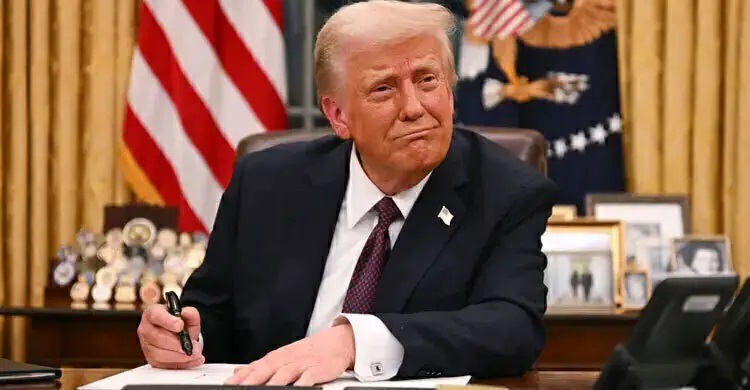
US President Donald Trump has imposed a new 10% global tariff to replace ones struck down by the Supreme Court, calling the ruling "terrible" and lambasting the justices who rejected his trade policy as "fools".
The president unveiled the plan shortly after the justices outlawed most of the global tariffs the White House announced last year.
In a 6-3 decision, the court held that the president had overstepped his powers.
The decision was a major victory for businesses and US states that had challenged the duties, opening the door to potentially billions of dollars in tariff refunds, while also injecting new uncertainty into the global trade landscape.
Speaking from the White House on Friday, Trump indicated that refunds would not come without a legal battle, saying he expected the matter to be tied up in court for years.
He also said he would turn to other laws to press ahead with his tariffs, which he has argued encourage investment and manufacturing in the US.
"We have alternatives - great alternatives and we'll be a lot stronger for it," he said.
The court battle was focused on import taxes that Trump unveiled last year on goods from nearly every country in the world.
The tariffs initially targeted Mexico, Canada and China, before expanding dramatically to dozens of trade partners on what the president billed as "Liberation Day" last April.
The White House had cited a 1977 law, the International Emergency Economic Powers Act (IEEPA), which gives the president power to "regulate" trade in response to an emergency.
But the measures sparked outcry at home and abroad from firms facing an abrupt rise in taxes on shipments entering the US, and fuelled worries that the levies would lead to higher prices.
Arguing before the court last year, lawyers for the challenging states and small businesses said that the law used by the president to impose the levies made no mention of the word "tariffs".
They said that Congress did not intend to hand off its power to tax or give the president an "open-ended power to junk" other existing trade deals and tariff rules.
In his opinion, Chief Justice John Roberts, a conservative, sided with that view.
"When Congress has delegated its tariff powers, it has done so in explicit terms and subject to strict limits," he wrote.
"Had Congress intended to convey the distinct and extraordinary power to impose tariffs, it would have done so expressly, as it consistently has in other tariff statutes."
Source: BBC