
US military presence in the Middle East

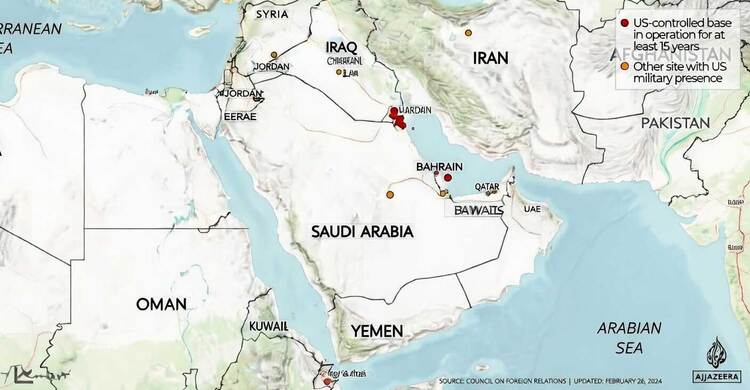
The United States maintains a vast military network across the Middle East, with between 40,000 and 50,000 troops stationed at bases spread across at least 19 locations. These installations, built over decades, form the backbone of Washington’s military presence in the region and have now emerged as key targets amid escalating tensions with Iran.
The American military footprint in the Middle East dates back to 1958, when US troops were deployed to Lebanon during a political crisis. Since then, the network has expanded significantly, with permanent and temporary bases now located in countries including Bahrain, Iraq, Kuwait, Qatar, Saudi Arabia, Jordan, Egypt and the United Arab Emirates. According to the Council on Foreign Relations, at least eight of these are permanent bases, while others serve as forward operating locations, logistics hubs and airfields.
Among the most important installations is Al Udeid Air Base, the largest US military airbase in the Middle East. Established in 1996, it hosts about 10,000 troops and serves as the forward headquarters of United States Central Command, which oversees American military operations across a vast region stretching from Egypt to Afghanistan. The base supports combat missions, intelligence gathering and drone operations, making it central to US power projection.
In Bahrain, the Naval Support Activity Bahrain houses the United States Navy Fifth Fleet, which patrols vital waterways including the Persian Gulf and the Red Sea. The base hosts around 9,000 personnel and plays a critical role in safeguarding global shipping routes. Its strategic importance was underscored when it was recently targeted in a missile strike amid rising tensions.
Another major hub is Camp Arifjan, a key US Army logistics and command centre that supports military operations across the region. From here, troops, equipment and supplies are coordinated for deployment. Similarly, Al Dhafra Air Base supports advanced air operations, hosting fighter jets, surveillance aircraft and drones used for intelligence and combat missions.
In northern Iraq, Erbil Air Base plays a vital role in supporting US operations and assisting allied local forces. These installations, along with smaller bases across the region, form an interconnected network designed to ensure rapid response to threats and maintain military dominance.
These bases allow the United States to monitor adversaries, protect global oil supply routes and support allied governments. They also serve as launch points for air strikes, naval patrols and intelligence operations. However, their strategic value also makes them vulnerable. Iran has repeatedly warned that US military facilities in the region would be targeted if conflict escalates.
Recent missile strikes targeting American installations have brought that threat into sharp focus, highlighting how US bases across the Middle East have become frontline assets in an increasingly volatile confrontation that could reshape the region’s security landscape.
Source: Al Jazeera