
Nepal votes six months after deadly anti-corruption protests

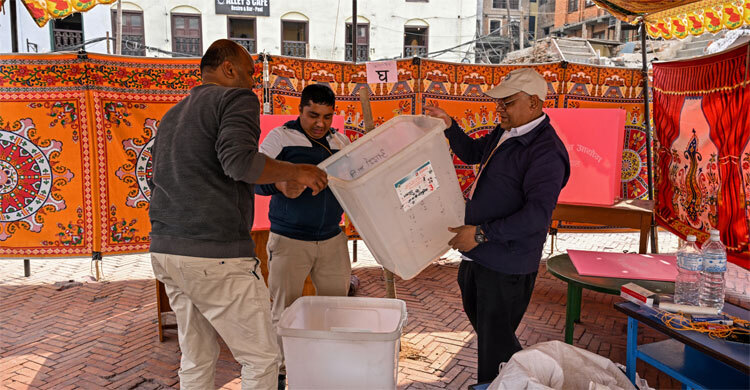
Nepal voted on Thursday for a new parliament, six months after deadly anti-corruption protests toppled the government -- a high-stakes showdown between an entrenched old guard and a powerful youth movement.
Queues began at dawn on the streets of the capital Kathmandu and in the usually sleepy eastern town of Jhapa, the site of a head-to-head contest between two key prime ministerial hopefuls.
"I came here early to vote, we have to exercise our rights. Nepalis have been waiting for change for so long, from one system to another," said Nilanta Shakya, 60, waiting to cast her ballot at a college in Kathmandu.
"I hope there is a meaningful change this time," she added.
Key figures contesting for power include the Marxist former prime minister seeking a return to office, a rapper-turned-mayor bidding for the youth vote, and the newly elected leader of the powerful Nepali Congress party.
Nearly 19 million voters are choosing who replaces the interim government in place since the September 2025 uprising, in which at least 77 people were killed, and parliament and scores of government buildings were torched.
Youth-led protests under a loose Gen Z banner began as a demonstration against a brief social media ban, but were fed by wider grievances at corruption and a woeful economy.
Sushila Karki, the interim prime minister, has urged people to vote "without any fear", and thousands of soldiers and police are deployed at polling centres.
The polls, which close at 5:00 pm (1115 GMT), are one of the most hotly contested elections in the Himalayan republic of 30 million people since the end of a civil war in 2006.
The election has seen a wave of younger candidates promising to tackle Nepal's woeful economy, challenging veteran politicians who have dominated for decades and argue that their experience guarantees stability and security.
"We are so hopeful," said Sashi Gurung, 33, who will vote in Kathmandu.
"This election is not a normal election. This is going to be one of the changing points for Nepalis, for Nepal."
'Blood will bring change'
Helicopters have flown voter materials to snowbound mountain regions across Nepal, home to eight of the world's 10 highest peaks, including Mount Everest.
But all eyes will be focused on the hot farming plains south of the capital, where all three prime ministerial hopefuls are contesting seats -- a departure from past elections that focused on the capital Kathmandu.
KP Sharma Oli, the 74-year-old Marxist leader ousted as prime minister last year and seeking a return to power, is being challenged in his home constituency of Jhapa by former Kathmandu mayor Balendra Shah, a 35-year-old rapper-turned-politician.
The Jhapa-5 constituency -- with around 163,000 voters -- will determine whether Oli secures his seat or whether Shah enters parliament.
Shah, from the centrist Rastriya Swatantra Party (RSP), has cast himself as a symbol of youth-driven political change, encouraging voters to "ring the bell" of change, in reference to the party symbol.
Also in the race as aspiring prime minister is Gagan Thapa, 49, the new head of the country's oldest party, Nepali Congress, who has told AFP he wanted to end the "old age" club of revolving veteran leaders.
"At the Gen Z protest, people died -- and their blood will bring change, we hope," said Tek Bahadur Aale, 66, queuing to vote in Jhapa.
"We hope a government with good governance, no corruption comes this time."
More than 3,400 candidates are running for 165 seats in direct elections to the 275-member House of Representatives, the lower chamber of parliament, with 110 more chosen via party lists.
Nepal's mountainous terrain presents logistical challenges in transporting the ballot boxes after the voting ends.
But Chief Election Commissioner Ram Prasad Bhandari said that initial results in direct elections results will be published within 24 hours.
Results under the proportional representation system may take longer.
Analysts say the vote is unlikely to deliver an outright majority for any single party.
It could take several days for full results -- and longer if negotiations for a coalition government prove tricky.
Source: AFP