
Rely on God, not great powers, Ahmadiyya caliph urges unity as war spreads

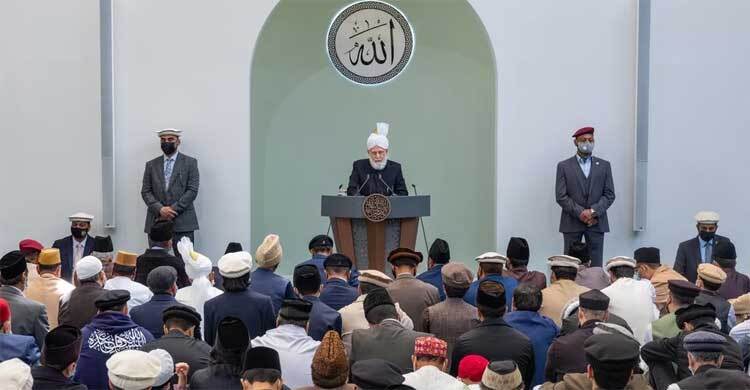
As tensions and violence continue to spread across the Middle East, the worldwide head of the Ahmadiyya Muslim Community, Mirza Masroor Ahmad, has called on Muslim nations to turn away from dependence on global powers and instead place their trust in God while striving for unity among themselves.
Delivering his weekly Friday Sermon from the Mubarak Mosque in Tilford in the United Kingdom, the supreme leader of the global Ahmadiyya Muslim Community warned that the ongoing conflict in the Middle East could spiral further out of control and leave Arab nations bearing the heaviest consequences, according to a press release of Ahmadiyya Muslim Jamaat, Bangladesh.
Speaking to millions of followers worldwide, Mirza Masroor Ahmad urged Muslim governments and leaders to set aside their political rivalries and personal interests, and instead work together to safeguard the future of the Muslim world.
“The governments of Muslim countries, their politicians and rulers should set aside their personal interests and instead strive for the unity of the Muslim Ummah,” he said.
In his sermon, the Ahmadiyya leader strongly cautioned Muslim countries against relying on Western nations for security or prosperity. According to him, such dependence has historically resulted in greater instability rather than protection.
“The United States has established military bases in many Muslim countries. But for what purpose? From whom, after all, were these nations facing a threat?” he asked.
“In reality, it was these very powers that themselves created the threats. Thereafter, the narrative was advanced that these [Muslim] countries were in danger, and therefore it was necessary to establish military bases to safeguard them.”
He said the presence of foreign military installations had, in many cases, made Muslim countries more vulnerable rather than safer.
“Due to the presence of these bases, the likelihood of attacks upon Arab countries increased, and such attacks eventually did occur. As a result, their economies are also being severely damaged,” he said.
“Yet, against the very forces from whom Muslims might genuinely face danger, these powers would never employ their strength or weaponry.”
Mirza Masroor Ahmad warned that the Middle East conflict could expand further, especially as it spreads across the Gulf region.
According to him, divisions within the Muslim world have created opportunities for powerful nations to exploit the situation for their own interests.
“Western powers have instigated unrest within Muslim countries, and then, gradually, by fuelling that unrest, continued to spread it from one country to another,” he said.
“It seems evident they wished to use their power to seize control of the resources of these countries and bring them under their influence.”
He cautioned Muslim nations against placing excessive trust in powerful states.
“They [Muslim nations] must not regard the great powers of the world as their gods, for the only power that endures forever is the power of God Almighty,” he said.
“If these great powers are regarded as the ultimate authority, they will gradually seize control of the entire Muslim world, one country after another.”
“These worldly powers have already destroyed the peace and stability of the world, and particularly the peace of the Muslim world, and they will continue to do so in the future as well.”
The Ahmadiyya leader also questioned claims by Western governments that military interventions were aimed at promoting freedom or protecting human rights.
Referring to statements made by US leaders about Iran, he said Washington had argued that its actions were intended to liberate the Iranian people, particularly women.
However, he cited remarks by Spanish Member of the European Parliament Irene Montero, who rejected such justifications.
“No woman has ever been freed by American bombs or illegal aggression… And it will not happen in Iran either,” Montero said.
Mirza Masroor Ahmad also spoke about what he described as double standards in the way global media and Western societies respond to civilian casualties.
“If one observes the situation in Western countries, some commentators themselves have begun to point out that if an attack were to occur in Israel, the United States, or any Western nation, and even a few of their children were killed, newspapers would publish column after column for days on end expressing outrage,” he said.
“Yet in Iran, a school is bombed, and hundreds of children are killed, and hardly anyone raises their voice.”
“This was the situation in Palestine, and now the same is unfolding in Iran. It appears as though, in their view, the life of a Muslim carries little value.”
Mirza Masroor Ahmad also warned that the financial cost of the conflict would likely fall most heavily on Arab countries.
He rejected the notion that major powers would simply absorb the economic burden of the war.
“Powerful nations make meticulous calculations of every matter and conduct comprehensive assessments before acting,” he said.
Instead, he suggested that Arab countries might ultimately be required to pay the financial price.
“They will likely be made to bear the immense costs under the pretext of providing them with defence,” he said.
“On the one hand, their oil production is being disrupted, and inflation is rising … while on the other hand, they are compelled to cover these immense costs, which will gradually diminish or even exhaust their financial reserves.”
“Ultimately, the Arab world will suffer severe economic damage. Although the Western world may also incur losses, the greatest harm will fall upon the Arab nations.”
The Ahmadiyya Muslim leader also urged efforts to pursue dialogue and reconciliation rather than prolonged confrontation.
He said reports suggested that China and several other countries, including Pakistan, had offered to help facilitate peace talks.
“It is reported that China and certain other countries, including Pakistan, have offered to play a role in facilitating peace,” he said.
“One can only hope that the Muslim world comes to understand the importance of this matter.”
He also praised Spain’s government for refusing to participate in the conflict.
According to him, Spain’s Prime Minister Pedro Sánchez “displayed the courage to state that Spain would neither take part in the war nor provide its bases.”
Mirza Masroor Ahmad concluded his sermon with a broader appeal for unity across the Muslim world.
“The Muslim world must strive to become peaceful and to live as brothers among one another,” he said.
“This is the true teaching of Islam, not that they should become people who cut one another’s throats.”
“Only then will we be able to safeguard ourselves from the attacks of the world, maintain our dignity and honour, and prevent the forces opposed to Islam from tearing us apart from within.”
He ended the sermon by praying for peace across the world and urging members of the Ahmadiyya Muslim Community to continue praying for an end to injustice, conflict and suffering.