
Iran fires missiles at 54 Israeli targets, deploys Sejjil in fresh wave of attacks

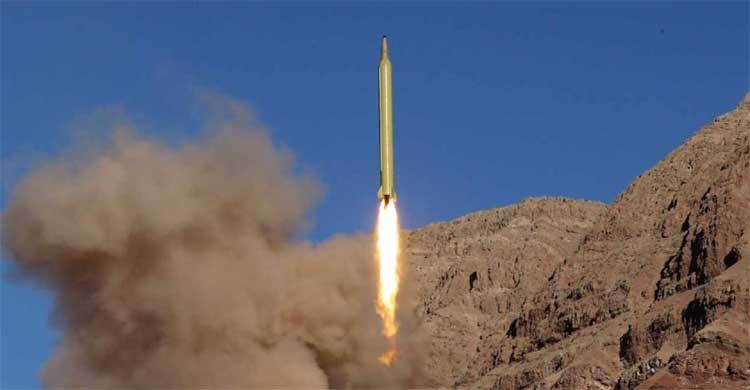
Iran's Islamic Revolutionary Guard Corps (IRGC) has announced that it launched a new barrage of missiles targeting locations in Israel, marking one of the most intense exchanges in the ongoing confrontation between Iran and Israel.
In a statement released by the IRGC, the force said a total of 54 missiles were fired during the latest phase of the operation, striking what it described as “various strategic targets” inside Israel.
According to the statement, the attack employed a mix of Iran’s advanced ballistic missile systems, including the Khorramshahr missile, Kheibar Shekan missile, Qadr missile, and Emad missile.
The IRGC also said it used, for the first time, four units of the strategic fuel-powered Sejjil missile during what it called Operation Sadeq Promise.
According to Iranian military statements, the missile can travel from the Natanz nuclear facility in Iran to Tel Aviv in about seven minutes, underscoring the rapid strike capability of the weapon.
First reported use of Sejjil
Iran says its long-range Sejjil missile has entered the confrontation for the first time, marking what analysts describe as a significant escalation in the ongoing military standoff with Israel.
Iranian state television reported on Sunday that Tehran had deployed the solid-fuel ballistic missile since the start of the war involving the United States and Israel.
The development comes as Iran continues its military campaign known as Operation True Promise 4, which Iranian officials say was launched in response to Israeli attacks carried out with US support.
Advanced solid-fuel design
The Sejjil is widely regarded as one of the most significant strategic weapons in Iran’s missile arsenal. Military analysts describe it as a major milestone in the country’s domestic aerospace programme.
Unlike many earlier Iranian ballistic missiles that rely on liquid fuel, the Sejjil uses a two-stage solid-fuel propulsion system.
This design allows the missile to be prepared and launched within minutes, while also making transportation and long-term storage easier compared with liquid-fuel systems.
The missile is estimated to have a range between 2,000 and 2,500 kilometres, placing much of the Middle East within striking distance.
Speed and maneuverability
Technical assessments cited in regional reports say the missile can travel at more than Mach 13, equivalent to roughly 17,000 kilometres per hour during its terminal phase.
Its trajectory reportedly takes it beyond the Earth’s atmosphere before descending toward its target, a flight profile that may complicate interception by conventional air-defence systems.
The missile’s design is also believed to include manoeuvring capabilities intended to evade radar detection and missile defences, though independent verification of these claims remains limited.
Upgraded Sejjil-2 variant
Iran has also developed an upgraded version known as Sejjil-2 missile, which incorporates improvements in navigation and guidance systems.
The missile reportedly uses a combined guidance system integrating GPS and inertial navigation, which some reports claim can reduce the margin of error to less than 10 metres, although this has not been independently confirmed.
The weapon measures about 17.5 metres in length and carries a warhead weighing roughly 650 kilograms.
Strategic symbolism
Beyond its military capabilities, the missile’s name carries symbolic meaning in Iranian discourse.
“Sejjil” refers to the Quranic story in Surah Al-Fil, where stones of “sijjil” were said to have destroyed an invading army. Iranian commentators often cite the reference as a symbol of deterrence and resistance.
Israel detects new wave of attacks
Earlier, the Israel Defense Forces (IDF) said it had detected another round of missile launches originating from Iran.
Israeli military officials said the new barrage came less than two hours after the previous wave of attacks, suggesting a coordinated and sustained missile campaign.
Air-raid sirens were reported in several Israeli areas as the military activated its air defence systems to intercept incoming projectiles.
Escalating regional tensions
The latest exchange comes amid rising tensions following the large-scale confrontation that began in late February, when the United States and Israel launched strikes on Iranian targets, prompting retaliatory missile and drone attacks by Tehran.
Since then, both sides have engaged in repeated strikes, raising concerns among regional observers about the risk of a wider Middle East conflict.