
NICVD: Brand new machines gather dust, patients seek tests elsewhere

Gopalganj Sadar resident Ashraf Hossain travelled over 80 kilometres with his four-year-old son, Imam Hossain, who suffers from multiple holes in his heart. After visiting three hospitals in Dhaka, they arrived at the National Institute of Cardiovascular Diseases & Hospital seeking surgery.
But no doctor is willing to operate – not because of medical complications alone, but due to the lack of necessary diagnostic tests within the hospital itself.
Ashraf says he was pressured by his wife to bring their child here, believing it would be the best option. However, instead of receiving comprehensive care under one roof, the family now finds themselves shuttling between private labs in the capital just to complete pre-surgery evaluations.
This situation is far from unique.
Hazera Begum, 40, from Mirpur-11 is currently in the ICU after being diagnosed with a faulty heart valve requiring surgery. Despite being admitted, her diagnostic tests were conducted at Victoria Diagnostic Lab and Children’s Hospital — private facilities located outside the hospital premises. Her husband, Masud Gazi, told Jago News, “The hospital doesn’t conduct these tests. We followed the doctor’s advice and went to private labs.”
Medical records show that Hazera underwent tests such as echo, PT INR, and others at external centres.
She is not alone.
Md Rajur, 40, Marjina Begum, 54, and dozens more have had to visit private labs like Capital Diagnostic Centre for essential blood tests including PT INR and APTT. In fact, out of the 2,000-2,200 patients seen daily at the hospital, many are forced to leave the premises for basic diagnostics.
Why patients being sent out?
Jago News investigation revealed that the hospital stopped conducting several critical tests – including PT INR, APTT, and other cardiac-specific diagnostics — over two years ago.
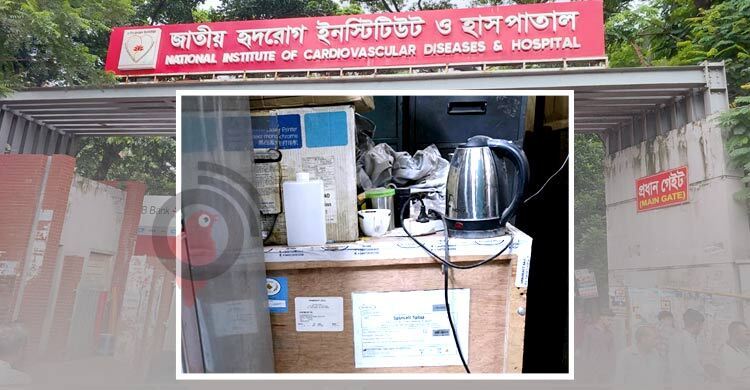
Yet, brand new machines imported from Spain to perform these very tests remain uninstalled in sealed boxes inside the hospital store.
One of them, valued at around Tk 16 lakh, is being used as a makeshift tea table. A kettle and tea utensils sit atop the machine, untouched since its arrival.

Engineers from Spain had even visited the hospital to install the equipment – but left empty-handed, reportedly without permission to proceed.
Doctors say the absence of these tests creates serious challenges in treating heart patients.
For instance, when a patient arrives with chest pain, the first diagnostic step should be a Troponin I test, which helps detect heart damage.
However, the hospital director recently issued a directive asking doctors not to recommend this test unless absolutely necessary due to a shortage of reagents.
CBC test report: Incomplete and potentially misleading
Another alarming issue uncovered during the investigation is the incomplete nature of the CBC (Complete Blood Count) test report. While the test is performed using an old haematology analyser, the process does not follow standard protocols.
Normally, a haematologist prepares a slide, stains it, and examines it under a microscope to ensure accuracy. But at the NICVD, the new microscope machine remains sealed in the hospital store, unused.

Instead, reports are generated solely based on a cell counter machine, which experts say can miss crucial findings such as malaria, thalassemia, or cancer cells.
Professor Dr ABM Yunus, former chairman of the Haematology Department at Bangladesh Medical University, explained: “A cell counter gives raw data, not a complete diagnosis. It cannot detect various blood disorders. A haematologist must manually verify the results under a microscope to provide accurate reports.”
He added that relying solely on automated machines could lead to misdiagnosis and inappropriate treatment.
Director blames govt, denies responsibility
When questioned about the situation, Professor Abdul Wadud Chowdhury, Director of the NICVD, shifted responsibility to the government: “There’s nothing to tell you. Tell the government to pay for reagent purchases. Without funding, we cannot operate all services.”
Meanwhile, despite having advanced machinery sitting unused, the hospital is reportedly moving forward with plans to purchase cheaper Chinese alternatives – raising questions about priorities and accountability.
Troponin I rest: Rationed due to reagent shortage
On January 22, 2025, the hospital issued a notice signed by the director, instructing doctors to avoid ordering the Troponin I test unless absolutely necessary. The reason cited was a shortage of reagents needed to perform the test.
However, when the Jago News reporter posed as patients and got tested on June 23, they found that hundreds of patients still received the test every day. Staff confirmed that the current supply would last only until June 30, with no new shipment scheduled for the next fiscal year.
Deputy Director Professor Dr Munir Ahmed Khan acknowledged the rationing: “We’ve reduced the number of tests so that the remaining stock can last longer until new supplies arrive.”
But insiders reveal that access to the test is often determined by personal connections rather than medical necessity.
Thousands suffer daily
According to hospital records from July 7, 2,216 patients visited the hospital in a single day — 1,247 through the outpatient department and 969 through emergency. Many of them came with symptoms requiring immediate testing.
Patients arriving with chest pain need Troponin I, while post-operative patients require PT INR and APTT tests – none of which are available in-house.
As a result, patients from outside Dhaka face additional burdens: staying overnight in the city, paying higher fees at private labs, and returning the next day for follow-up consultations.
While public hospitals charge Tk 100–200 for these tests, private labs charge anywhere from Tk 400 to Tk 1,000.
Authorities remain silent
Despite repeated inquiries, hospital authorities have not provided clear explanations for the delays in installing machines, the lack of reagents, or the apparent misuse of critical equipment.
When approached, Health Adviser Nurjahan Begum said, “Tell me which tests aren’t available. I will look into it.”
Until then, thousands of patients continue to suffer — caught between bureaucratic negligence and a crumbling healthcare system.