
Changing patterns slow child labour in Jashore but risks shift to the shadows
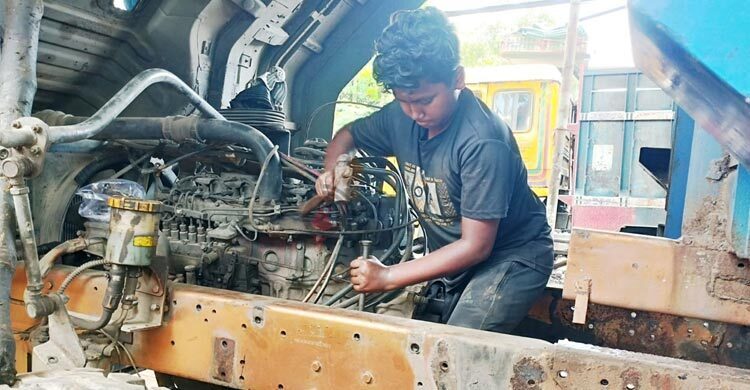
Minarul Islam Bappi, 15, was once a class VI student with dreams of becoming an engineer. But when his father, a tiler, fell ill and lost his income, the family could no longer afford school fees or uniforms. Forced to support his household, Bappi now works at Naushad Motorbike Workshop in Jashore’s New Market area.
Farhad Hossain, 14, shares a similar story. His father, a rickshaw-puller, met with an accident and could no longer work. His mother, a domestic help, struggled to make ends meet.
Farhad dropped out of school to help – working as an engine repair assistant. As he pounds on car parts, the clang reminds him of the school bell he used to hear every morning.
Bappi and Farhad are not alone.
Thousands of children in Jashore are being pushed into labour instead of classrooms. A survey by the Abdur Rashid Khan Thakur Foundation (ARKTIF) estimates that nearly 10,000 children are engaged in child labour across three key areas of Jashore district: Jashore Municipality, Nawapara Municipality, and Navaran Bazar.
Of these, 4,993 children are employed in Jashore Municipality, 3,488 in Nawapara, and 1,499 in Navaran Bazar. The majority fall between the ages of 14 and 18, though over 3,900 are under 14 – legally still children.
From factories to informal work and gangs
While official statistics on child labour remain sparse, local NGOs and officials note a shift in patterns. Child labour is moving from visible, institutional settings like factories to informal sectors such as workshops, battery rickshaws, and even underground activities like drug peddling and youth gangs.
Abdullah, 14, another former student turned mechanic, says he left school after Class V because his father could not afford private tuition. “I had no option but to learn motorcycle repair,” he said.
Saiduzzaman Mukul, owner of Suraiya Sumaiya Vulcanizing, observed a change: “Earlier, many child workers came to workshops to learn skills. Now, they’re more interested in earning quick cash. Some have moved to driving rickshaws, while others are getting involved in crime.”
Signs of progress amid persistent challenges
Despite the grim realities, there are signs of improvement. According to Pradeep Marcel Rosario, Executive Director of ARKTIF, the rate of increase in child labour has slowed. Parents are more aware of the value of education, and employers are increasingly cautious due to stricter enforcement of labour laws.
Sadhan Kumar Das, Jashore District Child Affairs Officer, noted that while child labour persists in industrial zones like Benapole and Nawapara, efforts to monitor and reduce it are ongoing.
Deputy Inspector General Ariful Islam of the Department of Inspection of Factories and Institutions confirmed that awareness is growing. “Child labour rates are decreasing, and working conditions are improving,” he said. “But we need a joint effort to fully eradicate this problem.”
The way forward
Experts stress that eradicating child labour requires addressing its root causes – poverty, lack of access to education, and social vulnerability. Children must be brought back to schools, and their families supported through social safety nets and financial inclusion programmes.
As ARKTIF’s survey warns, if urgent action isn’t taken, the current generation of working children may become tomorrow’s recruits for criminal networks and exploitative industries.