
New rules, bigger fines: Sound pollution gets stricter penalties

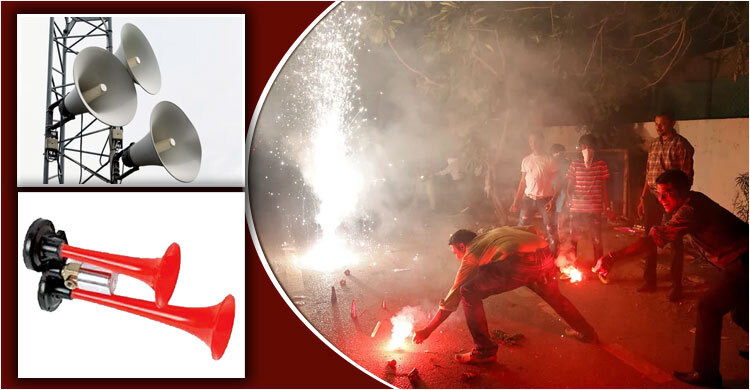
The government is set to introduce revised and significantly tougher regulations to combat rising noise pollution across the country.
The Ministry of Environment, Forest and Climate Change has drafted the ‘Sound Pollution (Control) Rules, 2025’, amending the existing 2006 rules to address growing public health concerns.
The proposed rules introduce harsher penalties, new restrictions, and clearer enforcement mechanisms, reflecting the worsening noise levels – particularly in Dhaka, where studies show noise exceeds acceptable limits by more than double.
Increased penalties for violations
Under the 2006 rules, the maximum penalty for noise pollution was one month in jail, a fine of Tk 10,000, or both. The 2025 draft raises this to up to two years in prison, a fine of Tk 200,000, or both – a major escalation aimed at deterring violations.
Ban on fireworks and controlled use of sound systems
The draft imposes a complete ban on noise-producing fireworks and crackers. However, conditional permission may be granted for festivals, cultural events, or public gatherings, subject to strict rules:
- Permission cannot extend beyond 9:00pm.
- Use is limited to 5 hours per day and two consecutive days, except in exceptional cases.
- Sound levels must not exceed 90 decibels.
Restrictions on loudspeakers and public address systems
The use of microphones, loudspeakers, amplifiers, and music systems at public events will be prohibited after 9:00pm, even with permission. Conditional use may be allowed for political, social, or cultural events, but only outside designated quiet zones and within the 90-decibel limit.
Crackdown on vehicle horns
The draft includes a ban on the import, sale, and use of excessively loud vehicle horns. The Ministry of Commerce and relevant agencies will no longer issue permits for horns exceeding prescribed noise levels.
Key provisions:
- No horn use in quiet zones.
- Drivers or vehicle owners cannot install or use any device that produces excessive noise.
- Import, manufacture, sale, distribution, or commercial use of such devices will be punishable.
New driving licence requirement: Noise pollution training
To raise public awareness, training on noise pollution will be mandatory for obtaining or renewing driving licenses. The Bangladesh Road Transport Authority (BRTA), in coordination with the Department of Environment, will develop the curriculum and testing standards.
Noise level standards by area
The draft sets area-specific noise limits, with daytime defined as 6:00pm to 9:00pm and nighttime as 9:00pm to 6:00am.
In quiet zones, the maximum permissible noise level is 50 decibels during the day and 40 decibels at night. For residential areas, the limit is set at 55 decibels during daytime and 45 decibels at night.
Mixed-use areas allow up to 60 decibels during the day and 50 decibels at night.
Commercial areas permit a higher threshold of 70 decibels during daytime and 60 decibels at night, while industrial areas have the highest allowable levels at 75 decibels during the day and 70 decibels at night.
Exceeding these prescribed limits in any zone will be subject to penalties under the proposed rules.
Horn noise limits for vehicles
New standards have been set for vehicle and watercraft horns:
- Light vehicles (cars, microbuses, pickups): 85 dB
- Medium vehicles (minibuses, medium trucks): 90 dB
- Heavy vehicles (buses, trucks): 100 dB
- Motorised watercrafts: 100 dB
Exceeding these levels will result in penalties.
Noise control infrastructure required
Local authorities, including union parishads, municipalities, and city corporations, must identify residential, commercial, industrial, and quiet zones; install and maintain noise signage; ensure noise control systems (e.g., sound barriers) are installed along railway lines, flyovers, and elevated expressways in quiet areas where traffic noise exceeds limits.
Exemptions
The proposed noise pollution rules will not apply to certain exemptions, including religious places such as mosques, temples, churches, and pagodas. Religious gatherings like Eid congregations, waz mahfils, janazas, and namakirtans are also exempt, as are funeral processions.
Emergency services, including ambulances and fire services, are excluded from the restrictions to ensure uninterrupted operations.
Additionally, the rules do not cover traditional iftar and sehri announcements during Ramadan, as well as specific government activities deemed necessary by authorities. These exemptions aim to balance public order and cultural, religious, and emergency needs while controlling general noise pollution.
Penalties for specific violations
Under the proposed noise pollution rules, various violations will carry specific penalties. Playing loud music after 9:00pm or exceeding the permitted sound levels will be punishable by up to one month in jail, a fine of Tk 50,000, or both.
Using vehicle horns in violation of the prescribed noise limits will result in a penalty of up to one month in jail, a fine of Tk 20,000, or both.
Those involved in manufacturing, importing, or marketing horns that exceed permissible noise levels may face a much stricter punishment of up to two years in prison, a fine of Tk 200,000, or both.
Additionally, selling, distributing, or commercially dealing in excessively loud horns will be subject to up to one month in jail, a fine of Tk 50,000, or both. These penalties aim to strengthen enforcement and deter noise pollution across different sectors.
Next Steps
Siddhartha Shankar Kundu, Deputy Secretary (Environmental Pollution Control-1) at the Ministry, told Jago News that the draft has undergone two inter-ministerial consultations and is currently open for feedback.
So far, 21 ministries have submitted their input, and the draft is available on the ministry’s website.
“We aim to finalise the rules within this month,” Siddhartha Shankar said. “After vetting by the Law Ministry, the rules will be published in the official gazette.”
Why the change?
Experts warn that noise pollution has become a silent public health crisis.
A study by the Centre for Atmospheric Pollution Studies (CAPS) at Stamford University found that noise levels at major Dhaka intersections are 2.5 times higher than the national standard. The duration and intensity of noise exposure have also increased significantly.
With traffic, construction, and urban events contributing to the problem, officials say the 2006 rules are outdated and lack clarity. The 2025 draft aims to close these gaps with enforceable standards and modern regulations.