
Interim govt marks one year

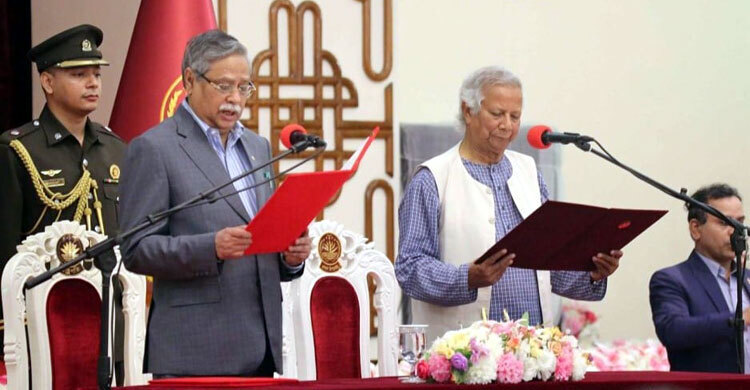
Today marks one year since the formation of the interim government led by Dr Muhammad Yunus, following the student-led mass uprising.
After the fall of the Sheikh Hasina government on August 5, 2024, the interim government was sworn in on August 8, with Dr Yunus as its Chief Adviser. During the three-day transitional period, the country was effectively without a functioning government.
On August 5 this year, marking the anniversary of the July uprising, the Chief Adviser presented the "July Declaration" to the nation and declared the day as "July Mass Uprising Day." Following multiple rounds of discussions with political parties through the National Consensus Commission, the draft of the "July Charter" is now in its final stage.
On the same day, the Chief Adviser also announced that the next national parliamentary elections will be held in February 2026.
“On behalf of the interim government, I will send a letter to the Chief Election Commissioner, requesting the Election Commission to organise the national election in February 2026, before the beginning of the next Ramadan,” he stated.
Accordingly, on August 6, a letter was sent from the Chief Adviser’s Office to the Election Commission, instructing it to complete preparations for holding the election before the start of Ramadan in February 2026.
Later, a press release from the Chief Adviser’s Press Wing confirmed that the government had formally requested the Election Commission to proceed with the election arrangements.
Election Commissioner Brigadier General (Retd.) Abul Fazal Md Sanaullah stated that the schedule for the upcoming general election will be announced in the first half of December.
Since taking office, the interim government has formed several reform commissions, including the Electoral Reform Commission, Police Reform Commission, Judiciary Reform Commission, Anti-Corruption Reform Commission, Public Administration Reform Commission, Health Reform Commission, Media Reform Commission, Workers' Rights Reform Commission, and the Women's Affairs Reform Commission. These commissions have submitted their recommendations, and the government has already initiated implementation in several sectors.
Meanwhile, following various government measures, the overall inflation rate dropped to 8.48% in June this year — the lowest in the past 35 months. However, in July, it slightly rose to 8.55%.
Dr Yunus stated that the government aims to bring food inflation down to 6% by December, noting that controlling inflation has been the biggest challenge for the caretaker administration.
He also mentioned that growing confidence among expatriate Bangladeshis in the current administration has contributed to the stability of foreign currency reserves.
The Chief Adviser further revealed that, over the past 11 months, Bangladesh repaid $4 billion in interest and principal to foreign lenders — the highest in the country’s history. Despite this, the foreign exchange reserves continue to rise.