
Tourists at risk: Cox's Bazar lifeguards to cease operations

Published: 21 September 2025, 02:09 PM
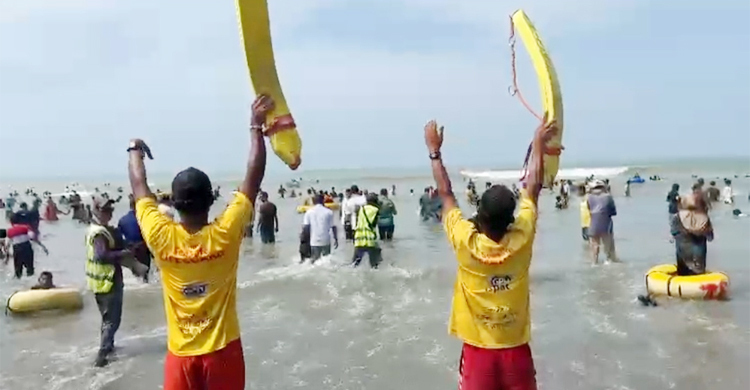
One of Bangladesh’s most vital tourist safety initiatives is on the verge of collapse. The Sea-Safe Lifeguard service, which has rescued hundreds of tourists from drowning along Cox’s Bazar’s world-famous beach, will cease operations on September 30 due to a severe funding shortfall leaving half a million annual visitors vulnerable to deadly rip currents with no professional rescue system in place.
For over a decade, 27 trained lifeguards clad in red and yellow uniforms have patrolled the busiest five-kilometre stretch between Labani, Sugandha, and Kalatali points, blowing whistles and waving tourists away from dangerous zones. Their presence, a reassuring fixture for beachgoers since 2012, will vanish by October 1. With it, 35 staff members including 27 frontline rescuers will lose their livelihoods.
A decade of service, now at risk
Funded by the UK-based Royal National Lifeboat Institution (RNLI), Sea-Safe has saved at least 815 lives in the past year alone. Since its inception, lifeguards have pulled countless tourists from treacherous rip currents — while also recovering bodies, including 11 fatalities this year alone.
But funding dried up after the project’s official end in December 2023. Two emergency extensions — first to June, then to September — bought time, but no replacement funding has materialized. The monthly cost? Just 1.4 million taka — a small price for a service that safeguards lives and upholds the reputation of Bangladesh’s top tourist destination.
Tragedies mount as deadline looms
The urgency is underscored by recent drownings:
On September 7, 17-year-old Ayman — nephew of cricketer Mushfiqur Rahim — vanished while bathing at Laboni Point. His body was found 16 hours later.
On July 7, three Chittagong University students were swept away at Himchhari. Two bodies were recovered; Aritra Hasan remains missing after two and a half months.
Tourists are alarmed. “Cox’s Bazar is our pride — but safety must be a state responsibility,” said Dhaka visitor Ahsan Shaon. “If lifeguards vanish, our tourism identity vanishes with them.”
Government inaction, hotel industry hesitation
Despite high-level meetings — including one in August chaired by Civil Aviation and Tourism Adviser Sheikh Bashir Uddin — no concrete solution has emerged. Instead of state funding, officials instructed the district administration to negotiate with hoteliers to shoulder the cost.
Under the proposal:
Star hotels would fund 3 lifeguards each.
Smaller hotels would fund 1 each.
But hotel owners balk at the estimated Tk 14-15 lakh per month cost. “No one is responding,” said Abul Kashem Sikder, president of the Hotel and Guest House Owners Association. “Even if they did, implementation would take months — time we don’t have.”
Lifeguards: “We saved lives, now who will save us?”
Joynal Abedin, a veteran lifeguard with 10 years of service and 98 lives saved, fears for his future: “We risked our lives daily. Now, we’re being abandoned. It’ll take time to find new work — and my skills will go to waste.”
Akram Tripura, another decade-long rescuer, echoes the despair: “With a 20,000-taka salary, I supported my family. What will I do next month?”
A possible lifeline, if authorities act now
Beach Management Committee Supervisor and Additional Deputy Commissioner Md Shahidul Alam confirms the Ministry of Tourism is aware — but insists hotels must step in. Recruitment would prioritize current, trained lifeguards.
Meanwhile, Abu Morshed Chowdhury Khoka, president of the Cox’s Bazar Chamber of Commerce, proposes an immediate stopgap: tap into the Beach Management Committee’s existing fund — which holds “crores of taka” collected from beach businesses, hotels, and sports events — to keep lifeguards on payroll until a permanent solution is found.
“Lifeguards are not optional — they’re essential infrastructure,” Khoka stressed. “Stopping this service is not an option.”
Tourist police sound alarm
Additional DIG Apel Mahmud, head of Cox’s Bazar Tourist Police, issued a stark warning: “Without lifeguards, tourist deaths will surge. Everyone is asking — what happens on October 1?”
What’s next?
As the September 30 deadline approaches, the fate of Cox’s Bazar’s lifeguards — and the safety of its tourists — hangs in the balance. Authorities must act swiftly: either redirect existing tourism funds, mandate hotel contributions, or provide direct government support.
Failure to act won’t just cost jobs — it will cost lives.