
13 years after Ramu’s temples burned, justice still smoulders

Published: 29 September 2025, 11:32 AM
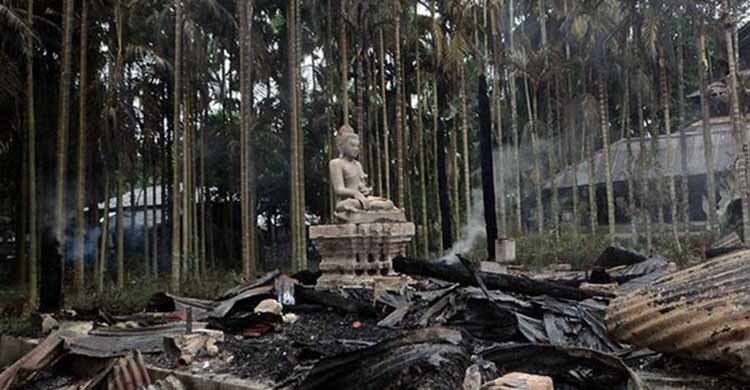
At dawn, the bells of Ramu Central Seema Mahavihara ring out softly, their sound carrying across the quiet lanes of the village. Monks in saffron robes step barefoot towards the prayer hall, where fresh paint still gleams on the rebuilt walls.
For worshippers, the temple is once again a place of peace. Yet behind the chants of devotion lies a memory that refuses to fade — the night, thirteen years ago, when flames consumed these very grounds.
On September 29, 2012, a Facebook rumour that a Buddhist youth, Uttam Barua, had desecrated the Holy Qur’an unleashed one of the worst communal attacks in Bangladesh’s history.
By nightfall, mobs had torched 12 temples and 26 homes in Ramu. The next day, violence spread to Ukhiya and Teknaf, where another seven temples were destroyed. The images of burning monasteries shocked the nation and the world.
Thirteen years on, the monasteries have been rebuilt and harmony has largely returned. But for the Buddhist community of Cox’s Bazar, the wounds remain unhealed. Justice, they say, has been denied.
‘The bleeding inside has not stopped’
Nineteen cases were filed; one later withdrawn. The other 18 remain pending with 993 accused. Not a single trial has concluded. Witnesses refuse to testify, some out of fear, others to preserve fragile peace. Many accused walk free, travel abroad, or live openly on bail.
“Thirteen years on, we have seen monasteries rebuilt and social harmony restored, but the hidden bleeding inside has not stopped,” said Mithun Barua Botham, member secretary of the Cox’s Bazar Nationalist Buddhist Forum. “The cases went under political control, the real culprits slipped away, and impunity has emboldened them.”
Bipul Barua Abbu, general secretary of the Ramu Central Buddhist Youth Council, was more blunt: “Those who carried out the attacks could not belong to any religion. But because the trials have not moved, the scar in the hearts of Buddhists remains. We saw no justice under the last government, and the interim government has not shown urgency either.”
For Pragyananda Bhikkhu, abbot of Ramu Central Seema Mahavihara, the silence of the courts is ominous. “If those responsible for the barbaric attacks remain unpunished, they may strike again,” he warned. “Since 2012, not a single verdict has been delivered. It is deeply disappointing.”
Justice stalled
Court insiders admit the trials are paralysed. Nearly 900 accused and 160 witnesses are tied to the 18 cases. Most proceedings have stalled because witnesses do not appear. Some cases have even been returned to the Police Bureau of Investigation (PBI) for reinvestigation.
Residents argue the flaws began on day one. “Police, not victims, filed the cases. That gave them power to choose who to charge and who to drop,” said local resident Saju Barua. “Photos and videos show many known attackers, yet they were excluded, while others with no involvement were named. The real perpetrators are still hiding.”
Witnesses also fear reprisals. “Many of them have families here. They worry about safety if they testify,” said Riton Barua, president of the Ramu Upazila Buddhist Protection Council. Others, he explained, fear that revisiting the past could destabilise today’s delicate calm.
Commemoration without closure
On Monday, the Buddhist community observed the anniversary quietly with prayers, flag-hoisting, art displays and film screenings. Unlike earlier years, no rally was held. “We hope never to see a repeat of 2012,” said Botham.
Still absent is Uttam Barua, the young man whose name became the pretext for the attacks. His parents Sudatta Barua and Madhu Barua say they have had no word from him since that night. “We wait for the day he returns,” they said.
A fragile peace
Former MP and BNP leader Lutfor Rahman Kajol reflected on the long shadow of that night: “Ramu’s religious harmony was centuries old, but in one night it was destroyed. Thirteen years later, justice has not come. The guilty must be punished, but it is heartening that harmony has returned stronger than before.”
As dusk falls over the monastery, candles flicker beneath freshly restored Buddha statues. The scars of 2012 may be hidden behind new paint and quiet rituals, but for the Buddhists of Ramu, true peace will only come when justice is finally served.