
Yunus unveils 7-point global blueprint at UN for Rohingya return

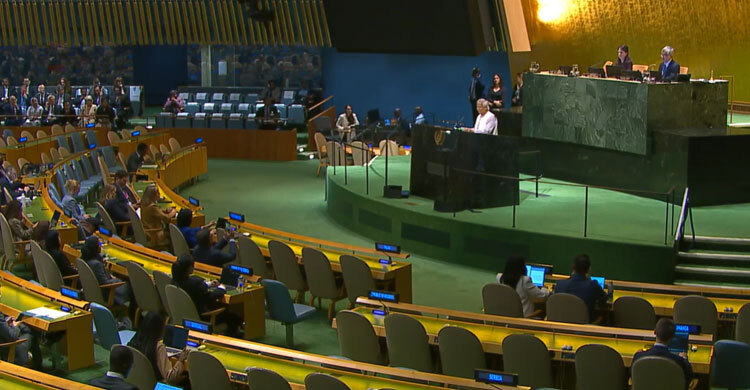
Chief Professor Muhammad Yunus has urged the international community to adopt a seven-point global strategy including a realistic roadmap for the safe and dignified repatriation of Rohingyas and end the protracted crisis, warning that time is running out both for the displaced community and for the countries hosting them.
Speaking at a high-level conference on “The Situation of Rohingya Muslims and Other Minorities in Myanmar” at the United Nations Headquarters in New York on Tuesday, September 30, Yunus said the world must move beyond expressions of solidarity and act decisively.
He outlined seven specific recommendations:
Develop a realistic roadmap for the safe and dignified repatriation of Rohingya refugees to their homeland.
Exert pressure on Myanmar and the Arakan Army to begin the repatriation process without further delay.
Deploy international support and monitoring teams in Rakhine to stabilise the situation and ensure security.
Undertake confidence-building measures to integrate the Rohingya sustainably into Rakhine society.
Complete donor funding commitments for the Joint Response Plan, which currently faces a severe shortfall.
Ensure justice and accountability, preventing impunity and supporting restorative justice initiatives.
Dismantle the narco-economy and curb cross-border crime networks that destabilise the region.
Yunus stressed that the crisis, now in its eighth year, remains unresolved because Myanmar has not faced sufficient pressure to change course.
“The root cause of the Rohingya crisis lies in Myanmar, and the solution must also be found there,” he said. “The world can no longer wait. We need to act now to send the Rohingya back to their homes with safety, dignity, and justice.”
The Nobel laureate highlighted the financial strain on humanitarian operations. Funding shortfalls have forced aid agencies to cut rations and reduce essential services for the nearly one million Rohingyas sheltered in Bangladesh’s Cox’s Bazar camps.
He argued that international donors could spend far less by supporting repatriation initiatives than by indefinitely sustaining refugee populations abroad.
He pointed out that the Rohingya themselves have consistently voiced their desire to return home. “The refugees want to go back to their villages, their land, their lives. They are not seeking permanent settlement elsewhere,” he said, adding that those who recently fled Myanmar should be prioritised for immediate deportation to avoid further regional conflict.
Yunus also spoke of the heavy toll on Bangladesh, where the Rohingya camps have created mounting social, economic, and environmental pressures. “Given our development challenges, such as unemployment and poverty, it is not possible to provide regular employment to the Rohingya in Bangladesh,” he said.
Local communities in Cox’s Bazar have faced rising tensions, competition over scarce resources, and environmental degradation, making a long-term solution increasingly urgent.
Concluding his remarks, Yunus called for a renewed global pledge: “The world can no longer stand by while the Rohingya wait to return home. Today, we must unite to commit to a final resolution of this crisis. Bangladesh pledges full cooperation.”