
Young hearts lose their storyteller: Rakib Hasan, creator of ‘Tin Goyenda,’ no more

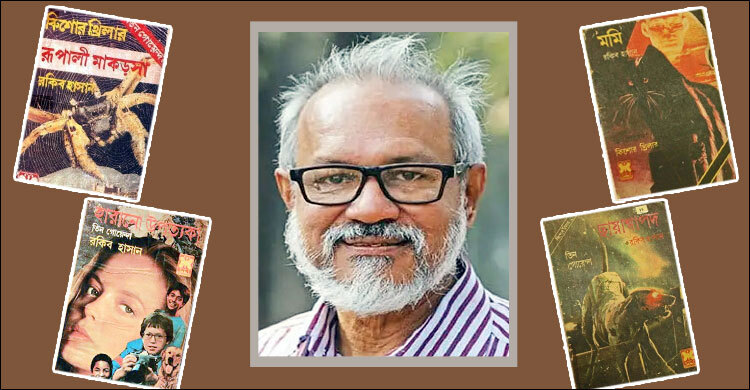
For countless young readers in Bangladesh, he was the quiet architect of their imagination – the man who taught them that courage could hide behind a school uniform, and that adventure might begin just beyond the familiar streets of home. His words turned ordinary afternoons into thrilling quests; his stories transformed friendships into secret societies of loyalty and logic.
Rakib Hasan built a universe where three boys — Kishore Pasha, Musa Aman, and Robin Milford — solved riddles that adults could not. In doing so, he gave a generation of Bengalis not just mystery and excitement, but also a moral compass rooted in friendship, wit, and courage. Tin Goyenda was never just a book; it was a shared language of youth, whispered in classrooms and playgrounds, its characters as real as the friends who read them.
That world of wonder fell heartbreakingly silent this afternoon.
Rakib Hasan, the visionary author who gave life to Tin Goyenda, passed away at the age of 74 at Gonoshasthaya Nagar Hospital in Dhanmondi, following a sudden cardiac arrest during dialysis. He had been receiving treatment for complications arising from kidney failure and other age-related illnesses. The news was confirmed by Masuma Maimur, adviser to Seba Prokashani, who shared on social media: “With deep sorrow, we inform the readers of Tin Goyenda and Sheba Prokashani that Rakib Hasan has passed away. He breathed his last during dialysis when his heart suddenly stopped. Please pray for the eternal peace of his departed soul.”
Tin Goyenda — first published in 1985 under Seba Prokashani’s Kishore Thriller line — quickly became a cultural phenomenon. The series followed three young detectives: Kishore, the sharp-witted leader; Musa, the loyal and street-smart techie; and Robin, the brave and good-hearted newcomer. Often joined by Georgina “Jina” Parker and her dog Rafi, the trio cracked cases from their secret headquarters — Pasha Salvage Yard — a scrapyard filled with secret tunnels, coded entrances, hidden rooms, and ingenious gadgets.
Their mentor, Davies Christopher, guided them from afar, while colourful characters like rival detective “Shutki Terry” and faithful chauffeur Hanson added depth and humour to their adventures. And, of course, the iconic Rolls-Royce — their most prized possession — became the ultimate symbol of youthful daring.
The blend of adventure, humour, and local flavour made Tin Goyenda an instant classic. Over 160 original titles were penned by Hasan, and the series was even adapted into a television show in 2014. For many Bangladeshis, it was a defining childhood experience — a gateway into imagination, logic, and courage.
Long before Tin Goyenda became a publishing sensation, Rakib Hasan was already honing his craft as an assistant editor of the country’s first mystery magazine, Rahasya Patrika, developing a keen sense for suspense, humour, and the art of revelation. Inspired by Robert Arthur Jr.’s The Three Investigators, he localised the idea with cultural nuance and authenticity, grounding it in a world familiar to Bangladeshi readers.
For decades, Tin Goyenda served as a bridge across generations. Fathers passed down their beloved, dog-eared copies to their children; bookstalls displayed fading covers like sacred relics of youth; and libraries bore the fingerprints of thousands who once devoured every clue, every twist, every chase. The clubhouse under the banyan tree — and later, the scrapyard headquarters — became symbols of defiance, curiosity, and fearless friendship.
Rakib Hasan’s legacy, however, goes far beyond his books. He taught readers to observe, to question, to reason — and above all, to believe that even the smallest minds could solve the biggest mysteries. He proved that Bengali fiction could be thrilling, intelligent, and emotionally resonant — all at once.
He gave us the rarest of gifts: the belief that stories could make us braver, kinder, and infinitely more curious about the world around us.
Now, as Kishore, Musa, and Robin live on in the hearts of their readers, the man who dreamed them into being takes his final bow. But his stories — like all great mysteries — never truly end. They wait, quietly, for the next reader to turn the page.
Rakib Hasan is survived by his family, his readers, and an imagination vast enough to fill the libraries of our youth. His passing closes a chapter — but his words, his worlds, and his wonder remain immortal.