
When sickness strikes twice: Brokers, thieves ripping off patients at NICVD

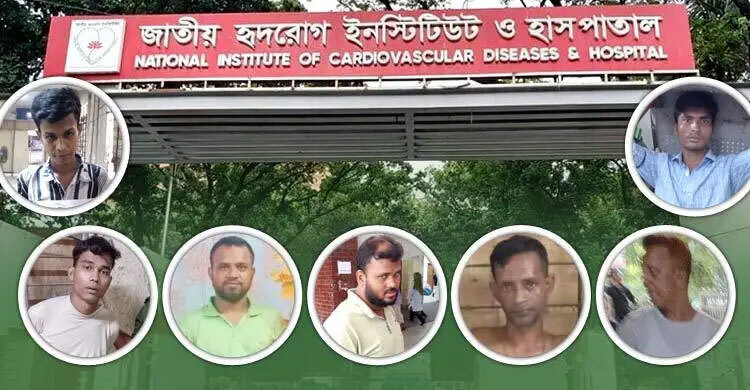
Dhaka’s National Institute of Cardiovascular Diseases (NICVD), established in 1978 in Sher-e-Bangla Nagar, was meant to be a sanctuary for Bangladesh’s most vulnerable heart patients.
As the country’s only government-run specialised cardiac hospital, it draws thousands each week –farmers from Rajshahi, rickshaw pullers from Chattogram, garment workers from Gazipur – all clutching hope and meagre savings, seeking life-saving care they cannot afford elsewhere.
But for many, that hope is swiftly replaced by fear – not from their illness, but from the predators who stalk the corridors, courtyards, and counters of the very place meant to heal them.
“Come with me, I’ll show you a professor for free”
Outside the outpatient department, a woman leans toward a frail man who has just purchased a Tk 50 ticket to see a junior doctor. “With this ticket, you’ll only see an intern,” she whispers. “But come with me – I’ll take you to a professor. No extra cost.”
This is not kindness. It’s a well-rehearsed script. Within minutes, the patient is whisked away not to a better doctor, but to a private clinic miles away, where he’ll be billed thousands for unnecessary tests, all orchestrated by hospital “brokers” who operate with brazen impunity.
These brokers – often posing as hospital staff or affiliated with private diagnostic centres like Advance, Prime, Heritage, and Genik – are not just opportunists. They are a syndicate. They swarm new arrivals, especially those who look lost, elderly, or poor. They promise faster care, better doctors, lower costs. In reality, they exploit desperation.
When this reporter attempted to speak with patients about their experiences, he was swiftly surrounded by five to seven men. “Who are you? Why are you disturbing our work?” they demanded aggressively. One identified himself as Rashed from “Advance Diagnostic Center.” Others, Ripon and Awal, openly admitted they “take patients elsewhere” but insisted, “We don’t force anyone.”
Yet, their “assistance” comes at a cruel price. One patient, brought to Dhaka with exactly Tk 3,000 for treatment, was lured to a private clinic and billed the entire amount just for a consultation. “He came to me crying,” said DrMezbah Uddin Ahmed, Assistant Director of NICVD. “He wanted me to retract his money from the swindler. But how can I?”
Dr Mezbah says such stories arrive daily. “Every morning, when I walk in, the brokers scatter. But by afternoon, they’re back. I’ve complained to the police, RAB, even the army. Still, they return.”
Theft in the Cath Lab: When even machines aren’t safe
The exploitation doesn’t stop at deception. Theft is rampant. On the night of October 11, vandals cut copper wiring from four air-conditioned machines in the hospital’s catheterisation lab – critical equipment used for emergency heart procedures. The next day, life-saving interventions were delayed or cancelled.
Personal belongings vanish too – mobile phones, wallets, even medication from bedside tables. On September 13, exasperated by the chaos, NICVD Director Professor Dr Abdul Wadud Chowdhury wrote a desperate letter to the commander of RAB-2: “Innocent common people, mostly low-income, come here trusting this hospital. But they fall into the clutches of brokers and thieves… Your cooperation is urgently needed.”
A hospital under siege
In response, the administration has taken modest steps. An October 6 office order now mandates all staff to visibly wear identity cards. Plans are underway to install security checkpoints at entrances, requiring entry passes, a move that could help, if properly enforced.
But patients and doctors alike say these measures are too little, too late. “We didn’t come here to be scammed or robbed,” said one elderly man from Barishal, gripping his grandson’s hand outside the OPD. “We came because our hearts are failing. And now, our trust is failing too.”
Inside NICVD, stethoscopes still listen for heartbeats – but outside, the heartbeat of compassion is being drowned out by the clatter of greed, deception, and theft. For Bangladesh’s poorest heart patients, the greatest risk may no longer be their disease, but the very journey to get treated for it.