
Lost in the spin: How online gambling destroys Bangladesh’s young generation

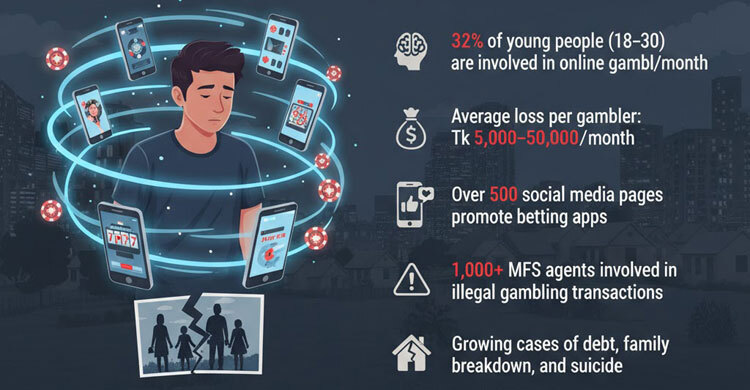
At just 24, Mahbub had already lost everything – his savings, his peace, and, eventually, his wife. What started as a few online bets for “fun” turned into a dark addiction that consumed his life. He would spend hours glued to his phone, his mood swinging between euphoria and despair with every virtual spin.
When 19-year-old Aklima was found hanging in their home, her family accused Mahbub of murder. Police records show she had endured days of torture and abuse – both emotional and physical – from her husband, whose life had been overtaken by gambling debts. Mahbub insisted it was suicide. But neighbors knew the truth: the couple had been fighting over money he had lost online.
Mahbub’s tragedy is not isolated. It’s the chilling reflection of a nationwide epidemic – a silent digital disease spreading through smartphones, swallowing the youth one by one.
The new face of addiction
In the past, gambling meant hidden dens, secret card games, or hushed whispers in tea stalls. Today, it lives inside every smartphone. Online gambling – or what young people call betting – has become as accessible as scrolling through social media.
A single click connects them to glittering casinos, digital card tables, and football betting apps that promise quick riches. Flashy ads on Facebook and YouTube flash across their screens: “Play now, win big!” But for most, it’s not luck waiting at the other end – it’s ruin.
A recent study in Dhaka found that 32 per cent of people aged 18-30 have been involved in some form of online gambling. On average, each loses between Tk 5,000 and Tk 50,000 per month. Social media hosts more than 500 betting pages, luring new users daily with fake success stories and “winning tips.”
Psychiatrists warn that this is not mere entertainment – it’s addiction. They say online gambling rewires the brain like drugs do. Every win releases dopamine – the brain’s pleasure chemical. But soon, players chase that high even as they lose everything.
A generation’s downfall
The stories are heartbreakingly similar.
Rifat (pseudonym), once a promising engineering student, placed his first bet during the Euro Cup. The initial thrill of winning Tk 3,000 made him feel unstoppable. Within 18 months, he had lost Tk 9 lakh. “I borrowed from friends, then from loan apps, then from my parents,” he said. “At one point, I couldn’t face my father. I dropped out for two semesters.”
For Sohel Rana (pseudonym), the fall was even steeper. A mid-level corporate employee earning Tk 80,000 a month, he lost Tk 89 lakh in total – selling his wife’s jewelry, emptying his savings, even mortgaging their flat. “I thought I’d recover it with one lucky game,” he said, his voice trembling. “Now, my wife is gone. My job is gone. I have nothing left.”
In Mirpur, a mother weeps for her teenage son. “He told us he was freelancing,” she said. “We were proud. Then we found he was gambling online – stealing my jewelry, lying, taking loans.” Her son, just 15, had been trapped in digital betting games disguised as “earning apps.”
The road from curiosity to despair
Experts say most gamblers begin out of curiosity – often encouraged by friends or social media influencers. The apps offer a small win at first to hook players. Once addicted, losses multiply.
Rajmul Hasan, a university student, shared how quickly it escalated: “One night I won Tk 9,000 from Tk 2,000. I felt invincible. Later, I lost Tk 2 lakh my father gave me to deposit in the bank. I ruined my family’s trust for a few clicks.”
A Jago News investigation found that local agents operate gambling networks across towns and villages, running transactions through mobile financial services (MFS) accounts. These agents earn millions while their victims – often students, farmers, and small traders – spiral into destitution.
A digital epidemic
The Criminal Investigation Department (CID) has identified over 1,000 MFS agents involved in online gambling transactions. CID Special Superintendent Jasim Uddin Khan confirmed that drives are underway nationwide under the Cyber Security Ordinance 2025, which prescribes up to two years in jail or a Tk 1 crore fine for gambling-related crimes.
Additional DIG of the CID Cyber Police Center, Md Jahidul Islam, told Jago News that the gambling trap of betting apps is no longer confined to urban centres – it has now spread to every corner of the country, with rural areas increasingly affected. Ordinary citizens, driven by excessive greed, are losing their savings, homes, and livelihoods. Moreover, online gambling is heightening the risk of cross-border money laundering. The CID currently has several cases under investigation, and a major crackdown targeting the accused is imminent.
But law enforcers admit that the fight is complex. Gambling platforms are often hosted abroad – mostly in China and Nigeria – and accessed through VPNs. Many offenders get bail due to lengthy investigations.
“This is not just a crime; it’s a cross-border network,” said IT expert and prosecutor Tanvir Hasan Joha. “If police could file reports within 72 hours, many wouldn’t get bail. But cases drag on for years – by then, new rings emerge.”
A social disease
Sociologists describe online gambling as a social cancer. “It’s eroding our moral foundation,” said Professor Omar Faruk, criminology expert at Maulana Bhashani University. “Youth no longer believe in hard work – they believe in quick money. That’s a dangerous shift for society.”
Psychiatrists say the consequences go beyond financial collapse – they include anxiety, depression, domestic violence, and suicide. “We are seeing patients who behave like drug addicts — trembling, lying, stealing,” said Dr. Kabir. “Except the drug is invisible. It’s inside their phone.”
The state’s struggle
The government has launched a multi-agency crackdown. The BTRC has blocked hundreds of gambling sites and warned media outlets that promote betting ads will be shut down without notice.
“BTRC cannot do this alone,” said its chairman Major General (Retd) Md Emdad ul Bari. “We’re working with banks, mobile companies, and cyber units. Every agency must coordinate if we are to win this battle.”
The ICT Division echoes that sentiment. “Stopping gambling is not just technical,” said Secretary Sheesh Haider Chowdhury. “It’s a social movement. We must change the mindset of our youth and make awareness a national priority.”
A generation on the brink
In the glow of their smartphone screens, countless young Bangladeshis chase illusions – betting, hoping, losing. For every story of a gambler who “made it big,” there are thousands like Mahbub, Sohel, or Rifat – their lives shattered, their families broken.
Online gambling isn’t just stealing money; it’s stealing futures. It’s turning ambition into addiction, hope into hopelessness.
As one psychiatrist put it, “This is not just a digital problem. It’s a moral collapse, one notification at a time.”