
Karail on fire again: Neglect, sabotage, or fate?

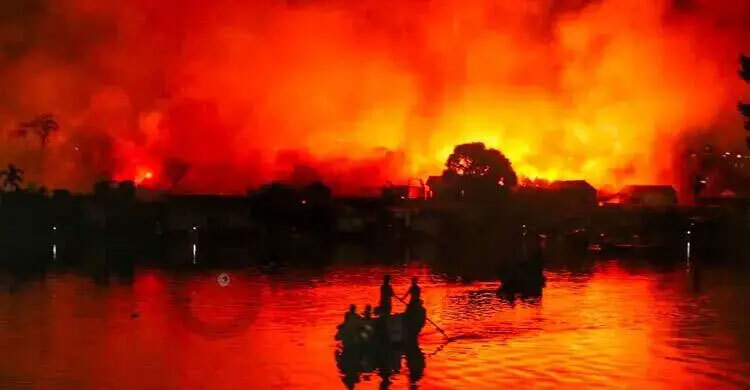
The capital’s largest and most densely populated slum, Karail, was engulfed in a massive fire on Tuesday, leaving hundreds of residents destitute once again. Situated just across a lake from the skyscrapers of Mohakhali and Gulshan, the slum’s corrugated-sheet-roofed, bamboo-and-wood homes stand in stark contrast to the elite neighbourhoods nearby. Yet behind this short distance lies a long history of neglect, vulnerability, and recurring disasters. For the residents of Karail, fire has become a familiar and feared enemy.
Recurring fire, recurring tragedy
The Karail slum has faced repeated fires over the years, with incidents occurring two or three times a year. On Tuesday, the fire reportedly began around 5:22 pm in the Cumilla Patti, Barisal Patti, and K-Block areas of Boubazar. The flames spread rapidly through the narrow alleys, destroying at least 1,500 homes, according to the Fire Service and residents.
Shahjahan Sikder, officer-in-charge of the Fire Service media cell, said that 19 units were deployed to control the blaze, which was contained by 10:35 pm. Full extinguishment was achieved Wednesday morning, but by then, thousands of lives had been affected.
Residents describe the burned homes not merely as structures but as lost dreams, memories, and futures. “Everything was burned in the fire last night, and I am destitute. We are tired,” said Rubina Akhter, a garment worker. Gias Uddin, a long-time resident, recounted losing his home three times in fires over the past two decades.
Why fires recur in Karail
Experts and residents cite multiple reasons for the repeated fires:
Highly flammable, dense structures: The slum is built on 90 acres with extremely narrow streets. Houses are made of tin, bamboo, wood, plastic, and cardboard. One spark can ignite dozens of homes instantly.
Unauthorised electricity connections: Illegal wiring and overloaded lines make short circuits a constant hazard.
Unsafe gas cylinders: Around 70 per cent of homes use gas cylinders, often without regulators or proper safety measures, creating a risk of explosions.
Limited water access: The lake-adjacent location and narrow lanes make it difficult for emergency vehicles to reach the site, hampering firefighting efforts.
Traffic and access issues: Even when fire service units arrive, congestion and narrow roads prevent large vehicles from reaching the fire efficiently.
Political influence and land disputes: Encroachment and power struggles over slum land sometimes result in fires, intentionally or otherwise.
Lack of government oversight: Absence of fire safety infrastructure, drainage systems, and proper urban planning leave the slum vulnerable.
Ignition sources: Most fires occur in the evening when electricity and cooking activity are high. Initial detection is often delayed, allowing fires to spread rapidly.
According to the Fire Service, initial causes are often traced to electrical short circuits, gas cylinder accidents, or careless handling of fire. However, dense settlement patterns accelerate fire spread, and evidence of origin is often destroyed.
Voices from the ground
Morjina Begum, a resident for 15 years, narrowly escaped the blaze with her children. “This may be the last fire I can survive,” she said. Her daughter, a student, lost all her schoolbooks and uniforms ahead of exams.
Raihan, a Boubazar resident, questioned accountability: “Whether the fire started naturally or was set intentionally is unclear. The slum burns often, but no investigation is done. Who cares if we lose our lives?”
Possibility of sabotage
Officials have not ruled out deliberate acts. Major (Retd.) AKM Shakil Newaz of the Fire Service suggested that political motives, land disputes, and power struggles could be behind some fires. Brigadier General (retd) Ali Ahmed Khan added that the fire could be set intentionally to establish dominance within the slum.
Challenges for firefighters
Lt. Col. Mohammad Tajul Islam Chowdhury, Director of Fire Service Operations and Maintenance, highlighted difficulties faced by emergency teams. “Traffic jams delayed our units by 35 minutes, and narrow lanes restricted large vehicles,” he said. “Despite limitations, firefighters worked tirelessly to control the fire.”
Fire Service DG Brigadier General Muhammad Zahed Kamal emphasized systemic challenges: illegal electricity and gas lines, densely packed homes, lack of awareness among residents, and absence of fire hydrants make firefighting extremely difficult.
Experts recommend long-term solutions, including widening lanes, installing fire hydrants, and deploying trained personnel familiar with the slum’s layout.
Investigation launched
The Fire Service and Civil Defense has formed a five-member committee to investigate the incident. Deputy Director Md Mamunur Rashid will chair the panel, tasked with submitting a report within 15 working days. The committee includes officials from Dhaka Zone-2, Tejgaon Fire Station, and other departments.
The Karail slum fire is not just a disaster – it is a symptom of deep-rooted urban neglect, unsafe housing, and systemic vulnerabilities. While the government promises investigations and remedial measures, residents remain trapped in a cycle of loss and displacement, waiting for a solution that has eluded them for decades.